49 works in this view — arrow keys or swipe to move between them.
Dance in Art
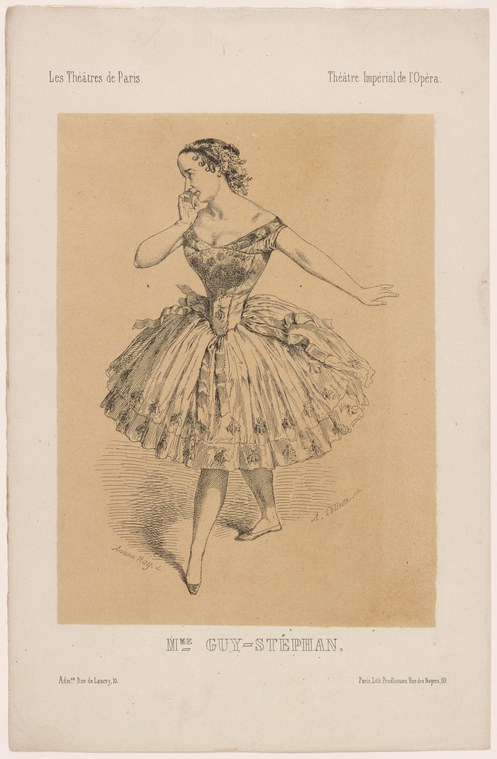
Mme. Guy-Stéphan
Unknown artist
- Collection:
- Prints depicting dance
- Source:
- New York Public Library
- Rights:
- Public domain — free to use, share and adapt.
- Recorded as:
- Public Domain
This print is a rare documented image of an individual Romantic ballet dancer from an era when photographs of movement were not yet feasible and when choreography, costumes, and roles exist only in written description and such visual records. The work demonstrates how artists translated the experience of seeing Romantic ballet into line and form, and it preserves the name and likeness of a performer whose career might otherwise have left no trace. For historians of dance technology and aesthetics, the image records the actual pointe shoes, costume proportions, and bodily ideals of a specific historical moment.
What you are looking at
A single female dancer is depicted in a three-quarter view against a warm tan background, captured mid-performance. She wears a short tulle skirt with decorative patterns or appliqués, fitted dark bodice, and pointe shoes. Her pose is characteristic of Romantic-era ballet: weight lifted on one pointed foot, the other leg extended or lifted, her upper body inclined gracefully forward from the waist with one arm raised to her head and the other extended to the side. Her hair is styled up in the period fashion, adorned with what appears to be a wreath or ornamental headdress. The drawing style is precise and linear, executed with fine pen work that emphasizes the delicacy of the figure's frame and the airy volume of the skirt.
The dancing
The dancer is shown in a single pose of aerial lightness—the hallmark of Romantic ballet technique. Her supporting leg is fully extended and turned out on the point of her shoe, with her free leg raised in what may be an arabesque or attitude. The upper body leans forward subtly from the hips in a classical line. The raised arm frames the head while the extended arm emphasizes the breadth of the pose. Her proportions and the anatomical precision suggest the artist understood the specific demands of pointe work and the ethereal quality the style demanded.
The dance depicted
This is a portrait of a Romantic-era ballet dancer, most likely dating from the mid-nineteenth century. The pointe work, the abbreviated skirt length, the sylph-like pose, and the theatrical headdress all mark this as depicting the ballet aesthetics that dominated European stages from the 1830s through the 1860s. The inscription identifies her as Mme. Guy-Stéphan, a performer of the period, and the image is almost certainly a promotional or documentary print made to celebrate a particular dancer or role. The pose and costume suggest a solo passage from a Romantic ballet, possibly a variation or an interpretation of an iconic role.
How it was made
This is a pen-and-ink drawing, likely reproduced as an engraving or lithograph for publication in a theatrical journal or collection of dance prints. The fine linear style and the use of parallel hatching to suggest form and shadow are consistent with mid-nineteenth-century reproductive engraving techniques. The warm cream or buff paper stock and the printed title and credit lines at the base indicate this was a commercial or semi-commercial print issued to a theatre-going public, part of a documented series titled 'Les Théâtres de Paris' and associated with the Théâtre Impérial de l'Opéra. Such prints circulated widely and served both as mementos and as promotional materials.
About this work
This is a documentation of a specific Romantic-era ballet dancer preserved in a contemporary theatrical print. The work is one of a series recording performers at major Parisian opera houses during the height of the Romantic ballet movement. It serves both as a historical record of an individual artist and as evidence of how dancers of the period were publicly presented and memorialized—through the idealized figure studies that celebrated their technical achievement and ephemeral art. The print format ensured wide circulation and made the dancer's image accessible to the theatre-going public who might see her perform.
The work's significance lies in its dual function: as portraiture and as technical documentation. It captures the specific aesthetic ideals of Romantic ballet—weightlessness, verticality, the illusion of flight—and shows how those ideals were understood and represented by contemporary visual artists. The inscription tells us the dancer's name and connects the image to a specific body and moment, grounding the idealized figure in historical reality.
How to look at it
Observe the extreme verticality of the figure and the lightness of the pose—the dancer is presented as if weightless, the body arranged to suggest an instant of suspension rather than effort. Notice how the artist has depicted the pointe shoe as a technical marvel that allows this illusion, and how the raised arms frame the head in a pose that emphasizes the line from foot through crown. The slight forward inclination of the torso is typical of Romantic ballet arabesque or attitude; it is a calculated tilt that creates grace rather than instability. The decorative patterns on the skirt and the jeweled headdress anchor the figure in theatrical artifice—this is a costumed role, not a study of the human body in nature.
The period
This print was made during the reign of the Romantic ballet aesthetic in Europe, approximately 1830–1870. The Romantic era revolutionized ballet by introducing the ethereal, weightless ideal of the female dancer—achieved through intensive pointe work—and the fantasy narratives of supernatural beings (sylphs, spirits, odalisques) that allowed dancers to embody the otherworldly. Major works such as La Sylphide (1832) and Giselle (1841) established a new vocabulary of movement and a new visual language of costume. Paris was the epicenter of this aesthetic, and the Opéra was its primary stage. Theatrical prints like this one were a major form of celebrity culture and documentation; they allowed audiences to possess an image of beloved performers and constituted a form of mass media circulation that preceded photography.
Where it lives
This work is held in the New York Public Library's collection of prints depicting dance. It is part of a documented series titled 'Les Théâtres de Paris,' which recorded performers at major Parisian theatrical institutions during the mid-nineteenth century. Such series were issued periodically and sold to the theatre-going public or collected by institutions; this example was eventually acquired by the NYPL.
Dance in this work
Questions about this work
Who was Mme. Guy-Stéphan?
She was a ballet dancer active at the Théâtre Impérial de l'Opéra in Paris during the mid-nineteenth century. Beyond the record of her name in this print and the likelihood that she performed in Romantic-era ballets, documented biographical information about her career is sparse. Like many dancers of the period, she is known primarily through such theatrical prints and the archives of the institutions where she performed.
What is this pose, and what does it show?
The dancer is shown in a classical Romantic-era pose—likely an arabesque or attitude—which demonstrates her technical mastery of pointe work. The pose emphasizes the illusion of weightlessness that was central to Romantic ballet aesthetics. It captures a moment of apparent suspension and grace rather than effort or transition between movements.
How were dancers documented before photography?
Theatrical prints, engravings, and lithographs like this one were the primary means of preserving images of dancers and circulating them to the public. Artists would attend performances or work from sketches and memory to create idealized portraits that celebrated both the individual dancer and the aesthetic ideals of the period. These prints served as mementos, promotional materials, and historical records.
What does the costume tell us?
The short, full tulle skirt, fitted bodice, pointe shoes, and ornamental headdress are all hallmarks of Romantic-era ballet costume and technique. The skirt length allowed visibility of the dancer's legs and footwork while the lightness of tulle reinforced the ethereal aesthetic. The headdress and decorative details indicate this is a specific theatrical role rather than a practice or generic performance.
More dance artwork





