49 works in this view — arrow keys or swipe to move between them.
Dance in Art
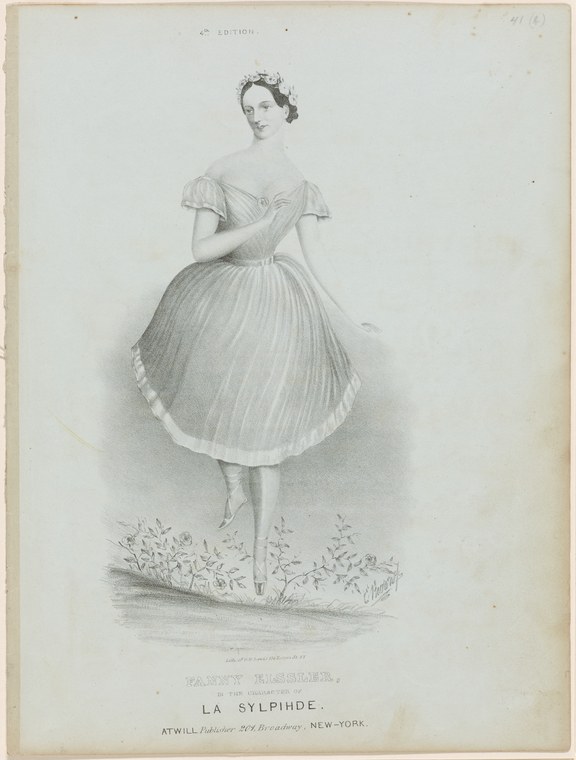
Fanny Elssler, in the character of La sylpihde [sic]
Unknown artist
- Collection:
- Prints depicting dance
- Source:
- New York Public Library
- Rights:
- Public domain — free to use, share and adapt.
- Recorded as:
- Public Domain
Elssler was one of two reigning ballerinas of the 1830s–1840s and a major innovator in character and national dance; La Sylphide was *the* defining Romantic ballet role. This engraving documents both the star dancer and the canonical costume and silhouette that became synonymous with the genre, making it essential visual evidence for anyone studying Romantic ballet, nineteenth-century theatrical portraiture, or the celebrity culture of the opera house.
What you are looking at
A young woman in a Romantic-era ballet costume stands in an idealized natural setting scattered with flowering plants. She wears a fitted bodice with off-shoulder sleeves and a voluminous skirt that falls to mid-calf, characteristic of 1840s Romantic ballet dress. Her posture is upright and graceful, with one arm extended gently and her gaze directed away from the viewer in a contemplative expression. The figure dominates the composition against a plain background, rendered in fine pencil or engraving technique with subtle shading that gives the skirt dramatic volume and movement. The overall effect is of a dancer frozen mid-performance, posed to emphasize the ethereal quality of the costume and the idealized beauty of the balletic form.
The dancing
The dancer stands in a classical ballet stance with her weight centered over both feet, suggesting stability rather than caught motion. Her right arm is extended diagonally across her body at approximately shoulder height, palm facing downward in a refined port de bras; her left arm hangs at her side with similar control. The head is held in profile or three-quarter view, with a serene, inward expression typical of Romantic ballet's ethereal aesthetics. There is a single figure only; the artist has isolated the dancer to emphasize the silhouette of the costume.
The dance depicted
This depicts Fanny Elssler in the role of La Sylphide, the signature Romantic ballet of the 1830s–1840s. Elssler was one of the two great rival ballerinas of the Romantic era alongside Marie Taglioni; she danced La Sylphide extensively but was perhaps more celebrated for her roles in Spanish and character dances (notably La Cachucha). The image captures the ballet's central conceit: a supernatural, weightless female spirit who lures the male protagonist away from his earthly bride. The costume—the knee-length tutu, fitted bodice, and ethereal presentation—is the visual signature of Romantic ballet and perfectly matched to the role's requirements for apparent effortlessness and otherworldly beauty.
How it was made
This is a steel or copper engraving, likely a commercial print produced for popular consumption and circulation. The fine parallel lines (hatching) used to model the figure and the delicate stippled shading in the skirt are characteristic of mid-nineteenth-century theatrical portraiture. The technique allowed for mass production and distribution at modest cost, making such images affordable to theater-goers and collectors of dance imagery. The print's formal composition and high finish suggest it was marketed as a celebrity portrait rather than a documentary record—a promotional image of Elssler in a famous role.
About this work
This is a theatrical portrait engraving of Fanny Elssler as the Sylphide, a role she performed repeatedly during the 1830s and 1840s. The image serves multiple purposes: it documents the costume and silhouette of canonical Romantic ballet, it celebrates Elssler as a star performer at the height of her fame, and it exemplifies the commercial print culture that grew up around ballet during this period. Theater-goers could own such images as souvenirs or as part of a collection of favorite performers.
The work belongs in a dance archive because it captures a specific historical moment in performance practice: the visual and bodily ideals of mid-nineteenth-century ballet, the celebrity status of the prima ballerina, and the costume design that defined Romantic ballet as a distinct theatrical form. The image is also a record of how audiences of the period understood and consumed ballet—through prints, playbills, and reviews—rather than through film or photography.
How to look at it
The artist has chosen a moment of stillness and composure rather than action: Elssler is posed rather than caught mid-leap or in a dynamic sequence. This was typical of theatrical portraits, which aimed to capture the essence of a role and a performer rather than a fleeting instant. Notice the emphasis on the silhouette and volume of the skirt, which was the most visually distinctive element of Romantic ballet costume and the thing audiences paid to see. The delicate line work and subtle shading give the figure an immaterial, almost ethereal quality—the visual equivalent of the Sylphide's supernatural nature.
The artist
The artist is not recorded. The print was published by Atwell of New York. Commercial dance prints of this quality and format were produced by print publishers throughout Europe and America during the nineteenth century, typically in runs of hundreds or thousands. Such prints were usually based on theatrical photographs, sketches made at performances, or costume designs, but their makers were often studio craftspeople rather than independent artists.
The period
La Sylphide premiered in Paris in 1832 and became the archetype of Romantic ballet. The 1830s–1840s saw the rise of the prima ballerina as a celebrated celebrity, with dancers like Elssler and Taglioni commanding international fame and commanding high fees. This period also coincided with the rise of commercial theatrical portraiture and the growth of the print trade; lithography and engraving made it possible to produce affordable images of famous performers for the mass market. The costume shown here—the knee-length tutu, fitted bodice, and soft pointe work—became the visual standard for European ballet and remained influential for decades.
Where it lives
This engraving comes from the New York Public Library's collection of prints depicting dance. It was published by Atwell of New York and is an example of the commercial theatrical portrait trade that flourished in America and Europe during the nineteenth century.
Dance in this work
Questions about this work
Who was Fanny Elssler?
Elssler (1810–1884) was an Austrian prima ballerina and one of the two greatest stars of the Romantic ballet era, rivaling the French dancer Marie Taglioni. She was celebrated for both classical roles like the Sylphide and for character dances, especially Spanish and Neapolitan styles. She toured extensively in Europe and America and was a major celebrity of her time.
What is La Sylphide?
La Sylphide (first choreographed by Filippo Taglioni for his daughter Marie in 1832) is a Romantic ballet about a supernatural spirit who seduces a Scottish bridegroom on his wedding day. It became the canonical work of Romantic ballet and defined the aesthetic and costume still associated with classical ballet today. Elssler danced the title role many times and was celebrated in it.
Why is the skirt so short?
The knee-length tutu was the costume of Romantic ballet (c. 1830–1860). It allowed dancers to show their footwork and extensions while maintaining an ethereal, weightless appearance. This length became iconic and was reproduced in countless prints and paintings. Later, in the late nineteenth century, tutus became progressively shorter for technical display.
How do I know this is an engraving and not a drawing or painting?
The image shows the characteristic fine parallel lines (hatching) and stippled shading used in metal engraving to create tone and volume. The uniform, precisely controlled line work and the flat paper support are diagnostic. Also, the imprint reads 'ATWELL PUBLISHER' and gives a New York address, indicating commercial print production rather than a unique artwork.
More dance artwork





