49 works in this view — arrow keys or swipe to move between them.
Dance in Art
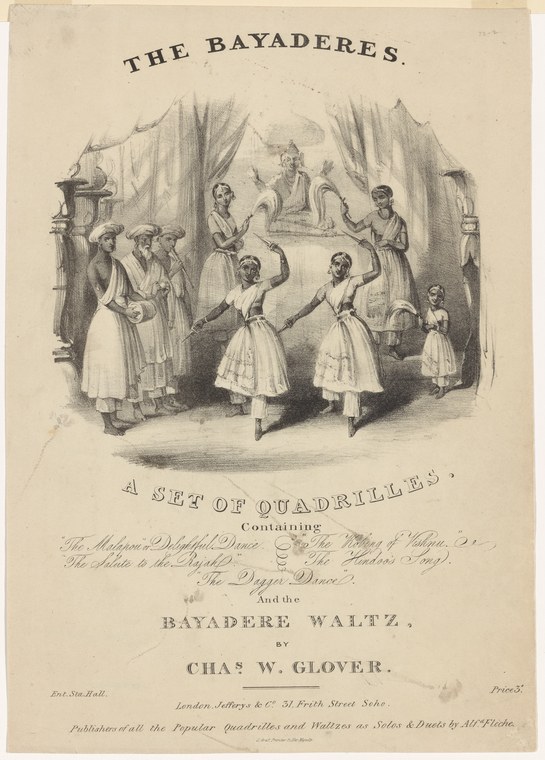
The bayaderes: a set of quadrilles ... and the bayadere waltz
Unknown artist
- Collection:
- Prints depicting dance
- Source:
- New York Public Library
- Rights:
- Public domain — free to use, share and adapt.
- Recorded as:
- Public Domain
This print directly documents how quadrilles—one of the most important dances of the nineteenth century—were learned, taught, and circulated. It shows the integration of dance, theatrical performance, music publishing, and commercial culture. The image is a rare record of the actual appearance of mid-nineteenth-century ballroom and stage dancers, and of the aesthetic values (lightness, verticality, exotic femininity) that shaped early Romantic performance.
What you are looking at
This is a printed score cover for a set of quadrilles and waltz commissioned for theatrical performance, likely mid-nineteenth century. The engraving depicts an interior theatrical or ballroom space with draped curtains framing the scene. Eight figures in light, high-waisted Empire-line dresses typical of the 1830s–1840s period occupy the space: some stand at the margins in conversation or observation, while others perform in the center. The dancers wear the pale, shapeless gowns characteristic of early Romantic ballet, with their hair arranged in the ringlets and braids of the period. The central group shows three women in motion, arms raised and bodies angled to suggest turning or gliding steps. The setting itself—the swags of heavy fabric, the ornamental urns visible at stage left and right, the proscenium-like framing—identifies this as a stage scene rather than a social dancing room, though the aesthetic and costume conventions are those of fashionable ballroom dancing translated into theatrical spectacle.
The dancing
The dancers stand mostly upright in the light, buoyant posture of early Romantic dance, with raised arms and extended limbs. Three central figures demonstrate forward-facing positions with arms lifted, suggesting the turning or gliding action of a quadrille or reel. The pose is open and frontal, not closed-couple ballroom hold; the dancers appear to move in formation or line rather than in paired embrace. The tall, slender proportions, the absence of visible footwork definition, and the floating quality of the drapery suggest bodies moving with the weightless, ethereal aesthetic that defined elite dance of the 1830s–1840s.
The dance depicted
This is a printed dance score for 'The Bayadères: a Set of Quadrilles' (with additional 'Bayadère Waltz'), composed by Chas W. Glover. The quadrille was the most fashionable social and theatrical dance of the early-to-mid nineteenth century, typically danced by four couples in a square formation. The title references the bayadères—Indian temple dancers—suggesting a Romantic-era fascination with Orientalism and exoticized femininity. Quadrilles were performed both in ballrooms and on stage; this theatrical version appears designed for stage performance, marketed for sale to the public, and likely intended for amateur or professional dancers to learn from published notation or to use as a pianist's reference during live performance.
How it was made
This is a wood or steel engraving, a reproduction process that allowed multiple impressions to be printed and sold. The fine linear hatching, the precision of the line, and the tonal range suggest professional engraving. The caption and text below the image are integral to the plate, indicating this is a published broadsheet or cover page for sheet music, not a standalone print. The engraving technique allowed wide distribution of both the image and the music—this appears to be a commercial music publisher's product, printed in London by Jeffreys and Co. and sold through Cramer, Addison and Beale.
About this work
This is a theatrical dance score cover from the London music trade, dating to the early-to-mid nineteenth century. It documents one of the most popular and commercially successful dance genres of the period: the quadrille, a French-derived formation dance that dominated both ballroom and stage performance. The engraved illustration shows the aesthetic conventions of Romantic-era dance—light drapery, upright posture, raised arms, and an ethereal quality—placed within a theatrical frame. The composition signals that this is both a commercial product (sheet music for sale) and a claim about fashion and taste (the exotic 'Bayadère' title, the fashionable dancers in high-waisted gowns).
The work sits at the intersection of social dancing, theatrical spectacle, and the expanding music publishing industry. Quadrilles could be danced in either context, and printed scores like this allowed the same piece to circulate across both markets—enabling amateur dancers to learn the latest fashions and theater professionals to stage variations. The print preserves not only a style of dance but a moment when the dissemination of dance culture through mass-produced commercial goods was becoming a major cultural force.
How to look at it
Attend to the posture and gesture: the raised arms, the upright spine, the open, frontal orientation of the bodies. These convey the lightness and ethereality prized in early Romantic dance—the impression of bodies barely touching the ground. Notice also the framing device—the heavy theatrical curtains that mark this as a stage scene, not a social ballroom. The engraver has chosen a moment of turning or gliding motion, with the dancers caught mid-step in an ordered, symmetrical composition. This reflects the principle of the quadrille itself: a choreography of formation and geometric precision, not of individual virtuosity or emotional intensity.
The artist
The engraver is not identified in the catalogue record. The composer is credited as Chas W. Glover, a London music composer and publisher active in the mid-nineteenth century. The print was issued by the London music publishers Cramer, Addison and Beale, major commercial distributors of dance music and theatrical scores.
The period
The quadrille dominated fashionable dance from the 1820s through the 1860s, taught in drawing rooms and performed on theatrical stages across Europe and North America. By the 1840s, the quadrille had become a standardized form with recognized figures and variations, making it ideal for publication and mass circulation. This coincided with the explosion of the music publishing industry: printed dance scores and instruction manuals became major commercial products. The 'Bayadère' theme reflects the Romantic era's fascination with Orientalism, exoticized femininity, and fantasy—the same impulses that produced the ballet *La Bayadère* (premiered 1877) and numerous theatrical variations on Indian and Middle Eastern subjects. Stage quadrilles and ballroom quadrilles were not sharply separated; the same dances and music traveled between contexts, a fluidity visible in this design.
Where it lives
The print comes from the New York Public Library's collection of prints depicting dance. It is a commercial music publisher's product—a printed cover or broadsheet page for sheet music or dance notation, created for sale to the public.
Dance in this work
Questions about this work
What is a quadrille and how is it different from a waltz?
A quadrille is a dance for four couples arranged in a square, with a fixed set of figures that progress through the formation. A waltz is a dance for couples in closed position, moving continuously around the room in a rotating pattern. Both were popular in the mid-nineteenth century. This score publishes quadrilles 'and the bayadère waltz,' indicating they were often performed as a pair—quadrilles first, then a waltz to end the set.
Why is this called 'The Bayadères'?
Bayadères (or bayaderes) were Indian temple dancers, a subject of intense Romantic-era fascination. European artists and musicians of the 1830s–1840s were attracted to the exotic, feminized image of Eastern women; this quadrille appropriates that aesthetic without any authentic Indian dance content. It is a fashionable costume party theme translated into choreography and music.
Were quadrilles danced on stage or in ballrooms?
Both. Quadrilles were the most versatile dance of the period: they were taught in dancing masters' studios, performed at balls and social gatherings, and staged as theatrical entertainment. This cover indicates a theatrical version designed for performance and sale, but the same dance and music could be executed in either context.
Who was Chas W. Glover?
Chas W. Glover was a London-based composer and music publisher active in the mid-nineteenth century. He composed numerous dances and theatrical scores, many of which were published and sold widely through commercial music houses like Cramer, Addison and Beale.
More dance artwork





