49 works in this view — arrow keys or swipe to move between them.
Dance in Art
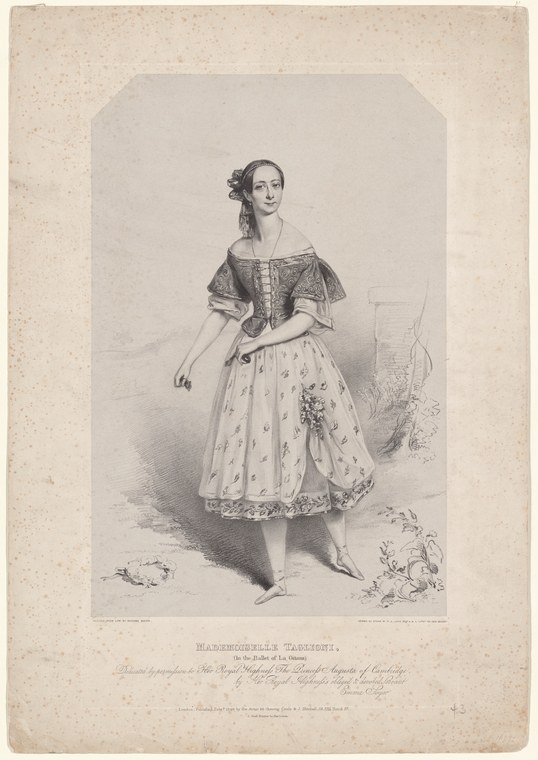
Mademoiselle Taglioni in the ballet of La gitana, dedicated by permission to Her Royal Highness the Princess Augusta of Cambridge
Unknown artist
- Collection:
- Prints depicting dance
- Source:
- New York Public Library
- Rights:
- Public domain — free to use, share and adapt.
- Recorded as:
- Public Domain
Taglioni was the defining figure of Romantic ballet, the first dancer to master pointe-work and embody the ethereal 'sylph' ideal that characterized the era. This print preserves both her performance in a specific role and the costume and body-aesthetic that made her revolutionary. For historians and dancers, it is documentary evidence of how the Romantic ideal actually looked in practice — the arm carriage, the leg position, the silhouette — rather than an abstraction.
What you are looking at
A young woman in Romantic-era theatrical dress stands in a three-quarter pose against a neutral background, her body angled to suggest movement or an imminent turn. She wears a distinctive off-shoulder corsaged bodice with short puffed sleeves and a full skirt decorated with floral motifs, gathered at the hem with deep scalloped lace trim — costume typical of mid-19th-century ballet. Her hair is styled in the period fashion with ringlets and a ribbon or ornament. Her left arm extends gracefully forward and slightly across her body, while her right arm hangs at her side; her weight appears to be on her right leg, with her left leg positioned forward and slightly turned outward. The composition is intimate and focused, with delicate botanical detail in the foreground (flowering plants at lower corners) that frames the figure without distracting from her pose. The overall effect is of a moment captured from a stage performance, frozen between steps.
The dancing
A single female dancer in a balletic stance, her body held in an upright yet elegant carriage characteristic of early Romantic ballet. Her arms are positioned in what appears to be a soft allongé or épaulement position — not a formal codified shape but a graceful, naturalistic extension typical of the era. Her legs are turned out from the hip, with weight distributed in a way that suggests she could rise or continue into movement. The pose conveys lightness and a readiness to move rather than a fixed classical position; there is a quality of momentary poise.
The dance depicted
This is a portrait of the celebrated Danish-Italian dancer Marie Taglioni (1804–1884) performing in *La Gitana* (The Gypsy), a ballet-pantomime from the Romantic era. The title dedication to Princess Augusta of Cambridge indicates this was a commemorative print, likely produced for court or aristocratic circulation. The costume and pose are consistent with Romantic ballet performance style: softened, naturalistic arm positions, emphasis on elongation and grace, and the characteristic layered skirt. Taglioni was the principal innovator of pointe-work and ethereal movement that defined the Romantic ballet aesthetic; this image captures the idealized, weightless quality her art represented.
How it was made
This is an engraving or lithograph, recognizable from the characteristic line-work, fine hatching used for shading, and the crisp definition throughout. The technique allowed for wide distribution as a print; the dedication to royalty and inscription in French suggest this was produced for European aristocratic and educated audiences, not for a mass market. The precision of the medium makes it an authoritative record of costume detail and pose convention. The object is a commemorative print designed to preserve a celebrated performance in circulation form.
About this work
This is a Romantic-era ballet portrait of Marie Taglioni in *La Gitana*, produced as a dedicatory print for British royal circulation. It documents a moment in one of the era's most celebrated theatrical forms through the body and costume of its greatest exponent. The work belongs in a gallery of dance because it is not merely a record of dress or a generic allegorical figure; it is a precise notation of how a particular dancer held her body, moved through space, and presented herself to an audience. The image preserves the movement aesthetic of Romantic ballet — its emphasis on grace, elongation, and the illusion of weightlessness — at a moment when that aesthetic was reshaping European dance and culture.
How to look at it
Attend to the pose itself: Taglioni's weight distribution and the soft, naturalistic arm positions that define the Romantic aesthetic — not the rigid formalism of earlier court dance, but a quality of ease and grace. The turned-out legs and upright carriage show the classical foundation, but the overall effect is one of movement arrested mid-moment rather than a static classical position. Notice the costume detail — the off-shoulder neckline, the short puffed sleeves, the decorated skirt hem — which was Romantic ballet's signature silhouette and which the dancer's pose is designed to display. The figure's gaze and the slight forward lean of her torso suggest the character of the gypsy in the narrative, not a generic allegorical dancer.
The period
This print dates to the height of the Romantic ballet era, roughly 1830–1850. Marie Taglioni dominated European dance in this period, performing in Paris, London, and across the continent. *La Gitana* was part of the wave of exotic and fantastical narratives that replaced classical court dance during Romanticism; the ballet-pantomime allowed for narrative spectacle, character roles, and the display of technical innovation (particularly pointe-work). The dedication to British royalty reflects the fact that Taglioni was celebrated across courts and that her performances commanded high-status commemorative treatment. Prints like this one were a primary means by which dance performance circulated beyond the theatre; they shaped how the Romantic ballet aesthetic was understood and imagined across Europe.
Where it lives
This is a decorative print held in the New York Public Library's collection of dance-related prints. It was produced as a commemorative object, distributed to mark a notable performance or to celebrate a dancer's career. The dedication to Princess Augusta suggests it may have been commissioned or presented in court circles.
Dance in this work
Questions about this work
Who was Marie Taglioni?
Taglioni (1804–1884) was a Danish-Italian ballet dancer who revolutionized the art form in the 1830s–1840s by perfecting pointe technique and embodying the ethereal, weightless ideal of Romantic ballet. She was the first dancer to achieve international celebrity on the scale of modern stardom, performing across Europe and commanding unprecedented fees. Her influence on ballet technique and aesthetics was decisive: she made pointe-work the foundation of classical technique and established the 'sylph' — a graceful, otherworldly female ideal — as ballet's central image.
What was Romantic ballet?
Romantic ballet (circa 1830–1870) replaced the formal court dances of the Baroque and Neoclassical periods with narratives drawn from fairy tales, folklore, and exotic settings. It emphasized female dancers, grace, and the illusion of weightlessness (aided by new pointe technique). Male dancers receded into supporting roles. The movement style was softer and more naturalistic than classical technique, with an emphasis on épaulement (the use of the upper body and head to create line and expression) and the appearance of effortlessness.
What is *La Gitana*?
*La Gitana* (The Gypsy) was a ballet-pantomime from the Romantic era, likely choreographed in the 1830s–1840s. It belongs to the wave of exotic narratives popular during the Romantic period — ballets set in Spain, the Orient, or among peasant and folk communities that bourgeois European audiences found fascinating and remote. The role allowed Taglioni to display technical virtuosity while also performing a character role, combining the two demands of Romantic ballet performance.
Why was this print dedicated to Princess Augusta of Cambridge?
Taglioni's fame extended to royal courts across Europe, and her performances were celebrated as major cultural events. A dedication to a British royal figure indicates that this print was produced in or for Britain, and that Taglioni's performance was considered worthy of commemoration at the highest social level. Such dedications were a form of flattery and a marker of the dancer's prestige.
More dance artwork





