49 works in this view — arrow keys or swipe to move between them.
Dance in Art
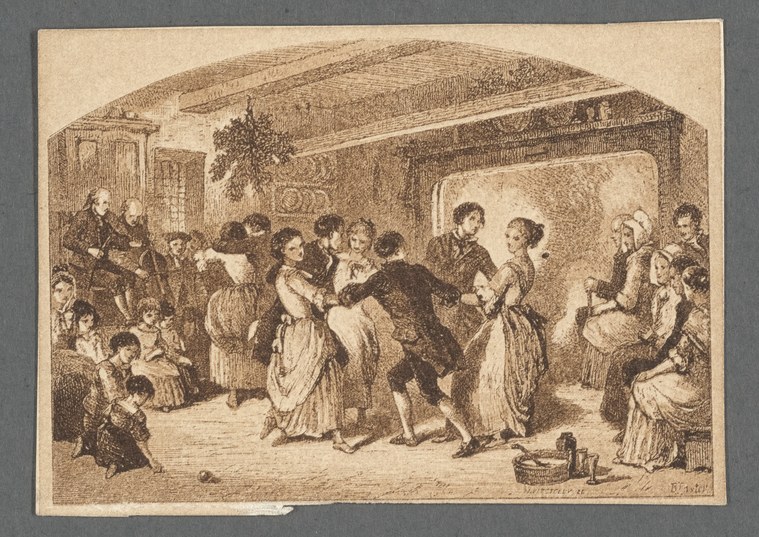
Circle dance in front of a fireplace in a crowded room
Unknown artist
- Collection:
- Prints depicting dance
- Source:
- New York Public Library
- Rights:
- Public domain — free to use, share and adapt.
- Recorded as:
- Public Domain
This engraving is one of the few surviving images of domestic social dance as it was actually practiced. It shows contredanse not as a technical achievement but as the ordinary fabric of genteel life—the evening's entertainment, the chance to move in company, the ritual of courtship. For historians of dance practice and social history, it is invaluable evidence of how ordinary people danced and why.
What you are looking at
A crowded interior scene lit by a large fireplace occupies the right side of the composition. A group of figures in 18th-century dress—women in long gowns and men in coats—are arranged in a circle on the floor, some dancing, others watching. The circle is the organizing principle of the gathering: dancers move within it while spectators stand or sit at the periphery, creating the social hierarchy typical of salon entertainment. The room itself is modest and domestic, with a barrel-vaulted ceiling and simple furnishings. The artist has captured a moment of social assembly where dance is central but not the only activity—conversation and observation matter equally. The engraving technique creates strong contrasts between lit and shadowed areas, emphasizing the fireplace as the emotional center of the scene.
The dancing
The dancers in the circle face inward, bodies angled to move along a circular path. Several couples are visible in what appears to be a linked or handheld formation typical of group dances of the period. Arms are extended toward partners or neighbors; the frame is open and social rather than the closed ballroom hold. The weight appears light and lifted, with small precise steps suitable for salon space. Children sit or stand at ground level among the adults, integrated into the gathering rather than separated. The overall posture is upright and formal, consistent with 18th-century deportment.
The dance depicted
This appears to be a contredanse or quadrille—a group social dance popular in 18th-century European salons. The circular formation, the number of participants, and the domestic setting all point to this genre. Contredanses were performed in homes as well as ballrooms, and they were central to evening entertainment among the middling and upper classes. The image shows the dance as a social event rather than a performance: the purpose is participation and courtship ritual, not display. The presence of both dancers and observers, children and adults, reflects how these dances functioned in real life—as occasions for family and friends to gather.
How it was made
This is an engraving or etching, identifiable by the fine parallel lines (hatching and cross-hatching) used to build tone and shadow, and the crisp black lines defining form. The technique allows for fine detail in clothing and facial expression while maintaining clarity of composition even at small scale. Engravings of this type were designed for circulation as prints—affordable, reproducible, and suitable for publication in books or as standalone sheets. The care taken with domestic detail and the legibility of the scene suggest this was meant to document or celebrate the practices of salon life, likely for a middle-class audience familiar with such gatherings.
About this work
This is a genre scene from 18th-century salon life, capturing a contredanse or quadrille in progress in a domestic interior. The engraving documents not just the dance but the social context in which it occurred—the mix of ages and genders, the balance of participation and observation, the integration of dance into evening entertainment. The work belongs in a dance gallery because it shows us how people actually danced together in their homes, not how professionals danced on stages. It reveals the contredanse as fundamentally social: a framework for movement, courtship, and community that required no special skill and welcomed the young, the old, and the merely curious.
How to look at it
Notice the fireplace: it is not merely a heat source but the organizing center of the room and the gathering, drawing the eye and defining the space. Watch the formation of the dancers: the circle and the linked arms create a democratic visual order very different from the hierarchical arrangements of court dance. Look at the faces of the watchers—they are engaged and attentive, not bored. The artist has chosen the moment not at a peak of movement but in the flow, showing the dance as something continuous and social, not a climactic performance.
The period
The contredanse was the dominant social dance of the 18th century across Europe, particularly in France and Britain. It emerged in the late 17th century and by the 1700s had displaced the minuet as the most fashionable group dance in salons. Engravings of salon life became popular in the 18th century as a way to document and celebrate refined domestic practice. This print sits within a broader tradition of genre scenes that valued the representation of polite society and bourgeois respectability. The image reflects the Enlightenment interest in observing and recording social behavior.
Where it lives
The work is held in the New York Public Library's Prints collection and is catalogued as a dance image. It is an engraving on paper, the standard format for the circulation of images in the 18th century.
Dance in this work
Questions about this work
What is a contredanse?
A contredanse is a group dance for multiple couples, arranged in lines or circles, with choreographed figures that couples perform in turn. It was the most popular social dance of the 18th century and required no special training—anyone could join. Unlike the minuet, which was soloistic and required skill, the contredanse was democratic and inclusive.
Could children dance contredanse?
Yes. This engraving shows children present and integrated into the gathering. Children learned contredanse as part of their social education, and they participated in family dances at home.
How do we know this was an actual practice and not just an artist's invention?
Multiple engravings of salon dances survive from the 18th century, and they are consistent in showing the same formations, participants, and domestic settings. Writing from the period also describes these gatherings. The details—the fireplace, the mix of watchers and dancers, the children—all match accounts in letters and memoirs of salon life.
More dance artwork





