49 works in this view — arrow keys or swipe to move between them.
Dance in Art
Selected plates from The art of dancing explained by reading and figures
Unknown artist
- Collection:
- Prints depicting dance
- Source:
- New York Public Library
- Rights:
- Public domain — free to use, share and adapt.
- Recorded as:
- Public Domain
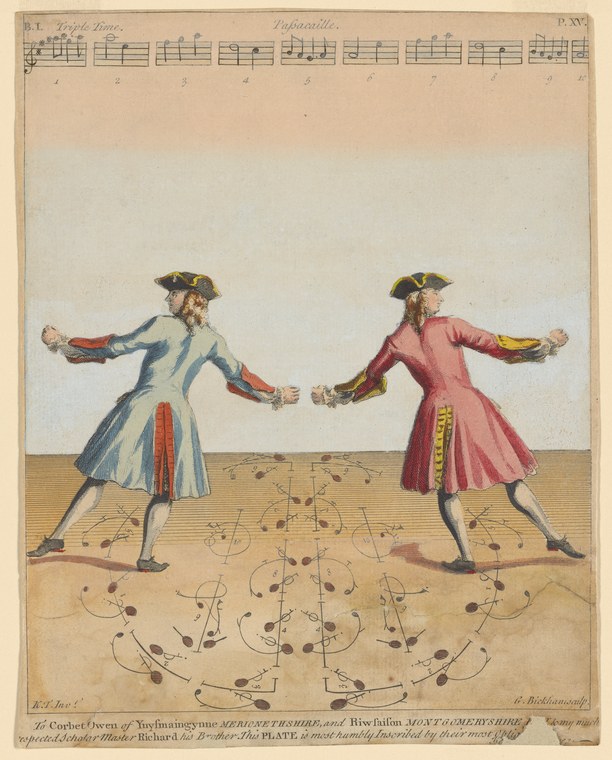
This image shows the actual pedagogical tools used to teach and preserve elite social dance in the 18th century—and demonstrates that dancers of that era thought about the geometry of space as seriously as modern choreographers do. For historians of notation systems and for anyone interested in how dance knowledge was transmitted before video, this is primary source material showing the convergence of music, geometry, and body position as a single intellectual problem.
What you are looking at
Two male figures in 18th-century dress face each other in a formal stance on an open ground, their bodies angled in mirror-image positions with arms extended outward in a controlled, geometric manner. Both wear tricorn hats and long coats—one blue with red lining, one maroon with gold trim—suggesting gentlemen of rank. The ground beneath them is marked with an intricate system of geometric lines, dots, and curves forming a pattern that extends across the entire floor space. Above the figures, musical staff notation appears at the top of the composition, suggesting this is a documented choreography rather than an observed scene. The image has the character of an instructional diagram, presenting what appears to be a specific position or moment in a formal dance sequence rather than a naturalistic representation.
The dancing
Both figures stand with weight distributed evenly, bodies held upright in the formal posture required of courtly dancing. Their arms are extended symmetrically—not clasped or in closed hold—suggesting a figure in which partners face but do not touch. The positioning is precise and static, frozen at what appears to be an opening or salutation pose. The mirrored positioning of the two men indicates a choreographic symmetry typical of processional or geometric dances where form and geometry matter as much as movement.
The dance depicted
This is a teaching diagram for 18th-century ballroom dancing, most likely a minuet or cotillion, illustrated from a dance instruction manual. The geometric floor pattern is a *trace* or *floor track*—a visual notation system used in Baroque and early Georgian dance notation to show the path dancers should follow through space. The music staff at the top confirms that this combines written notation (music) with spatial notation (floor diagram and figure positions), representing the way dance was recorded and transmitted among the educated gentry. The symmetrical positioning of the male figures suggests a partner dance in the courtly tradition.
How it was made
This is a hand-colored engraving, a standard method of reproducing dance instruction manuals in the 18th century. The fine lines of the floor pattern and the precision required to render the geometric traces suggest professional engraving work. Hand coloring of the coats and careful detail in the tricorn hats and shoe buckles is consistent with expensive instruction books produced for a wealthy clientele. The combination of musical notation, figure illustration, and floor pattern on a single plate was a sophisticated and costly approach to dance documentation.
About this work
This is a page from a Georgian-era dance instruction manual, part of a genre that flourished from the 1680s through the 1750s in which professional dancing masters documented courtly dances through a system combining music notation, figure illustrations showing body position, and geometric floor traces showing the path through space. The work belongs to the pre-Labanotation era when such diagrammatic systems were the only way to record and teach dance across distance and time. It represents a crucial moment in Western dance history when dance began to be treated as a subject of systematic documentation and analysis—a practice that would eventually lead to modern dance notation.
How to look at it
Attend first to the floor pattern: the dots and curved lines beneath the figures are not decoration but a choreographic score, showing the precise path each dancer should trace. The positioning of the figures—facing, symmetrical, arms extended—represents a specific moment in the sequence, probably a formal salutation or opening figure. The matching musical notation above completes the picture: this is what the dance looked like and sounded like in time. The artist has chosen to show a static, architectural moment rather than a moment of action, emphasizing the geometric order and studied control that defined genteel dance of the period.
The artist
The artist is not recorded in the catalogue. The work is drawn from a published dance manual, a genre authored by professional dancing masters (often French) whose books were engraved and hand-colored for sale to aristocratic households and aspiring social dancers across Europe. The precision of the engraving and the careful color work suggest a professional print shop accustomed to scientific or technical illustration.
The period
This belongs to the era of Baroque and early Georgian social dance, when the minuet reigned supreme as the marker of genteel status and correct deportment. Dance notation systems flourished in this period as dancing masters sought to document and systematize the steps, rhythms, and geometric patterns that defined courtly accomplishment. The floor traces visible here are descendants of the Feuillet notation system (developed c. 1700) which represented a major advance in dance documentation. By the mid-18th century, such manuals were widely published and were standard references for anyone training in social dance.
Where it lives
The work is held by the New York Public Library as part of a collection of prints depicting dance. It is identified as a selected plate from *The Art of Dancing Explained by Reading and Figures*, a published instructional work; the specific edition and date are not recorded in the catalogue.
Dance in this work
Questions about this work
What is the floor pattern beneath the dancers?
That is a *trace* or floor track—a choreographic diagram showing the path each dancer should follow through space. Each line, curve, and dot indicates where the dancer's feet should move, making the floor itself a kind of score. This was a standard system for recording 18th-century social dances before the modern notation systems we use today.
Why do the dancers face each other but not touch?
Many 18th-century courtly dances, especially minuets and cotillions, involved phrases in which partners faced or circled each other without holding. This position likely represents a moment of formal acknowledgment or a transition between figures. The symmetry emphasizes the geometric, controlled nature of courtly dance.
How was this manual used?
Wealthy families and professional dancers would purchase or consult such manuals to learn the steps, timing, and spatial geometry of fashionable dances. The combination of music, figure position, and floor trace allowed a trained eye to reconstruct the entire dance. Such books were one of the primary ways new dances spread across Europe.
What does the music notation at the top tell us?
It provides the rhythm and timing for the figure shown below. Together, the music and the floor trace form a complete record: you could hear the dance and see the path it traces through space, allowing a skilled dancer to reconstruct the movement without a live teacher.
More dance artwork





