49 works in this view — arrow keys or swipe to move between them.
Dance in Art
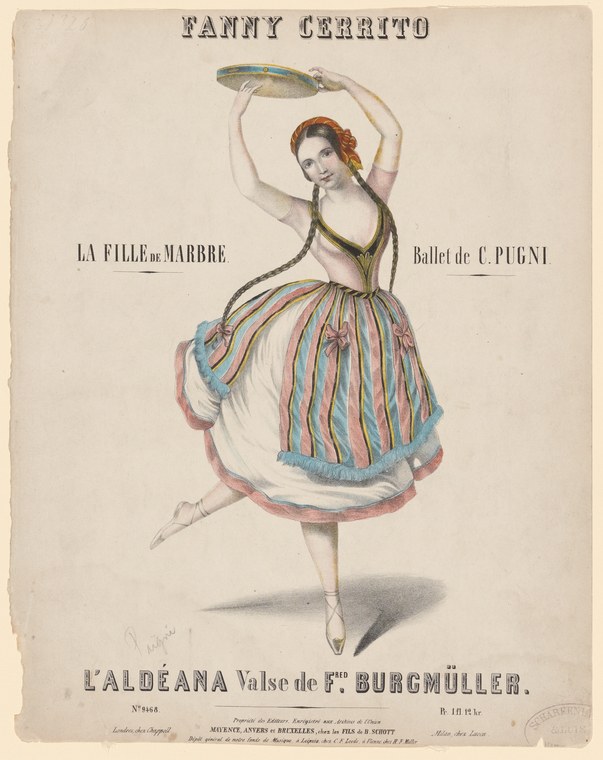
Fanny Cerrito, La fille de marbre, ballet de C. Pugni.: L'aldéana valse de Fred. Burgmüller
Unknown artist
- Collection:
- Prints depicting dance
- Source:
- New York Public Library
- Rights:
- Public domain — free to use, share and adapt.
- Recorded as:
- Public Domain
Fanny Cerrito was one of the four or five greatest ballet dancers of the nineteenth century, and this print is evidence of how her fame was circulated and sold. The image also captures the specific aesthetic of romantic ballet—the fusion of virtuosic pointe work, narrative mime, and spectacular costume—and shows how the theatrical print both documented and promoted that aesthetic to a broad public.
What you are looking at
A female dancer in a classical romantic-era ballet costume occupies the center of this hand-colored lithographic print. She wears a fitted bodice with a deep V-back, baring her shoulders and upper back, paired with a bell-shaped skirt of pale silk with bold vertical stripes in blue, pink, and cream tones. The skirt is gathered to reveal a white underskirt with a pink-trimmed hem. She stands in profile, balanced en pointe on her right leg, her left leg extended in a controlled développé to the side. Her reddish-brown hair is parted and pulled back simply. Most striking is the large ornamental tray or salver she holds aloft in both hands above her head, tilted as if presenting it. The background is plain cream, drawing all attention to her figure and costume. The pose suggests a moment of dramatic narrative—perhaps an offering or presentation within the ballet's story.
The dancing
A single dancer occupies the composition, alone and frontal to the viewer. Her weight is concentrated on her right leg, which is fully extended and locked en pointe; her left leg is extended to the side in an accomplished développé, foot flexed. Both arms are raised and bent, supporting the weight of the ornamental object above her head, which requires core stability and control. Her upper back is arched slightly, opening the chest. The pose is held and static, not captured mid-movement, suggesting a tableau or a narrative moment in the ballet rather than a traveling step.
The dance depicted
This is a romantic-era ballet, almost certainly mid-nineteenth century. The title identifies the work as *La fille de marbre* (The Marble Maiden), choreographed by Cesare Pugni, with Fanny Cerrito as the principal dancer and the title role. The print advertises "L'aldéana Valse de Fred. Burgmüller," a waltz associated with the ballet. Cerrito was one of the greatest ballet dancers of her time, known for her technical facility and her capacity for dramatic mime and character roles. The pose—a sustained balance with a dramatic prop—reflects the hybrid nature of romantic ballet, which fused pure dance technique with pantomime and spectacular visual effect. The tray likely relates a narrative moment within the ballet.
How it was made
This is a hand-colored lithographic print, identifiable by the soft edges, the layering of translucent color washes, and the fine stippled tone work. The image was printed in monochrome and then colored by hand—a labor-intensive process standard for theatrical publicity of the period. Lithography was the ideal medium for theatrical promotion: it could be produced in multiple copies for distribution to theater-goers and critics, the colors could be adjusted to suggest the richness of stage costume and lighting, and the process allowed for finer detail than woodcut. The presence of ornamental typography and the printer's mark at the base confirm this as a commercial theatrical print.
About this work
This hand-colored lithograph documents a performance by Fanny Cerrito in *La fille de marbre*, a romantic-era ballet by Cesare Pugni. The print shows Cerrito in a single, sustained dramatic pose: balanced en pointe, upper back open, both arms raised to support a large ornamental tray. Her costume—a V-backed bodice and a bell skirt with bold vertical stripes—exemplifies the refined, spectacular silhouette that romantic ballet cultivated. The print functioned as theatrical publicity, distributed to promote performances and to circulate the fame of a celebrated dancer. It belongs in a dance gallery because it documents both a canonical work of ballet history and the visual and commercial infrastructure that sustained that art form.
How to look at it
Notice the moment the artist chose: not mid-leap or in rapid motion, but held and formal, with the dancer presenting both herself and the object in her hands. This reflects the ballet's fusion of pure technique and narrative theater—the pose requires real skill (sustained pointe balance, control of the extended leg, stability against the weight of the prop) but reads as a static, dramatic tableau. The costume is rendered with meticulous attention to color and texture; the vertical stripes of the skirt are not realistic but decorative and visually striking, designed to catch light on stage and to create a sense of movement even when the dancer is still. The absence of a stage set or other figures focuses all attention on the dancer and her costume—standard practice for celebrity publicity prints.
The artist
The artist is not recorded. The print was issued by Mineuse Anvers / Bruxelles (Mineuse, the printer, based in Antwerp and Brussels) and was sold by retailers in London. A typical theatrical print of this era was often designed by a house artist employed by the printer or theater, not a celebrated independent artist. The style—the soft modeling of the figure, the careful attention to costume detail, the professional color work—indicates a skilled practitioner working within the conventions of mid-century theatrical lithography.
The period
This print dates from the height of the romantic ballet era, roughly 1840–1860. During this period, ballet was dominated by four or five female stars—Cerrito among them—whose technical gifts and dramatic presence drove the art form forward. *La fille de marbre* was created in the 1840s and circulated internationally; Cerrito performed it across Europe and was celebrated for her mimed acting and her virtuosity in both pure dance and character roles. The spectacle of romantic ballet relied heavily on advertising and on the circulation of prints that brought images of celebrated dancers into homes and theaters. This print is evidence of that apparatus: it advertises both a work and a dancer, and it circulates the spectacle of the stage to an audience that could not attend every performance.
Where it lives
This print is housed in the New York Public Library's collection of prints depicting dance. It is a theatrical publicity print, produced and distributed for sale to theater-goers in the mid-nineteenth century. Its presence in an institutional collection is evidence of its value as both art and historical documentation.
Dance in this work
Questions about this work
Who was Fanny Cerrito?
Fanny Cerrito (1817–1909) was an Italian-French ballet dancer and one of the greatest performers of the romantic era. She was celebrated for her technical facility, her expressive mime, and her ability to take on character roles as well as purely classical roles. She performed across Europe and was a major star of the 1840s and 1850s. She also choreographed many of her own roles and was an innovator in ballet technique.
What is *La fille de marbre*?
The Marble Maiden is a romantic-era ballet choreographed by Cesare Pugni, a prolific Italian ballet composer and choreographer. The plot likely involves a statue or a marble figure that comes to life—a common trope in romantic-era ballet and opera. The ballet was created as a vehicle for Cerrito, and she danced the title role.
Why is she holding a tray?
The tray is part of the narrative of the ballet, though the exact context cannot be determined from this image alone. It may relate to a scene of service or hospitality, or it may be a symbol within the ballet's allegorical framework. The ballet's full scenario would explain its dramatic function.
What is the Aldéana Waltz?
The Aldéana Valse is a waltz composed by Frédéric Burgmüller for the ballet, likely a solo or ensemble number. Burgmüller was a minor but prolific composer of ballet music and other concert works. The print advertises both the ballet and this specific musical number, suggesting it was a celebrated moment in the performance.
More dance artwork





