49 works in this view — arrow keys or swipe to move between them.
Dance in Art
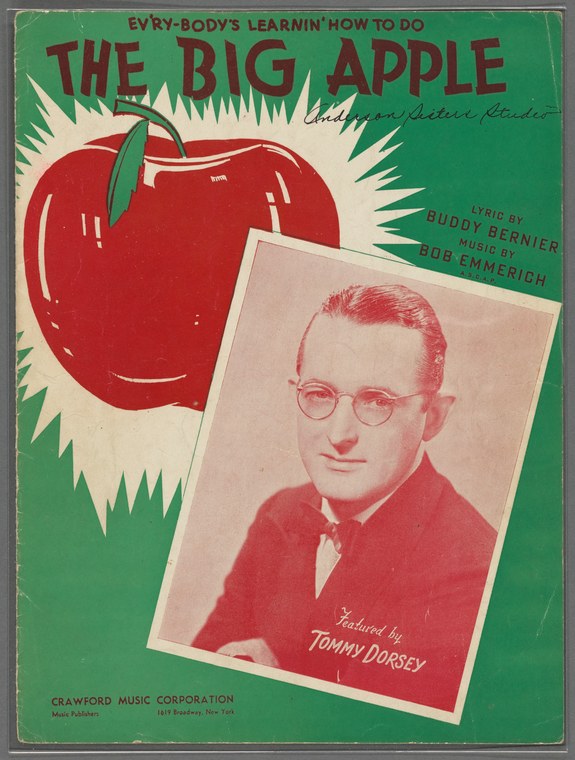
Ev'ry-body's learnin' how to do the big apple ... music by Bob Emmerich
Unknown artist
- Collection:
- Prints depicting dance
- Source:
- New York Public Library
- Rights:
- Public domain — free to use, share and adapt.
- Recorded as:
- Public Domain
For dancers and historians, this cover is a primary document of 1930s American social dance culture and the mechanics of how dances become crazes. It shows the role of bandleaders, songwriters, and the music industry in promoting dance; it also shows how racial and cultural forms moved into mainstream commerce. The Big Apple itself is historically important as a democratic, group-oriented social dance that preceded and influenced the swing era and later forms of social dancing.
What you are looking at
This is the cover of sheet music for a song teaching Americans how to perform the Big Apple, a social dance craze of the 1930s. The composition is split between the dance itself and its celebrity promoter. On the left, a large red apple with a green leaf dominates the upper half against a green background with radiating white lines suggesting energy and motion. Below this, a rectangular photograph shows a man in his thirties wearing round glasses and formal attire (red jacket, white shirt, bow tie), identified as Tommy Dorsey, the bandleader who featured the dance. The layout is typical of popular sheet music of the era—eye-catching, star-driven, and designed to sell both the song and the dance craze it advertised. The typography is bold and red against the green, announcing the title in large capital letters at the top.
The dancing
No dancers appear in this image—it is a commercial product cover, not a depiction of dance in progress. The photograph of Tommy Dorsey shows a formal portrait pose: he faces the camera directly, shoulders squared, a neutral or slight smile. His dress is entirely ballroom or formal evening wear. The apple is rendered as a simple, bold graphic with clear outlines and highlights, designed for quick recognition and visual impact rather than naturalism.
The dance depicted
The Big Apple was a group circle dance that became a major American fad in 1937–1938. Dancers stood in a circle and followed a caller's instructions for choreographed steps and movements, similar to square dancing but to jazz music. The dance was associated with the Savoy Ballroom in Harlem and became a crossover hit that swept ballrooms, dance halls, and social venues across the country. This sheet music, with lyrics by Buddy Bernier and music by Bob Emmerich, was one of many commercial products capitalizing on the craze. Tommy Dorsey was a prominent bandleader whose orchestra performed the song, lending it legitimacy and reach. The title 'Ev'ry-body's learnin' how to do' signals the dance's democratic, participatory appeal—it was meant to be simple enough for anyone to learn.
How it was made
This is lithographic sheet music cover, printed in four colors (red, green, black, and cream) on paper. The technique allowed for mass production and wide distribution to music retailers, dance halls, and homes across America. Lithography made the bold, graphic quality possible—the simplification of the apple, the sharp typography, and the color separation all depend on the medium's technical capabilities. The quality of reproduction suggests this was a major commercial release from Crawford Music Corporation (printed in New York), distributed nationally. The photograph of Dorsey was reproduced photographically and integrated into the lithographic design.
About this work
This is a commercial sheet music cover from 1937–1938 advertising a novelty song tied to the Big Apple dance craze. Rather than depicting the dance itself, it uses a celebrity photograph and a symbolic image of the apple to sell both the music and the cultural moment. The Big Apple was a participatory social dance that bridged racial and class boundaries, emerging from Harlem but spreading rapidly to mainstream white ballrooms and dance halls. This cover documents that moment of crossover success, when a dance form moved from a specific community into mass-market entertainment. It belongs in a dance gallery because it is evidence of how dance and music were marketed, consumed, and made into mass culture; it shows the commercial machinery that turned a grassroots phenomenon into a national fad.
How to look at it
Read this cover as a piece of commercial design rather than as a depiction of dance. Notice how the apple and the celebrity portrait work together to create a simple, memorable brand identity for the song and dance. The radiating lines around the apple suggest movement and energy without showing actual bodies moving. The photograph of Dorsey anchors the design to a real, famous person, giving the product authority and glamour. The bold typography and color contrast were designed to catch the eye on a crowded music store shelf or a ballroom poster.
The artist
The cover was designed for Crawford Music Corporation, a major American music publisher based in New York. The songwriter credits (Buddy Bernier for lyrics, Bob Emmerich for music) indicate this was a professional composition, not folk vernacular. The featured performer, Tommy Dorsey, was one of the most commercially successful bandleaders of the swing era, known for his smooth trombone and his orchestra's broad appeal. Dorsey's endorsement and recording of the song was crucial to its commercial success and the song's function in promoting the dance.
The period
The Big Apple craze of 1937–1938 emerged during the height of the swing era and the Harlem Renaissance's final flowering. The dance originated at the Savoy Ballroom in Harlem, where it was danced to jazz and swing music. Its sudden popularity in mainstream American ballrooms and dance halls coincided with the broader 'swing' craze and the emergence of swing as the dominant popular music and social dance form of the era. This was also a period when music publishers and record companies were investing heavily in promoting dances tied to popular songs—the Big Apple, the Lindy Hop, and the Shag all benefited from this commercial machinery. The sheet music cover represents the commercial infrastructure that turned a community-based dance into a mass phenomenon.
Where it lives
This sheet music cover is held by the New York Public Library as part of its collection of prints depicting dance. The Library's cataloguing identifies it as a commercial music publication from the 1930s, though the exact date is not recorded in the current record.
Dance in this work
Questions about this work
What is the Big Apple dance?
The Big Apple was a group circle dance that became a major American fad in 1937–1938. Dancers stood in a circle, and a caller shouted instructions for synchronized steps and movements. It was participatory and easy to learn, appealing to both experienced dancers and beginners. The dance originated at the Savoy Ballroom in Harlem and became a crossover hit that reached mainstream ballrooms and dance halls across the country.
Who was Tommy Dorsey?
Tommy Dorsey was one of the most prominent bandleaders of the swing era, famous for his trombone playing and his orchestra's broad commercial appeal. His recording of 'The Big Apple' helped popularize both the song and the dance. Dorsey's name and image on the sheet music cover gave the product celebrity endorsement and marketing reach.
Why does the cover not show dancers?
This is a commercial sheet music cover, not a documentary image. The design uses the symbolic apple and a celebrity portrait to market the product quickly and memorably. The title and songwriting credits make clear what the song is about; the visual design prioritizes brand identity and shelf appeal over depicting the actual dance.
More dance artwork





