49 works in this view — arrow keys or swipe to move between them.
Dance in Art
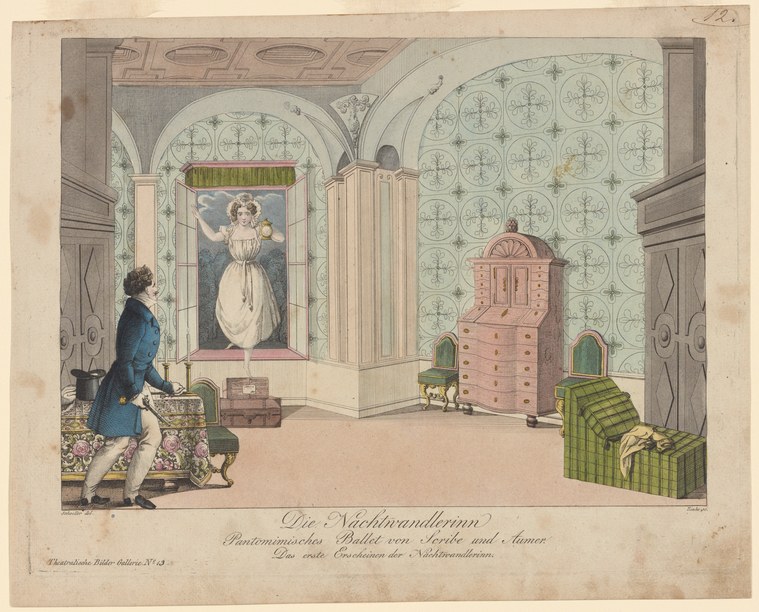
Die Nachtwandlerinn: pantomimisches Ballet von Scribe und Aumer, das erste Erscheinen der Nachtwandlerinn
Unknown artist
- Collection:
- Prints depicting dance
- Source:
- New York Public Library
- Rights:
- Public domain — free to use, share and adapt.
- Recorded as:
- Public Domain
The sleepwalking scene became one of the most imitated and celebrated moments in 19th-century ballet, influencing choreography and performance practice across Europe for decades. This print preserves the visual and spatial conventions of how the scene was staged at a crucial moment in Romantic ballet's development. For historians and dancers, it documents an early understanding of how suspension, stillness, and trance could be danced and how theatrical design created the conditions for that effect.
What you are looking at
A richly appointed interior chamber with neoclassical architecture, divided into three distinct zones. On the left, a male figure in dark blue coat and breeches stands in profile, gazing toward the center. The central space frames a ghostly female figure in a flowing white nightgown, emerging from or suspended within a columned alcove draped in green fabric—her arms raised in an ethereal, sleepwalking gesture. On the right, a pink-upholstered chest of drawers and a green upholstered chair suggest a private bedroom. The walls are decorated with geometric cross-pattern panels in soft greens and earth tones, and the ceiling displays classical molding. The lighting is cool and theatrical, creating strong contrasts between the illuminated figure and the shadowed setting. The composition emphasizes the supernatural and dreamlike quality of the scene.
The dancing
The female figure at center dominates through her isolation and verticality. She stands with arms raised symmetrically, palms outward or upward in a gesture of vulnerability or spiritual distress—the classic pose of sleepwalking in Romantic ballet. Her body is elongated and ethereal, emphasized by the flowing white gown that extends to the floor. The male observer stands at a distance, his body turned away or in three-quarter view, suggesting surprise, reverence, or hesitation. There is no physical contact; the spatial separation between the figures emphasizes psychological distance and the supernatural divide between waking and sleeping states.
The dance depicted
This is a scene from *La Somnambule* (*The Sleepwalker*), the pantomime-ballet created by Eugène Scribe and Jean-Louis Aumer. The inscription confirms this is "das erste Erscheinen der Nachtwandlerinn" (the first appearance of the sleepwalker). The dance was famous for its mime sequences and the famous sleepwalking scene itself—a technical and dramatic showpiece in which the dancer moved with slow, suspended weight and dreamlike fluidity while appearing unconscious. The raised-arm gesture is signature Romantic ballet vocabulary: it conveys trance, emotion, and otherworldly presence without mimicry. The setting indicates this is likely the crucial moment when the male character first discovers the female protagonist sleepwalking, before or around the moment of dramatic recognition.
How it was made
This is a hand-colored engraving or etching, recognizable by the fine linear hatching visible in the floor, walls, and fabric textures, combined with delicate watercolor or gouache washes. The technique allowed precise architectural detail and fabric rendering while the color adds emotional atmosphere—the cool greens and flesh tones enhance the uncanny, staged quality. The print's formal composition and careful perspective suggest it was a professional theater documentation print, likely published in Vienna (given the German-language inscription) to commemorate a notable stage production. Such prints were marketed to educated audiences who had attended or read about celebrated ballet performances.
About this work
This engraving documents a famous moment from *La Somnambule*, a pantomime-ballet that premiered in the 1820s and became one of the defining works of Romantic ballet. The print captures the aesthetic of early 19th-century stage design and the peculiar beauty of sleepwalking as a dance subject—a fusion of mime, suspended movement, and supernatural visual effect. The work demonstrates how ballet of the Romantic era was disseminated to wider audiences through prints, which recorded not just the performers but the architectural staging and spatial relationships that created meaning. This particular image emphasizes the psychological and visual drama of the moment when the ordinary world (the sleeping chamber) collides with the otherworldly (the trance-walking protagonist).
How to look at it
Attend first to the spatial composition: the deep recession into the alcove creates a stage-within-a-stage, isolating the sleepwalking figure as if she exists in a different realm. The observer's position—standing at the threshold, looking inward—invites the viewer to share his experience of discovery. Notice the contrast between the heavy, grounded architecture (straight lines, geometric clarity) and the weightless, floating quality of the female figure's pose and drapery. The raised arms are not expressive in a naturalistic sense; they are a balletic vocabulary for trance and emotion. The moment captured is one of suspended revelation—neither the sleepwalker nor the watcher is in active motion, yet the composition conveys psychological intensity and the imminence of dramatic change.
The artist
The artist is not recorded. The print was published in Vienna and bears the mark of professional theater documentation practice—common in German-speaking lands, where such prints served as both publicity and archival record. The technique and formal composition suggest a trained printmaker working from a stage design or from direct observation of performance.
The period
This work dates to the early Romantic ballet era, when the supernatural and dreamlike became central to ballet's subject matter and aesthetic. *La Somnambule*, created by the influential choreographer Jean-Louis Aumer in collaboration with librettist Eugène Scribe, premiered around 1822. The work was part of a broader cultural fascination with dreams, sleepwalking, and the irrational—themes also explored in Romantic literature, opera, and visual art of the period. The ballet's success reflected and reinforced the era's embrace of ethereal, weightless movement and the ballerina as an otherworldly figure. Theater prints like this one were a major form of cultural dissemination before photography, circulating images of celebrated performances to audiences across Europe.
Where it lives
This print is held in the New York Public Library's collection of prints depicting dance. The German-language inscription and Vienna publication mark suggest it was part of a Central European tradition of documenting and circulating celebrated ballet performances through engraved and hand-colored prints.
Dance in this work
Questions about this work
What is *La Somnambule* and why was it important?
*La Somnambule* was a groundbreaking pantomime-ballet created by choreographer Jean-Louis Aumer and librettist Eugène Scribe in the early 1820s. It became one of the defining works of Romantic ballet, celebrated across Europe for its fusion of mime, dance, and supernatural atmosphere. The sleepwalking scene in particular became famous for its technical and dramatic innovations—the dancer moved with suspended, dreamlike weight to create the illusion of unconscious motion.
Who would have danced this role?
The role of the sleepwalker (*Nachtwandlerinn* in German) was typically danced by the prima ballerina of a theater company, as it required both strong technique and dramatic presence. The role became a vehicle for famous ballerinas of the Romantic era, including dancers at the Vienna court and opera theaters. The role demanded a particular quality of movement—sustained, ethereal, and psychologically present even while appearing unconscious.
What does the raised-arm gesture mean?
In Romantic ballet, the raised arms signaled emotion, trance, supernatural presence, or spiritual distress without naturalistic mimicry. This specific pose—symmetrical, with palms open—conveyed vulnerability and heightened consciousness (ironically, given the character is asleep). It was part of the balletic vocabulary of the period, instantly recognizable to audiences as indicating an altered or exalted state.
Why was this image printed and circulated?
Before photography, hand-colored engravings and etchings were the primary means of documenting and publicizing theatrical performances. This print served multiple purposes: it preserved a record of how the scene was staged and costumed, it advertised the production to potential audiences, and it allowed people who had seen the ballet to remember and discuss the work, and those who had not to imagine it. Such prints were collected by theater enthusiasts and formed an important archive of performance history.
More dance artwork





