49 works in this view — arrow keys or swipe to move between them.
Dance in Art
Fanny Elssler's dances
Unknown artist
- Collection:
- Prints depicting dance
- Source:
- New York Public Library
- Rights:
- Public domain — free to use, share and adapt.
- Recorded as:
- Public Domain
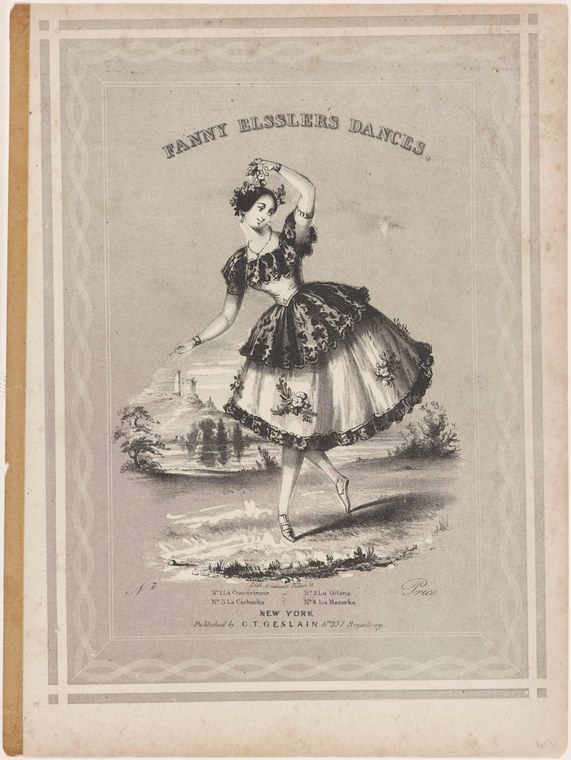
Elssler was a transformative figure in dance history—a technician who expanded the vocabulary of ballet and a cultural celebrity whose image was reproduced and circulated as widely as any performer of her time. This print is evidence of how dancers moved, what they wore, and how they were marketed to audiences. It also demonstrates the symbiotic relationship between printmaking and theatrical celebrity in the nineteenth century: without images like this, the dance would be invisible to all but those who saw it live.
What you are looking at
A young female dancer is depicted in a three-quarter pose against a plain background, her body angled to the viewer's left. She wears the costume of early nineteenth-century Romantic ballet: a short, bell-shaped skirt reaching mid-calf, decorated with floral embroidery or appliqué; a fitted bodice with short puffed sleeves; and a small headdress or tiara. Her posture is weightless and ethereal—one leg appears to be en pointe or nearly so, while the other is lifted behind or to the side in a delicate, extended line. Her upper body tilts forward slightly, one arm extended gracefully outward in an open, balletic port de bras. The engraving captures the illusion of upward lift and effortless elevation central to Romantic ballet technique. A small landscape vignette appears below the figure, suggesting a theatrical setting or the romance of the stage itself.
The dancing
The dancer stands in a single figure, isolated on the page. Her weight is concentrated on one leg—likely the supporting leg—while the other extends in an open, lifted position. Both arms are held in soft, curved lines characteristic of Romantic ballet, with no rigid geometry or tension. The neck is lengthened, the head slightly inclined. The pose conveys the illusion of effortless elevation and weightlessness that defined the Romantic ideal; the body does not appear to be working, but instead floating. There is no partner, no closed hold, no grounded weight-sharing—only the solitary female body suspended in an attitude of grace.
The dance depicted
This is almost certainly a Romantic ballet solo, and the inscription names the subject as Fanny Elssler, one of the greatest dancers of the mid-nineteenth century. Elssler (1810–1884) was celebrated for her technical brilliance, her ability to dance both the ethereal, weightless roles of early Romantic ballet and the more earthy, character dances she made famous—particularly the Cachucha, a Spanish-inspired solo. The costume and pose here depict her in a Romantic ballet context: the short skirt, the pointe work, the ethereal port de bras all align with the vocabulary she performed in ballets by Filippo Taglioni and others. The image is a promotional print, likely circulated during or after Elssler's celebrated European tours in the 1830s–40s.
How it was made
This is an engraving or lithograph, printed and hand-tinted or printed in multiple passes to achieve the subtle gray tones and flesh tones visible in the image. The technique allowed for relatively inexpensive, reproducible images that could be circulated to theaters, patrons, and the broader public—a crucial medium for celebrity and promotion in the nineteenth century. The careful attention to the dancer's physiognomy and dress, combined with the plain background, suggests this was drawn from life or a staged portrait and then engraved for publication. The precision of the line and the delicacy of the modeling of the body indicate a skilled artist working from a careful drawing. The printed border and the landscape vignette below are typical of theatrical prints of the period.
About this work
This is a theatrical portrait engraving depicting Fanny Elssler, one of the nineteenth century's most celebrated dancers, in Romantic ballet costume and pose. The image captures the vocabulary of early Romantic ballet—the pointe work, the ethereal port de bras, the weightless elevation, the short embroidered skirt—in a moment that aims to convey not a completed step but the illusion of effortless grace that dancers and audiences valued above all. The engraving is part of a long tradition of dance portraiture and theatrical promotion stretching back to the baroque court, but rendered in the specific visual language and technical means of the nineteenth-century mass-produced print. It belongs in a gallery of dance in art because it shows both what Romantic ballet looked like and how dancers were imaged and sold to the public.
How to look at it
Attend to the pose itself: the careful extension of the lifted leg, the soft curves of the arms, the slight forward inclination of the torso. These details show what the artist understood about how a trained dancer held her body. The costume—the short skirt, the headdress, the fitted bodice—is accurate to the period and would have been immediately recognizable to anyone who attended the theater. Notice the landscape vignette below: it grounds the figure in a theatrical or romantic world, but it is faint and secondary, keeping all attention on the dancer's body. The absence of a partner or corps de ballet emphasizes the solitude and isolation central to the Romantic ideal. Finally, observe that the artist has chosen a moment that suggests rather than completes a movement—the dancer appears to be rising, not landed, giving the image its characteristic weightlessness.
The artist
The artist is not recorded in the catalogue. The print bears the credit line of C. Goeslain, a Parisian printmaker active in the 1830s–40s, working in the tradition of theatrical and portrait engraving that flourished in Paris during the Romantic period. Goeslain's work was typical of mid-market theatrical prints: skilled enough to capture likeness and costume detail with clarity, but executed within established conventions of pose and composition. The blank artist attribution suggests this print may have been one of many thousands produced for quick circulation, valued for its celebrity subject rather than the reputation of its maker.
The period
This print was made during the height of the Romantic ballet era, roughly 1830–50, when ballet became one of Europe's dominant theatrical forms and dancers emerged as genuine celebrities. The Romantic movement in the visual arts celebrated the ethereal, the otherworldly, and the feminine ideal—all reflected in the ballet of the time. Female dancers in particular were imaged as weightless, spiritual beings, often depicted in the very pose shown here: a single figure, isolated and elevated, ethereal rather than powerful. Male performers, by contrast, were often shown in vigorous character roles or as partners relegated to support. This gendering of the image—the isolation and grace expected of women—was central to both the dance and its visual representation. Elssler's fame coincided with the rise of the mass-produced theatrical print and the celebrity culture it created.
Where it lives
The print is held in the New York Public Library as part of a collection of dance-related prints and engravings. It is a mass-produced theatrical print, likely sold or distributed in Paris or London during the 1830s–40s. Such prints were common merchandise, sold at theaters, through print sellers, or by subscription, and were collected by patrons, dancers, and theater enthusiasts.
Dance in this work
Questions about this work
Was Fanny Elssler famous?
Yes. She was one of the most celebrated dancers of the nineteenth century, renowned for her technical mastery and her charismatic presence. She performed throughout Europe and the Americas and was a major celebrity of her day. Her image was reproduced in prints, lithographs, and paintings, and she was as famous as many opera singers or actors of the period.
What dance is she performing?
This is not a specific named ballet, but rather a portrait in Romantic ballet costume and pose. However, Elssler was most famous for the Cachucha, a fiery Spanish-inspired solo that was her signature role and very different from the ethereal image shown here. This print may represent one of her Romantic ballet roles, or it may be a generalized theatrical portrait meant to convey her identity as a dancer rather than a specific choreography.
What does 'en pointe' mean, and is she dancing en pointe here?
En pointe means on the tips of the toes, using specially reinforced shoes. It became standard in Romantic ballet. The artist has suggested the dancer is on or nearly on pointe by the extreme extension and lift of the supporting leg. However, from a still image alone, it is difficult to be certain. The pose is consistent with pointe work as it was practiced in the 1830s–40s.
Who made this print?
The print is credited to C. Goeslain, a Parisian printmaker of the 1830s–40s. Goeslain was a specialist in theatrical and portrait prints and worked within the conventions of mid-market Parisian printmaking. Little is known of his individual biography, but his work was typical of the theatrical prints that sustained the celebrity culture of the Romantic era.
More dance artwork





