49 works in this view — arrow keys or swipe to move between them.
Dance in Art
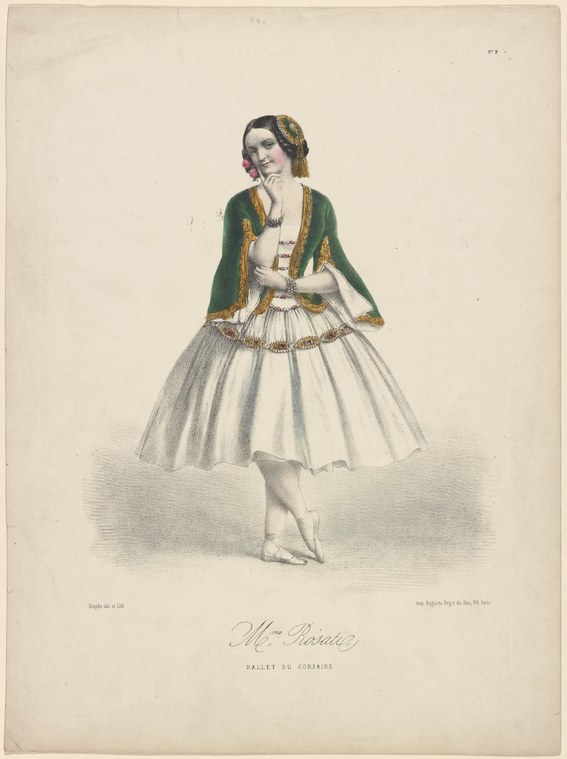
Mme Rosati, ballet du Corsaire
Unknown artist
- Collection:
- Prints depicting dance
- Source:
- New York Public Library
- Rights:
- Public domain — free to use, share and adapt.
- Recorded as:
- Public Domain
This print records both a specific dancer's fame and the aesthetic conventions of romantic ballet, which prized emotion and narrative over technical display. For historians, it is evidence of how ballets were documented and circulated to the public, and of which dancers and roles held the greatest cultural prestige in the 1850s–60s.
What you are looking at
A single female dancer in theatrical costume stands in a pose of repose against a neutral background, her body weight shifted to one leg in a relaxed stance. She wears a romantic-era ballet costume: a white tulle skirt reaching mid-calf with horizontal pleating at the waist, accented with gold braid trim. Over this she wears a dark green velvet or satin jacket or tunic, also trimmed in gold, worn loosely off the shoulders in the manner of a Greek or classical-inspired garment. Her hair is styled in a low chignon with what appears to be a gold ornament or wreath. She gazes downward and to the side with one hand raised to her face in a contemplative gesture, the other arm relaxed at her side. The pose suggests a moment of stillness between movement—a character at rest or in reverie rather than in active dance.
The dancing
The dancer stands in a nearly frontal pose with weight primarily on her right leg, the left leg only lightly planted. Her upper body is poised but relaxed, shoulders dropped naturally. The raised hand to the cheek creates an inward-looking moment; the downward gaze and the stillness of her frame suggest introspection or waiting rather than energetic movement. Her posture shows the turned-out stance and elongated line characteristic of ballet, but this is a moment of choreographic pause, not virtuosic action.
The dance depicted
This is a portrait of a named dancer—Mme Rosati—in character from the ballet *Le Corsaire* (The Corsair), a romantic-era narrative ballet first performed in 1856. The costume and the character's pause suggest a scene of theatrical drama rather than pure dance spectacle. *Le Corsaire* was one of the great vehicles for female dancers of the mid-19th century, and Rosati was a celebrated performer of this role. The image captures not a moment of virtuosic dancing but a moment of character, which was central to romantic ballet's fusion of mime and dance.
How it was made
This is a hand-colored lithograph or engraving, evident from the precision of line, the delicate tonal gradations, and the printing technique visible in the background wash. The soft shading of the skirt and the careful rendering of fabric texture—the crisp pleating of the tulle, the weight of the velvet jacket—suggest lithography, which allowed fine control of tone and was the dominant medium for theatrical portraiture of this era. Such prints were disseminated widely as souvenirs and promotional images, making the work part of the commercial apparatus of 19th-century theater and an index of a dancer's celebrity.
About this work
This is a mid-19th-century theatrical portrait print of a named ballerina in her role from *Le Corsaire*, one of the canonical romantic ballets. The image is not primarily a document of dance technique but of theatrical character and costume—a moment of pause and interiority. It belongs in a dance gallery because it captures how ballet was performed, promoted, and remembered in the romantic era: not as pure movement but as narrative drama with music, mime, and emotional truth. The work is also a document of celebrity culture and the ballerina as a figure of public fascination.
How to look at it
Attend to the costume and setting. The romantic tutu, the velvet jacket, the gold accents, and the classical styling all signal the theatrical and exotic world of romantic ballet. Note the pose: this is not a display of technique (no lifted leg, no extreme line) but a moment of character—the dancer is a dramatic figure, not a pure dancing body. The stillness and the introspective gaze were part of romantic ballet's vocabulary, valued as highly as virtuosity. The print's own technique—the delicate hand-coloring, the precision of the line—was part of how dancers' images were circulated and treasured.
The artist
The artist is not recorded in the catalogue. However, the style and quality of the print—the refinement of line, the professional hand-coloring, the theatrical subject—indicate it was produced by a commercial printmaker or atelier working in Paris or another major European theater city. Such prints were usually made in editions and credited to the theater or to named artists; this attribution gap may reflect the print's age or the dispersal of collections.
The period
This work dates to the height of romantic ballet, roughly 1840s–1870s, when the ballerina was the focus of theatrical spectacle and when ballet had moved from court and aristocratic circles to commercial, paying audiences. *Le Corsaire*, with its exotic setting, adventure plot, and demands for technical and emotional virtuosity, was emblematic of this era. Lithographic and engraved portraits of dancers were essential to their commercial promotion and to fan culture; theatergoers collected them as we now collect playbills and photographs.
Where it lives
The work is held in the New York Public Library's collection of prints depicting dance, indicating it was collected as a document of theatrical history. Such prints are typically stored in prints and photographs divisions and were often part of larger theater collections or donations.
Dance in this work
Questions about this work
Who was Mme Rosati?
Rosati was a celebrated Italian ballerina of the mid-19th century, known for her roles in romantic ballets. She performed major roles in *Le Corsaire* and other works and was a star of European theaters from roughly the 1840s to 1870s. This print is a record of her fame and of the roles she was known for.
What was Le Corsaire?
*Le Corsaire* is a romantic ballet choreographed by Joseph Mazilier with music by Adolphe Adam, premiered in 1856. It tells a tale of pirates, shipwrecks, and exotic adventure set in the Mediterranean. It was a showcase for ballerinas and remains in the repertory today.
Why is she not dancing?
Romantic ballet valued dramatic character and narrative as much as pure technique. This image captures a moment of stillness—a moment of the dancer in character, waiting, thinking, or in a scene of emotional weight. Such moments were choreographed and admired, and this print records one such moment.
Why was this print made?
Theatrical portrait prints were essential to promoting dancers and ballets in the 19th century. They were sold at the theater, collected by fans, and distributed as promotional images. They were the equivalent of modern playbills and celebrity photography.
More dance artwork





