49 works in this view — arrow keys or swipe to move between them.
Dance in Art
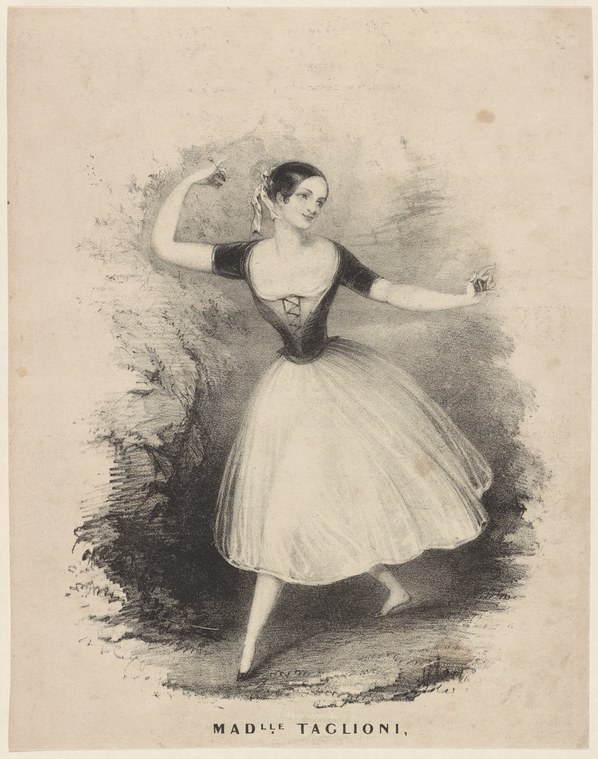
Mad'lle Taglioni
Unknown artist
- Collection:
- Prints depicting dance
- Source:
- New York Public Library
- Rights:
- Public domain — free to use, share and adapt.
- Recorded as:
- Public Domain
Taglioni was the most celebrated female dancer of her age and set the technical and aesthetic standard for ballet for decades. Her image circulated widely in lithograph form and became synonymous with Romantic ballet itself. This print offers insight into how the Romantic ideal was manufactured and consumed—how a specific body, trained in a specific way, was immortalized and celebrated across European and American audiences.
What you are looking at
A young woman in Romantic-era theatrical dress is captured mid-leap or sustained port de bras, her body rising and extending across the composition. She wears a dark corseted bodice with short sleeves and a voluminous pale tulle skirt that falls to mid-calf—the signature silhouette of early 19th-century ballet. Her left arm is raised high and curved; her right extends outward for balance. Her head is turned in profile, serene and focused. The figure occupies the center of the sheet, rendered in fine lithographic crayon, with soft tonal shading that creates atmospheric depth around her. There is no visible stage setting, no wings or backdrop: the dancer floats against an almost abstract ground of delicate cross-hatching and smudged tone. The whole composition emphasizes the illusion of weightlessness and ethereal grace.
The dancing
A single dancer in full upright extension, weight transferred to a supporting leg with the working leg lifted or extended. The arms frame an open port de bras—one arm raised to about shoulder height, the other extended to the side—suggesting a moment of suspension within a traveling step or a posed attitude. The torso is lifted and aligned; the head maintains the noble carriage required by ballet technique. The posture demonstrates command of the body in an elevated position, a hallmark of trained classical ballet.
The dance depicted
This is a portrait of Romantic ballet, almost certainly in the style of Marie Taglioni, the Swedish-Italian ballerina who dominated the European stage from the late 1820s onward. Taglioni pioneered the ethereal, weightless aesthetic of Romantic ballet and became the defining image of the style. The costume—short corseted bodice with full tulle skirt—and the sustained aerial port de bras are consistent with the ballets in which Taglioni performed, notably *La Sylphide* (1832). The lithograph captures the ideal of Romantic ballet technique: strength made invisible, the body as spirit rather than flesh.
How it was made
This is a fine lithograph executed in crayon on stone. The artist has used tonal layering and controlled hatching to create aerial perspective and volumetric form, particularly in the modeling of the tulle and the figure's arms and shoulders. Lithography's sensitivity to subtle gradations of tone makes it the perfect medium for capturing the shimmer and weightlessness that Romantic ballet pursued. The work is printed on laid paper with visible chain lines, suggesting mid-19th-century production; the loose mounting and state of preservation indicate this was issued as a popular print rather than a single artist's proof.
About this work
This is a portrait lithograph of a principal dancer of the Romantic era, executed with the technical refinement required to capture the ethereal ideal of early 19th-century ballet. The unnamed artist has rendered a moment of suspension, emphasizing the illusion of weightlessness and control that defined the period's aesthetic. The work belongs in a dance collection as a visual document of Romantic ballet's visual and physical language—how the dancers of that era were taught to move, how they appeared to audiences, and what the period valued in the female dancer's body and technique. It is both a portrait of an individual performer and a portrait of a style.
How to look at it
Attend to the moment of suspension: the artist has frozen the dancer at the apex of a jump or at the hold of a sustained port de bras—that is, not in transit but at the moment of apparent stillness. Notice how the tulle skirt catches light and weight differently from the body beneath it, and how the lithographic crayon renders transparency without hard lines. This is a print made to sell the illusion of effortlessness. The balance of the body—the way weight is centered over the supporting leg, the lift through the torso—tells you this is a trained dancer, not a generic figure: the artist understood ballet.
The period
This print was produced during the height of the Romantic ballet era (c. 1830–1850), when ballet became primarily a vehicle for the display of the female dancer's aerial prowess and ethereal presence. Marie Taglioni's debut in *La Sylphide* in 1832 established the Romantic formula: a supernatural heroine, pointe work, flowing tulle skirts, and an aesthetic of weightlessness achieved through rigorous training. Lithography became the primary medium for circulating images of celebrated dancers to an expanding urban audience. These prints served as souvenirs, advertisements, and devotional objects; fans collected them, theaters sold them in lobbies, and they were pasted into scrapbooks. The unnamed artist was part of a commercial apparatus that turned ballet dancers into celebrities and their images into commodities.
Where it lives
This is a commercial lithograph from the NYPL's Prints collection depicting dance. It belongs to the 19th-century market for theatrical prints—the mass-produced visual souvenirs of Romantic ballet's golden age.
Dance in this work
Questions about this work
Who was Marie Taglioni and why was she famous?
Marie Taglioni (1804–1884) was a Swedish-Italian ballerina who became the most celebrated dancer of the Romantic era. She was renowned for her technical mastery of pointe work, her ethereal stage presence, and her role in *La Sylphide* (1832), which became the template for Romantic ballet. She performed across Europe and America, and her image was circulated in lithographic prints like this one, making her an international celebrity.
Why was Romantic ballet so obsessed with weightlessness?
Romantic ballet (c. 1830–1850) emerged alongside Romantic poetry and painting, which prized the supernatural, the emotional, and the transcendent. Ballets featured sylphs, spirits, and otherworldly heroines—characters for whom weightlessness was literal and symbolic. Pointe work and tulle skirts were engineered to create the illusion that the dancer had escaped gravity. This aesthetic required extreme physical discipline but was designed to look easy.
How were ballet dancers promoted and sold to audiences?
Lithographic prints like this one were central to ballet's commercial apparatus. Theaters, print publishers, and dancers themselves circulated these images as souvenirs sold in lobbies, advertisements in newspapers, and gifts to fans. They were collected, mounted, and treasured—functioning as both advertisement and devotional object. This print culture made ballet dancers into celebrities and created a visual archive of how they moved and appeared.
More dance artwork





