49 works in this view — arrow keys or swipe to move between them.
Dance in Art
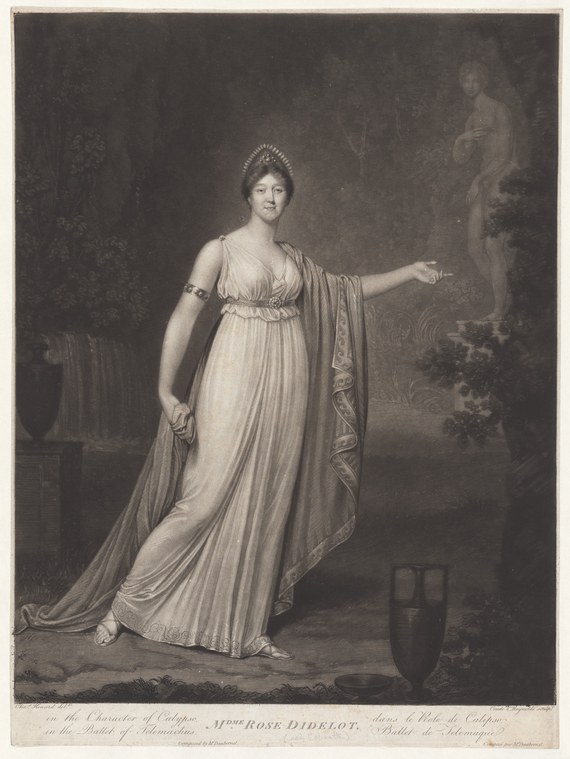
Madme. Rose Didelot: in the character of Calypso, in the ballet of Telemachus
Unknown artist
- Collection:
- Prints depicting dance
- Source:
- New York Public Library
- Rights:
- Public domain — free to use, share and adapt.
- Recorded as:
- Public Domain
The image preserves the stage appearance and costume of a named dancer in a specific role at a known moment in the history of ballet. For historians, it is primary evidence of what a Romantic-era ballet costume and pose actually looked like; for dancers, it shows how a classical character was embodied and presented, and how the aesthetic of nobility and restraint was visual as well as kinetic.
What you are looking at
A woman in Neoclassical dress stands alone in a darkened interior, posed as the mythological figure Calypso. She wears a high-waisted, pleated linen chiton that falls to her ankles, with a draped mantle sweeping behind and to her side. A diadem crowns her hair. Her right arm extends outward in a gesture of languor or invitation; her left arm rests across her body. The setting is austere—classical architectural elements (a pedestal, a sculptural fragment) emerge from shadow on either side, and a faint figure or statue appears in the background. The lighting is theatrical, concentrating on the figure's pale drapery and leaving the background in shadow. The composition is a formal portrait of a named performer, not a scene of action or ensemble dance.
The dancing
A single standing female figure occupies the frame. Her weight rests evenly on both feet; there is no suggestion of active movement or momentum. The right arm is raised and extended at roughly shoulder height, palm open, in a pose of classical repose or rhetorical address rather than dynamic gesture. The left arm drapes across the body. The body is frontal and nearly symmetrical, following Neoclassical conventions of noble restraint. The extended arm is the only asymmetry, and it reads as a held pose rather than a moment caught in motion.
The dance depicted
The work depicts Madame Rose Didelot in the role of Calypso from the ballet *Télémaque* (also known as *Telemachus*), a narrative work of the Romantic era. The pose is formal and statuesque rather than a representation of active dancing. Calypso—the mythological enchantress—is presented here in an attitude of dignified melancholy or watchful waiting, which aligns with her character in the narrative (the goddess who held Odysseus captive on her island). The image documents a role and a costume rather than a step or sequence; it is a character study frozen in a pose that was likely held on stage, not a snapshot of dancing in progress.
How it was made
This is an engraving, executed with fine hatching and delicate line work to render texture and shadow. The technique—fine line engraving on paper—was the standard medium for theatrical portraiture and documentation in the early to mid-nineteenth century. Engravings of this type were distributed as prints to be collected and displayed, and they carried text below the image identifying the performer and role. The medium allowed precise rendering of costume detail and the formal staging of the pose, and its reproducibility meant that images of celebrated performers could circulate widely among theatregoers and collectors.
About this work
This engraved portrait documents Madame Rose Didelot as Calypso in the ballet *Télémaque*, a work of the Romantic ballet era. The image is not a scene of dancing but a formal representation of a performer in character and costume, posed in the grave and restrained manner appropriate to a classical goddess. It belongs in the history of theatrical dance as evidence of how roles were visualized and marketed to audiences, and of the Neoclassical aesthetic that dominated ballet's visual culture in this period. The work is a document of both the dancer and the choreographic tradition in which she was trained.
How to look at it
Attend to the stillness and formality of the pose: this is not a moment of active dancing but a held attitude, the kind of position a performer might sustain while other action occurred around her on stage. The extended arm and the frontal posture follow conventions of classical portraiture and theatrical nobility rather than the dynamic asymmetry of active choreography. The rendering of the drapery—fine, fluid, and catching light—shows the engraver's skill in depicting the costume that defined the role. Notice how the darkness surrounding the figure concentrates attention on her dress and pose, making the image function as both a portrait of the performer and a display of the costume itself.
The artist
The engraver is not recorded in the catalogue. Theatrical engravings of this type were typically produced by professional printsellers and engravers working in Paris and London in the 1830s–1850s, often from drawings by theatrical portraitists. The work was likely produced for sale to theatregoers and collectors, and distributed through print shops or at the theatre itself.
The period
This work dates to the Romantic ballet era (approximately 1830–1860), when narrative ballets on classical and medieval themes dominated European stages. *Télémaque*, based on Fénelon's 18th-century prose epic, was a popular subject for ballet and other theatrical works. The Neoclassical vocabulary of costume and pose—the chiton, the diadem, the restrained gesture—reflects the period's investment in classical learning and aesthetics, even as Romantic choreography began to emphasize otherworldly and supernatural characters. Rose Didelot was a prominent ballerina of this era, and her appearance in such roles was documented extensively through engravings and lithographs for circulation.
Where it lives
The work is part of the New York Public Library's collection of prints depicting dance. It is a theatrical engraving of the type widely produced and distributed in the nineteenth century, likely sold to theatregoers or held in personal collections of dance enthusiasts.
Dance in this work
Questions about this work
Was Madame Rose Didelot actually dancing in this image?
No. This is a formal portrait pose, not a representation of active dancing. The extended arm and frontal stance are statuesque and restrained, designed to present the performer and her costume to the viewer. The image documents how the role was presented on stage, but this particular pose may be a theatrical attitude held during a scene rather than a moment of movement.
What is Calypso doing in this ballet?
In *Télémaque*, Calypso is the mythological enchantress who detained Odysseus (Telemachus in Fénelon's version) on her island. The pose here—watchful, resigned, extended—suggests the character's role as a dignified but melancholy figure, resigned to the hero's departure. The classical costume and refined gesture emphasize her status as a goddess rather than a comic or exotic character.
Why is the background so dark?
The engraver used shadow to isolate the figure and its costume from the setting, focusing all attention on the performer and her role. The faint architectural elements and statue in the background establish a classical setting without distracting from the central figure. This use of light and shadow is typical of theatrical portraiture of the period.
How do I know this is an engraving and not a different print technique?
The fine, regular hatching lines that build tone and shadow, the precision of the line work, and the characteristic appearance of engraved metal-plate impressions all identify this as an engraving. Lithographs and etchings would show different mark-making. The text below the image, which identifies the performer and role, was commonly printed from a separate plate beneath the engraved portrait plate.
More dance artwork





