49 works in this view — arrow keys or swipe to move between them.
Dance in Art
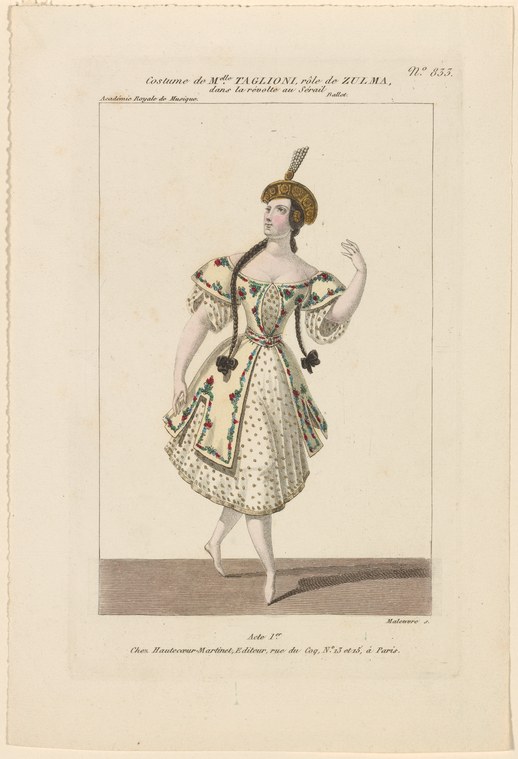
Costume de Melle. Taglioni, rôle de Zulma, dans La révolte au sérail, ballet, acte 1er, Académie royale de musique
Unknown artist
- Collection:
- Prints depicting dance
- Source:
- New York Public Library
- Rights:
- Public domain — free to use, share and adapt.
- Recorded as:
- Public Domain
This engraving is rare visual evidence of how Romantic ballet costumes actually looked in performance, rather than in idealized or retrospective representations. It documents the orientalist fantasy that was central to the Romantic ballet repertory and shows how the European stage used costume, headdress, and body display to construct an imagined "Orient." For historians of dance, fashion, and theater, it is a primary source for understanding what nineteenth-century audiences saw and what the star system depended on—the dancer as object of visual spectacle as much as movement.
What you are looking at
A woman in elaborate mid-nineteenth-century theatrical dress stands in a relaxed contrapposto pose against a plain background, with one leg bearing weight and the other extended gently forward. Her costume is the visual focus: a broad-skirted white dress with polka dots, decorated along the hem and sides with darker patterned trim, worn off the shoulder to expose the upper arms and décolletage in the Romantic ballet mode. Over this sits a short, heavily embroidered bolero or jacket in a contrasting dark fabric, and she wears a jeweled turban or headdress adorned with a feathered plume rising vertically from the crown. Her arms hang naturally at her sides, one hand raised slightly in a gesture of ease or greeting. The figure is rendered in hand-colored engraving, the drapery and fabric textures carefully distinguished through fine line work and subtle wash.
The dancing
A single female figure in a standing pose with minimal dynamic tension—the weight settles on one leg in a natural stance rather than the lifted, turned-out positions of classical ballet technique. The arms are relaxed and unframed, without the geometric clarity of a trained balletic line. This is an attitude of display and presentation rather than movement: the dancer is shown as a stage figure to be admired rather than caught mid-choreography. The posture suggests a pause, an entrance, or the moment of being seen.
The dance depicted
This is a costume study for the role of Zulma in *La révolte au sérail* (*The Revolt in the Seraglio*), a ballet from the Romantic era performed at the Paris Opéra. The work belongs to the tradition of Romantic ballet that flourished in the 1830s–1840s, characterized by exotic and orientalist settings, supernatural elements, and the star system that made particular dancers' performances the draw. The label identifies this as Act 1, suggesting the image documents a specific entrance or scene-setting costume. The dance itself, not visible here, would have been performed in the technique and aesthetic of mid-nineteenth-century theatrical ballet: pointe work, turned-out positions, and the illusion of weightlessness. This engraving functioned as a souvenir and advertisement of the dancer's performance.
How it was made
This is a hand-colored engraving, a reproductive print technique that dominated theatrical and fashion documentation in the nineteenth century before photography displaced it. The fine line work establishes the contour and detail of the costume with precision; the subtle wash and watercolor overlay render fabric, shadow, and the jeweled ornaments. The technique allowed for both wide circulation (multiple impressions from a single plate) and the aesthetic refinement demanded by a wealthy operatic audience. The hand-coloring, done after printing, made each impression unique and allowed for accurate representation of the costume's actual colors—here, the pale ground and jewel tones of the theatrical dress.
About this work
This engraving documents a specific theatrical performance costume from the Romantic ballet era at the Paris Opéra, likely 1840s or 1850s. It belongs to a large body of promotional and commemorative prints that circulated alongside theater programs and as standalone souvenirs for ballet enthusiasts. The image shows how Romantic ballet fused orientalist fantasy with European theatrical convention, encoding exoticism and spectacle in costume, headdress, and the framing of the dancer's body. The work is a document of both dance history and the visual culture of nineteenth-century French theater: it tells us what audiences came to see, how roles were marketed, and what the marriage of ballet and orientalism looked like on stage.
How to look at it
Look at the pose: this is not a moment of choreography but a moment of presentation, a pause for the audience's gaze. Notice the asymmetry between the simple, naturalistic stance and the elaborate, costly costume piled onto it—the disparity signals that the costume, not the movement of the body, is what creates the fantasy. The headdress, especially the vertical plume, was characteristic of orientalist theater and would have caught light and movement on stage in ways the engraving cannot fully show. This is a souvenir designed to let the viewer at home recall or imagine the theatrical experience without seeing dance itself.
The period
This work dates to the heyday of Romantic ballet in France, an era when the ballet d'action—a narrative ballet with dramatic content—replaced the court spectacle and classical divertissement of earlier periods. Romantic ballet was defined by pointe work made visible and magical through costume, by the introduction of the supernatural (sylphs, spirits, exotic maidens), and by the cult of the individual dancer—the ballerina as star. Paris was the center of this world; the Opéra was its temple. Orientalism saturated European art and letters in this period, fed by colonial expansion and Romantic fascination with the "other." Ballet seized on orientalist subjects (*La Bayadère*, *Giselle*, *La Péri*) as vehicles for fantasy and spectacle. The costume—the turban, the jeweled bolero, the polka-dotted skirt—is the visual language through which the stage claimed to transport the audience to another world.
Where it lives
The work is held in the New York Public Library's collection of prints depicting dance. It is a commercial reproductive print, produced for sale to a theater-going public as a memento of a specific performance or series of performances.
Dance in this work
Questions about this work
Who danced this role?
The catalogue record does not identify the dancer. The engraving is labeled simply as a costume for the role of Zulma; the name of the performer would have been recorded on the title or margin at the time of sale or archival acquisition, but it is not visible in this reproduction. Theater archives and dance histories of the period would be needed to identify which dancer or dancers wore this costume.
What is 'La révolte au sérail'?
It was a ballet performed at the Paris Opéra in the Romantic era. The title translates as *The Revolt in the Seraglio*, suggesting a plot centered on intrigue or rebellion in an Ottoman court setting. This was a common orientalist narrative template for Romantic ballet. No full record of this specific ballet survives in readily available sources, suggesting it may have been a secondary work or a dance with limited longevity in the repertory.
Why is the dancer not moving?
This is a costume study, not a choreographic record. The engraving was made from a design drawing or a live observation of the costume worn in rehearsal or performance. Its purpose was to document the visual spectacle—the dress, the ornament, the fantasy—rather than to capture the movement of dance. Many such costume prints were sold without any representation of choreography at all.
When was this printed?
The catalogue record does not provide a date. The style of dress, the printing technique, and the fashion for orientalist ballet suggest the 1840s–1850s. The hand-coloring and the fineness of the engraving work are consistent with high-quality French theatrical prints of that period.
More dance artwork





