49 works in this view — arrow keys or swipe to move between them.
Dance in Art
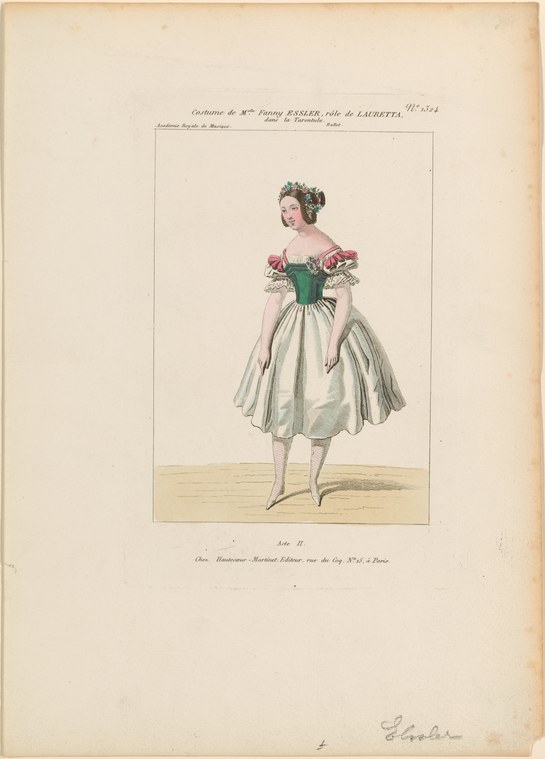
Costume de Melle. Fanny Essler [sic], rôle de Lauretta, dans La tarentule.: Ballet. Académie Royale de Musique. Acte II.
Unknown artist
- Collection:
- Prints depicting dance
- Source:
- New York Public Library
- Rights:
- Public domain — free to use, share and adapt.
- Recorded as:
- Public Domain
Fanny Essler was one of the two supreme dancers of Romantic ballet, rivaling Marie Taglioni; this image documents the actual dress she wore in a major role. The *La Tarentule* costume exemplifies the visual language of Romantic ballet at the moment of its widest international success, and the care taken in creating, documenting, and circulating such images shows how central costume and the dancer's body were to the work's effect.
What you are looking at
A single female dancer in theatrical costume stands against a plain cream background, posed in a classical ballet stance. She wears a green bodice with a dramatically voluminous white skirt that falls to mid-calf, gathered or pleated to create a full, bell-like silhouette typical of Romantic-era ballet. Her shoulders are bare, framed by pink or rose-colored sleeve caps or decorative elements. She wears a flower crown or wreath in her dark hair and holds what appear to be flowers or floral props in her hands. Her posture is upright and elegant, with her weight distributed evenly; her legs are visible and appear straight, her feet turned outward in ballet position. The figure is rendered in hand-colored engraving or lithograph, with careful attention to the modulation of her flesh tones and the delicate rendering of fabric folds. A warm tan floor line grounds her figure.
The dancing
A single dancer in a classical fifth or closed position, standing with turned-out legs and an upright, elongated frame. Her arms hang naturally at her sides, each holding a bouquet or floral accessory. Her body alignment is vertical and composed, with the weight centered. The positioning suggests a pose held for formal presentation rather than captured mid-movement — this is a costume study rather than a moment of action.
The dance depicted
This is a costume design for a named dancer, Fanny Essler, in the role of Lauretta from the ballet *La Tarentule* (*The Tarantula*), Act II. *La Tarentule* was a popular Romantic-era ballet first choreographed by Jean-Auguste Aumer in Paris in 1839, featuring a young woman possessed or driven to dance by a tarantula bite. Essler, an Austrian dancer of legendary technical skill and dramatic presence, was famous throughout Europe in the 1830s–1840s for both her brilliant technique and her gift for character roles. The image documents theatrical costume rather than choreography; it shows the dress prescribed for a specific role by a specific dancer at a specific moment in the ballet.
How it was made
This is a hand-colored engraving or lithograph — the record does not specify which. The image shows the careful stippling and fine line work characteristic of engraving, with hand-applied watercolor or gouache used to define flesh tones, the green bodice, pink sleeves, white skirt, and floral crown. The technique was standard for theatrical costume documentation in the early-to-mid 19th century, allowing precise reproducible images that could circulate to theaters across Europe and serve as a record for other performers undertaking the same role. The hand-coloring indicates a higher-quality object, likely a presentation or archive copy rather than a commercial print.
About this work
This is a costume study—a documentary engraving of the dress worn by the celebrated Austrian dancer Fanny Essler in the role of Lauretta in the 1839 Romantic ballet *La Tarentule*. The image preserves not choreography but theatrical practice: the precise cut, construction, and ornamentation of a celebrated performer's costume at a specific historical moment. Such prints circulated among theater companies, dancers, and the ballet-going public as records of authentic costume and as advertisements for the dancers and works they documented.
The work belongs in a dance archive as evidence of how Romantic ballet was actually dressed on stage, and of the international celebrity of Fanny Essler at the height of her career. It captures the aesthetic of Romantic tutus — the voluminous, pale skirts; the bare shoulders; the floral ornamentation — that defined the visual identity of the era, and it testifies to the importance of costume design and the dancer's appearance in the reception of Romantic ballet.
How to look at it
Attend to the absolute stillness of the figure and the formal, frontal presentation. This is not a moment frozen mid-performance, but a costume on display—the dancer presented as an object of admiration rather than a body in action. Notice the specificity of every detail: the flower crown (which marked Lauretta as a character, not a classical sylph), the voluminous skirt gathered from the bodice, the bare shoulders, the weight of the floral props. The hand-coloring shows the actual palette of the stage costume, which would have appeared under gaslight in a theater. The artist's choice to show the full figure centered and isolated emphasizes the costume as an artifact worthy of study and preservation.
The artist
The artist is not recorded in the catalogue. The style and inscription suggest a commercial theatrical print house, likely in Paris (where the ballet premiered and where such prints were first published) or another major European theatrical center. Such prints were typically made by reproductive engravers working from costume sketches or live observation, often published by print dealers in theater districts.
The period
This print dates from the height of Romantic ballet, a period (roughly 1830–1850) when ballet was dominated by narratives of the supernatural, the exotic, and the tragic, and when the female dancer became the central focus of the theatrical spectacle. *La Tarentule* premiered in 1839 and was one of the major successes of the decade. Fanny Essler's Tarantula roles were among her most celebrated; she performed the work across Europe from Paris to London to Milan, often to extraordinary acclaim. The circulation of such costume prints was part of the international ballet economy—they announced new works, documented star performers, and allowed dancers and theater companies across Europe to replicate celebrated productions. The hand-colored engraving technique was the standard mode for such documentation before photography; it was expensive enough to indicate official or semi-official theatrical records, yet reproducible enough to allow wide distribution.
Where it lives
From the New York Public Library's collection of prints depicting dance, this is part of an extensive archive of theatrical costume documentation from the 19th century. The inscription and style indicate a commercial or semi-official publication, likely issued during the height of *La Tarentule*'s success in the 1840s.
Dance in this work
Questions about this work
Who was Fanny Essler?
Fanny Essler (1810–1884) was an Austrian dancer and one of the two supreme stars of Romantic ballet, rivaling the Italian-Swedish dancer Marie Taglioni. She was known for her brilliant technique, her gift for character roles, and her charisma on stage. She performed across Europe and was celebrated as a national figure in Austria and Italy as well as France and other countries. She retired from the stage in 1853 after an exceptionally long and successful career.
What was *La Tarentule*?
*La Tarentule* was a ballet choreographed by Jean-Auguste Aumer, premiered in Paris in 1839. It told the story of a young woman who is bitten by a tarantula and driven to dance uncontrollably. The role became one of Essler's signature parts, allowing her to combine technical brilliance with dramatic acting and character comedy. The tarantula-bite premise gave the dancer license to dance with apparent madness, making for vivid and exciting theater.
Why did 19th-century theaters circulate costume prints?
Costume prints served multiple purposes. They advertised star dancers and new works to the ballet-going public across Europe. They provided reference images for other theaters mounting the same works, helping ensure consistent and authentic costume design. And they functioned as souvenirs and collectibles for ballet enthusiasts, much like theater playbills and photographs do today.
How was this print made?
This is a hand-colored engraving or lithograph—the record does not distinguish. An engraver (or lithographer) created a black-and-white master image, likely from a costume sketch or live observation, which was then printed in quantity. Each print was then carefully hand-colored with watercolor or gouache to show the actual colors and details of the stage costume. This process was labor-intensive and expensive, which is why such prints were relatively costly objects.
More dance artwork





