49 works in this view — arrow keys or swipe to move between them.
Dance in Art
Costumes de théatre
Unknown artist
- Collection:
- Prints depicting dance
- Source:
- New York Public Library
- Rights:
- Public domain — free to use, share and adapt.
- Recorded as:
- Public Domain
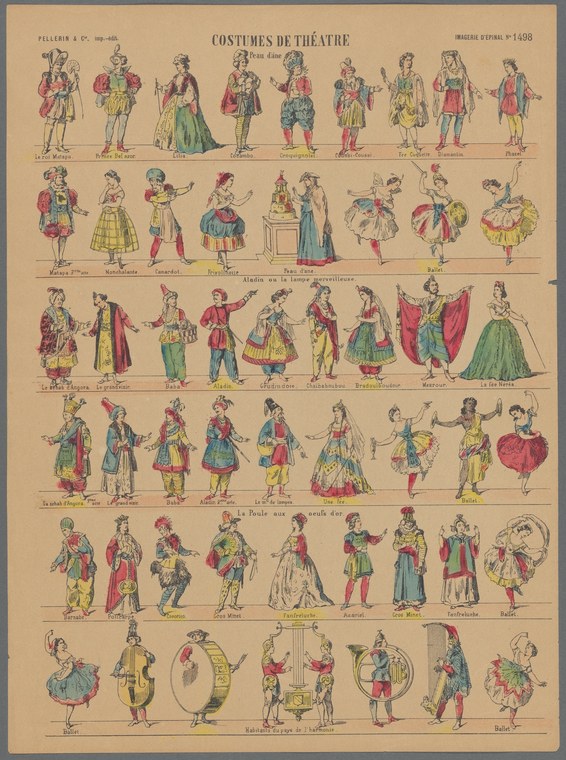
This print documents the codification of theatrical costume as a visual language in the 19th century, at a moment when printed educational materials were making theatrical practice more accessible and standardized across Europe. For dance historians, it is valuable evidence of how performers were visually identified through dress, and how costume communicated character, social rank, and theatrical tradition before film or photography became dominant. The prominence of commedia dell'arte costumes also reflects the enduring influence of that performance tradition on European theater and the movement vocabularies associated with specific character types.
What you are looking at
This is a comprehensive theatrical costume reference sheet divided into six horizontal rows, each containing approximately 9–10 costumed figures in full color. The sheet appears to be printed on tan or buff paper, with French text labels identifying character types beneath each figure. The costumes span a wide range of theatrical traditions: Renaissance court dress with puffed sleeves and hose; commedia dell'arte figures (identifiable by their distinctive masks and patterned clothing); classical theatrical figures in draped garments; and various folk and comic characters. The color palette is bright and varied—reds, greens, golds, blues—applied with hand-coloring or chromolithographic printing. The figures are arranged in a grid format, each standing in an isolated, posed position rather than interacting, suggesting this is a reference document for costume makers, directors, or performers rather than a narrative scene. The presentation is systematic and encyclopedic, documenting the visual language of theatrical dress across multiple genres and periods.
The dancing
Each figure stands in a frontal or three-quarter pose, weight evenly distributed, with bodies held upright and formal. Arms are positioned naturally at the sides or occasionally raised to show costume details such as sleeves, cloaks, or props. The stances are presentational rather than gestural—these are costume displays, not dance positions, though some figures gesture with hands. The variety of silhouettes is striking: wide skirts over panniers and crinolines; fitted breeches and stockings; draped robes; and military jackets. Several figures hold attributes—fans, staffs, weapons—that identify their theatrical roles. There is no weight-shift, no dynamic momentum, no partnering; the bodies are arranged to maximize visibility of dress.
The dance depicted
While the print documents theatrical costumes rather than choreography, many figures are associated with danced or movement-based theatrical traditions. The commedia dell'arte characters (identifiable by their characteristic masks and costumes in the lower sections) were integral to performance traditions that included acrobatic movement and stylized gesture. The aristocratic court dress visible in several figures reflects the milieu of Renaissance and Baroque court dances such as the pavane and galliard. However, this is a costume reference, not a depiction of dance in action; it shows what dancers wore rather than how they moved. The image documents the visual vocabulary of theatrical character and social rank through dress, which was foundational to how dancers were recognized and understood in early modern and early modern-adjacent theatrical contexts.
How it was made
This is a hand-colored engraving or chromolithograph on paper, likely produced by a commercial Paris publisher (the signature 'Pellerin & Cie' is visible at top left, along with an archive number '14108'). The printing technique allowed for mass production at relatively low cost, making theatrical costume references widely available to costume makers, amateur performers, and theater companies. Hand-coloring adds specificity to the figures and suggests this was a premium or semi-luxury version of the print; an uncolored engraved version may also have circulated. The clarity and precision of the line work indicates professional engraving, while the systematic arrangement and French labeling suggest a deliberate pedagogical or reference purpose.
About this work
This is a theatrical costume reference sheet, likely French, from the 19th century (Pellerin & Cie was a major Paris publisher active from the 1830s onward). It documents costume types across multiple theatrical traditions—court drama, commedia dell'arte, folk theater, and comic character roles—arranging them in a grid for easy visual comparison and reference. The work served a practical purpose in theatrical production, helping performers, costume makers, and directors identify appropriate dress for different character types and social positions. It is an artifact of how theatrical knowledge was transmitted and standardized through printed visual reference.
How to look at it
Approach this as a reference document, not a narrative artwork. Read it systematically, row by row, to understand the range of theatrical character types available to performers and makers. Notice how costume communicates character: the commedia dell'arte figures (lower rows) are immediately recognizable by their masks and patterned clothing, while aristocratic figures (upper rows) are distinguished by the scale and richness of fabric and the presence of jewels, feathers, and ornament. Observe how silhouette changes across periods and character types—the rigidity of Renaissance court dress versus the mobility suggested by simpler folk costumes. The label text beneath each figure (readable with magnification) identifies the character type or role, anchoring each costume to a specific theatrical tradition or stock character.
The artist
This is a commercial product of Pellerin & Cie, a major Parisian publisher and printer based in Épinal. The company was known for producing affordable, colorful prints for popular and theatrical audiences, including costume references, moral tales, broadsheets, and educational prints. The work is likely the product of an in-house design and engraving team rather than a single named artist. Pellerin & Cie operated from the 1830s into the early 20th century and was a significant distributor of visual culture to non-elite audiences.
The period
This print dates to the era when theatrical costume was becoming increasingly standardized and documented through printed reference materials. In the early-to-mid 19th century, as national theaters and commercial theater companies expanded across Europe, the need for reliable costume references grew. Simultaneously, commedia dell'arte—while no longer a dominant performance tradition—remained a reference point and training ground for European theater, and its character types and costumes were widely reproduced in educational and reference prints. The grid format and systematic categorization reflect Enlightenment and 19th-century impulses to classify and make knowledge accessible through visual systems.
Where it lives
This print is held by the New York Public Library as part of its collection of prints depicting dance. It is a commercial printed reference sheet, one of many such costume guides produced and circulated by Pellerin & Cie and similar publishers to serve theatrical practitioners, amateur performers, and collectors of theatrical imagery.
Dance in this work
Questions about this work
Is this a depiction of dance?
Not directly. It is a costume reference sheet for theatrical performance. However, many of the characters shown—particularly commedia dell'arte figures—were part of performance traditions that included choreographed movement and stylized gesture. The print is valuable for understanding how dancers and performers were visually identified and differentiated through costume in historical theatrical contexts.
Who would have used this print?
Theater companies, costume makers, amateur theatrical societies, and individual performers would have consulted this sheet to understand appropriate dress for different character types and theatrical traditions. It is both a practical tool and a collector's item—affordable enough for working theaters, but also visually appealing and decorative enough for amateur enthusiasts and collectors.
What is Pellerin & Cie?
Pellerin & Cie was a major Parisian publisher and printer based in Épinal, active from the 1830s onward. They were known for producing affordable, colorful prints aimed at popular and theatrical audiences, including costume references, moral tales, broadsheets, and educational materials. They were pioneers in using chromolithography to make high-quality color prints available at low cost.
Why are commedia dell'arte costumes so prominent?
Commedia dell'arte, though it had declined as a dominant performance tradition by the 19th century, remained enormously influential in European theater as a source of character types, performance styles, and movement vocabularies. These costumes would have been instantly recognizable to theatrical audiences and were widely taught as part of actor training.
More dance artwork





