49 works in this view — arrow keys or swipe to move between them.
Dance in Art
No. 92, Bergère écossaise
Unknown artist
- Collection:
- Prints depicting dance
- Source:
- New York Public Library
- Rights:
- Public domain — free to use, share and adapt.
- Recorded as:
- Public Domain
This print documents the European appetite for exotic and pastoral character dances, and shows how non-European identities were constructed visually on the French stage—the Scottish shepherdess is a metropolitan fantasy, not a document of living practice. For historians of theatrical costume and the early Romantic ballet repertoire, such prints are primary evidence of the aesthetic and the stagecraft that defined the era, even though they show costume rather than choreography in action.
What you are looking at
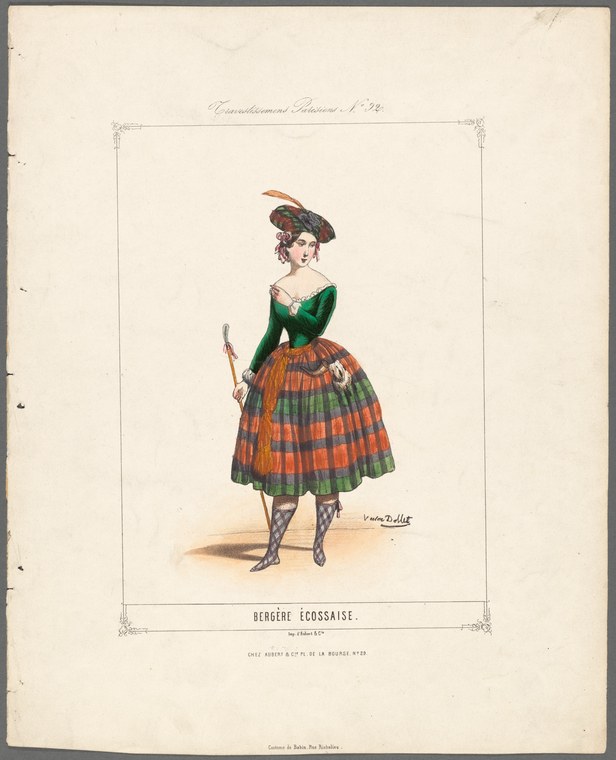
A single female dancer is portrayed in a three-quarter pose against a plain background, captured in a moment of stillness rather than active motion. She wears a striking ensemble: a deep green silk bodice with a low, square neckline and short sleeves, paired with a voluminous skirt of vivid orange and deep green horizontal stripes that falls to mid-calf. The skirt's width and construction suggest considerable fabric and structural support—it reads as a full gathered or pleated skirt of the Romantic era. Her legs are clad in dark stockings, and she wears flat shoes. Her dark hair is swept up and crowned with a small black hat adorned with a single prominent orange plume. She holds a long stick or staff in her right hand, angled diagonally across her body. The composition is contained within a delicate rectangular border with ornamental corner flourishes, and text beneath identifies the figure as "BERGÈRE ÉCOSSAISE" (Scottish Shepherdess). The figure's poise is controlled and dignified, with weight balanced evenly, her gaze directed toward the viewer with a slight turn of the head.
The dancing
The dancer stands in a relaxed, frontal stance with shoulders level and arms in neutral position, her right hand holding what appears to be a pastoral staff. Her posture suggests the moment between steps rather than the peak of movement—there is no sense of momentum, turnout, or elevation. The stance reads as upright and formal, consistent with early nineteenth-century theatrical portraiture. The body alignment shows no particular technical training in the sense of Romantic ballet; the weight sits naturally and the frame is open rather than gathered.
The dance depicted
The costume and title explicitly reference Scottish pastoral culture, suggesting this is a Scottish dance performed in the French theatrical tradition—likely a choreographed solo or character dance from an opera-ballet or stage production rather than an authentic folk practice. The staff (possibly a crook, as befits a shepherdess) and the deliberate costume exoticism indicate this is a European theatrical interpretation of 'Scottish' identity, the sort of ethnographic or character dance common in French ballet and opera during the 1830s–1850s. The static, portrait-like pose does not show active dancing, but rather presents the character in costume—a standard convention for theatrical prints of the era.
How it was made
This is a hand-colored engraving or lithograph, identified by the uniform line work, the delicate border, and the evidence of selective hand coloring in the orange, green, and flesh tones. The technique allowed mass circulation of theatrical costume and character studies to audiences who would never see the performance. The coloring—applied by hand or stencil—gives the work a vivid immediacy that would have served both as a record of stagecraft and as a souvenir or publicity image. The publication information at the foot indicates a Parisian publisher, consistent with the metropolitan distribution of such theatrical prints.
About this work
This is a theatrical costume print depicting a character dancer in a choreographed 'Scottish shepherdess' role, produced for the French stage market in the early-to-mid nineteenth century. It belongs to the body of theatrical portraiture and character studies that documented the Romantic ballet and opera-ballet repertoire, capturing not movement itself but the visual spectacle of costume and character that defined stage performance of the era. The figure is frozen in a formal, dignified pose that emphasizes her costume and identity rather than any technical display of dance.
How to look at it
Attend to the stillness of the pose: this is not a moment captured mid-leap or mid-turn, but a formal presentation, a costume study. The horizontal lines of the skirt and the strong verticals of the bodice and staff create a composed, symmetrical silhouette—the opposite of the flowing, unstable positions that would characterize Romantic ballet in motion. The print is meant to be read as you would read a fashion plate or a portrait: to admire the costume, the character, the theatricality of identity. The border and the publication details ground it as a commercial theatrical print, a piece of merchandise designed to extend the life of a stage role into the domestic sphere.
The artist
The print is credited to L. Vandi-Pillet, a mid-nineteenth-century Parisian lithographic artist and colorist whose name appears as a signature on the drawing. Vandi-Pillet was part of the substantial production of theatrical costume and character prints that supplied the Paris market with images of popular stage roles. The work was published by Aubert & Cie., a major Parisian print publisher of theatrical and satirical imagery. The artist's hand is visible in the assured draftsmanship of the figure and the decorative border, suggesting a professional theatrical atelier rather than a singular artistic vision.
The period
This print dates to the 1830s–1850s, the height of the Romantic ballet and the opera-ballet tradition in Paris. During this period, character dances—pantomimic and choreographed solos in exotic or pastoral costume—were a staple of theatrical entertainment. The fascination with Scotland, Italy, Spain, and other 'picturesque' locales was part of a broader Romantic aesthetic that valued the rural, the distant, and the ethnographically novel. French ballet had inherited the tradition of character dances from the opera-ballet tradition of the previous century, and they remained a vehicle for female performers to display technique, acting, and visual spectacle. The costume here—the striped skirt, the plume, the pastoral staff—are all stage inventions designed to signal 'Scottishness' to a Paris audience, not documents of authentic practice.
Where it lives
This work is held in the NYPL's collection of prints depicting dance. It is one of hundreds of such theatrical costume and character prints produced in Paris during the nineteenth century, part of the systematic visual documentation and marketing of staged entertainment.
Dance in this work
Questions about this work
Was this a real Scottish dance?
No. This is a European theatrical costume fantasy, a choreographed character dance created for the Paris stage. The costume and the pastoral staff are stage inventions designed to signal exoticism and rural identity to an urban theatre audience, not records of Scottish folk practice. The 'shepherdess' character was a common figure in opera-ballet and theatrical divertissement across Europe during this period.
What is she holding?
A long staff or crook, consistent with a shepherdess character. In the context of stage costume, it functions both as a prop that identifies the character and as a compositional device that anchors the vertical line of the figure and creates visual balance with the volume of the skirt.
Why is this a print rather than a painting?
Theatrical prints were mass-produced and cheap, allowing widespread circulation to audiences, theatre-goers, and collectors. A colored engraving or lithograph could be reproduced hundreds of times, making it an ideal medium for theatrical marketing and documentation. The print would have been sold in bookshops and at the theatre itself, extending the commercial and cultural life of a popular role.
What does the title mean?
'Bergère' means shepherdess; 'écossaise' means Scottish. The title announces both the character type (pastoral woman) and the exoticized national identity (Scotland) that the costume and props are meant to invoke. Similar character dances existed with Italian, Spanish, and other national costumes.
More dance artwork





