49 works in this view — arrow keys or swipe to move between them.
Dance in Art
Mlle. Taglioni
Unknown artist
- Collection:
- Prints depicting dance
- Source:
- New York Public Library
- Rights:
- Public domain — free to use, share and adapt.
- Recorded as:
- Public Domain
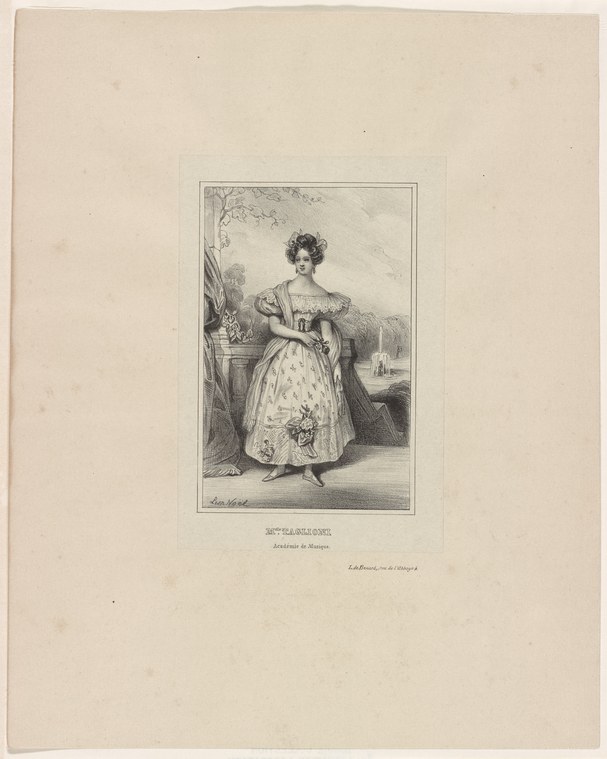
Taglioni was not merely a famous dancer; she fundamentally transformed what ballet could be. This engraving captures her at the height of her influence and shows the visual codes—the pose, the dress, the neoclassical setting—through which Romantic ballet was understood and marketed. For anyone studying how dance history is made and transmitted, this image is essential: it shows that Taglioni's fame rested on her image as much as on her technique.
What you are looking at
A young woman in Romantic-era ball dress stands in a graceful pose within a classical interior. She wears a white muslin gown with a fitted bodice and full skirt trimmed with embroidered or applied decoration at the hem; her dark hair is arranged in the fashionable style of the 1830s–40s, adorned with flowers or feathers. She stands near a draped column or pilaster, one arm raised in a delicate gesture, the other at her side, her weight balanced on one leg in a posture suggesting readiness for movement. To the left background, a classical urn or vase sits on a pedestal; to the right, a garden or landscape is suggested by foliage and distant architecture. The engraving is finely detailed, with careful attention to the fall of fabric, the play of light across her dress, and the neoclassical setting that frames her.
The dancing
A single female figure occupies the composition. Her body is upright and elongated, with shoulders back and the torso held in perfect alignment—characteristic of Romantic ballet's emphasis on verticality and ethereal lightness. One leg appears to bear her weight while the other is positioned to suggest movement or readiness; her arms are positioned asymmetrically, one higher and more extended, the other lower, in a pose of classical restraint mixed with emotional expression. The raised arm is held with the elbow slightly bent, the hand graceful but not hyperextended. Her gaze is directed outward, and her overall demeanor conveys nobility and composure.
The dance depicted
This is almost certainly a portrait of Marie Taglioni, the Swedish-Italian dancer who revolutionized ballet in the 1830s and became the supreme icon of Romantic ballet. Taglioni premiered La Sylphide in 1832, a work that defined the Romantic aesthetic and made her an international celebrity. The costume—white muslin, the full skirt, the minimal ornamentation, and the classical setting—matches contemporary descriptions and images of her stage appearance. The pose suggests the calm, weightless quality Taglioni brought to the art: she does not perform a specific step but embodies the dancer herself, in a moment of stillness that nonetheless radiates the technical control and expressive power she was known for. The engraving documents her not as a character but as an icon of the dance form itself.
How it was made
This is a line engraving, executed with the fine parallel hatching and careful modeling typical of high-quality reproductive prints of the 1830s–40s. The signature and inscription are hand-lettered in the lower margin. Engravings of this type were the principal means by which theatrical performers reached a mass audience before photography; they circulated widely among the educated classes and served as both artistic records and celebrity portraits. The technique allowed for fine tonal gradations in the drapery and an almost sculptural modeling of the figure, lending Taglioni an air of neoclassical permanence and artistic seriousness rather than mere theatrical spectacle.
About this work
This is a formal portrait engraving of Marie Taglioni, the defining figure of Romantic ballet, shown in stage costume against a neoclassical setting. The work documents both her appearance and the aesthetic values she embodied—verticality, lightness, classical restraint, and a fusion of technical mastery with emotional depth. As a reproductive print from the 1830s–40s, it represents the dominant visual technology for disseminating knowledge of performance and performers before mass photography, and it reveals how seriously the art of ballet was treated by contemporary printmakers and audiences. Taglioni's image became iconic and was reproduced in numerous variants; this engraving is a primary document of how the Romantic ballet dancer was seen and celebrated during the movement's peak.
How to look at it
Observe the stillness of the pose and the absence of dramatic action. The artist has chosen a moment not of peak exertion but of poised readiness—a moment that communicates authority and control rather than spectacle. This reflects a key value of Romantic ballet: the dancer should seem effortless, weightless, almost supernatural. Notice how the engraver has used fine parallel lines to model the muslin fabric so that it appears both substantial and ethereal; this technical skill was essential to conveying the visual ideal of the Romantic ballerina. The pose itself—upright, one leg bearing weight, the arms asymmetrically raised—became a standard formula for ballet portraiture in this era, codifying an ideal of beauty and technique that endured for decades.
The artist
The artist of this engraving is not recorded in the catalogue. However, the quality of execution and the formality of presentation suggest a skilled reproductive engraver working in the commercial print market of early 19th-century Europe, likely Paris or London, where Taglioni performed repeatedly and where demand for her portrait was highest. Such engravings were often made after drawings by theatrical illustrators or popular portraitists, and multiple printmakers might issue variants of the same image. The inscription style and the technique are consistent with French or British practice of the 1830s–40s.
The period
This engraving dates to the height of Romanticism in Europe, when ballet was undergoing a radical transformation. The 1830s saw the rise of the Romantic ballet as a distinct aesthetic: emphasis on female dancers, ethereal and supernatural themes, pointe work, and a rejection of the heavily ornamented spectacle of Baroque and Neoclassical ballet. Marie Taglioni's debut in La Sylphide (1832) crystallized this new style and made her the first truly international ballet superstar. Simultaneously, reproductive engravings and lithographs were the primary means by which theatrical imagery circulated; a famous dancer's image could be sold in dozens of variants. The neoclassical setting of this engraving reflects the Romantic era's admiration for classical antiquity as a source of refined beauty, even as the dancer herself represents a new, modern form of movement.
Where it lives
The work is held in the NYPL's collection of prints depicting dance. It is catalogued as part of a broader archival effort to document theatrical and dance iconography through printed images. The collection comprises engravings, lithographs, and later photographic reproductions, many from the 19th century.
Dance in this work
Questions about this work
Is this actually Marie Taglioni?
The title of the engraving is 'Mlle. Taglioni,' and the costume, setting, and pose are consistent with contemporary images and descriptions of her. However, without a dated signature or documented exhibition history, the attribution rests on the title inscription and visual consistency. Many variant engravings of Taglioni circulated, made by different artists from different source images, so caution is warranted—but this is almost certainly intended to represent her.
What is she doing in this picture?
She is not performing a specific step or choreography. Instead, she is posing for a portrait in her stage costume, struck in a pose that became standard for Romantic ballet imagery: upright, graceful, with asymmetrical arm placement. This kind of stillness was meant to communicate the dancer's technical control and the ethereal quality that made Romantic ballet distinctive.
What does the neoclassical setting have to do with ballet?
The Romantic era admired classical antiquity as a source of beauty and taste. Taglioni and her contemporaries were often portrayed against classical architecture, urns, and drapery to elevate ballet from mere entertainment to high art. The setting associates the dancer with the refined world of classical culture.
Why is the dress so important?
The white muslin gown with minimal ornamentation was a defining innovation of the Romantic ballet era. Earlier ballet costumes were heavily decorated and restrictive. Taglioni's simple, flowing dress allowed greater freedom of movement and created the visual effect of weightlessness that audiences associated with her style. It became the template for the modern ballet tutu.
More dance artwork





