49 works in this view — arrow keys or swipe to move between them.
Dance in Art
Triton
Unknown artist
- Collection:
- Prints depicting dance
- Source:
- New York Public Library
- Rights:
- Public domain — free to use, share and adapt.
- Recorded as:
- Public Domain
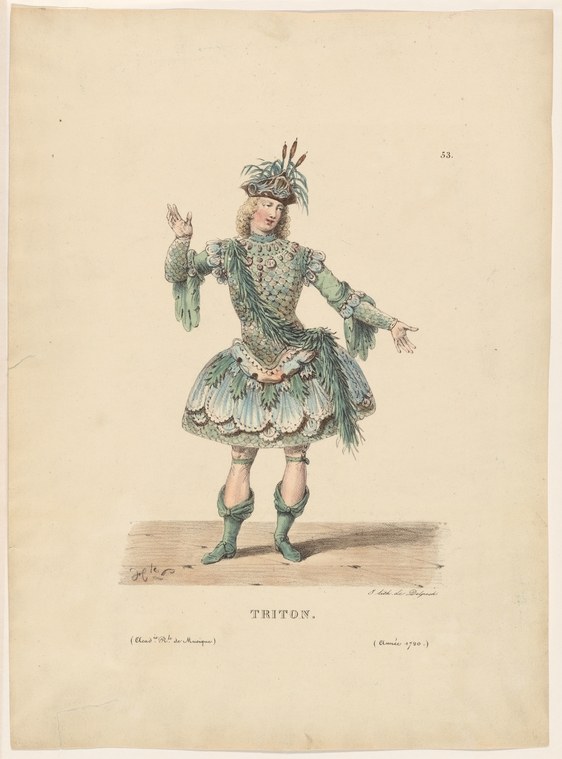
This image preserves a record of how male court dancers presented themselves in the early modern period—the pose, the costume logic, the relation between dancer and role. For historians of dance, it documents a moment when male performers in European court ballet were central to entertainment and when mythological character was expressed through costume and formal bearing rather than through narrative action. The work also shows how print culture made theatrical performance knowable and discussable beyond the event itself.
What you are looking at
A single male dancer in theatrical costume stands centered on a bare stage, rendered in hand-colored engraving. He wears an elaborate green silk doublet densely patterned with gold embroidery or jeweled ornament, paired with a striking white tulle skirt that extends to mid-thigh in a series of scalloped, layered tiers. Green silk stockings and shoes complete the lower half. His upper body is adorned with flowing green silk scarves or ribbons that drape from the shoulders and wrists. He wears a feathered headdress—a tall plume or crown of mixed feathers—and his face is painted or masked. His pose is theatrical and open: weight appears evenly distributed, left arm raised at shoulder height with hand extended, right arm extended downward and outward, the body turned slightly to one side in a three-quarter view. The figure occupies most of the composition against a neutral background. Below the image, the title "TRITON" appears in capital letters, with printed notes in French indicating the character's theatrical attribution.
The dancing
The single dancer displays a confident, open frame typical of theatrical male performance. Both arms are extended away from the body in an attitude of presentation or address to an audience; the raised left arm and lower right arm create a dynamic asymmetry. The posture is upright and controlled, with no visible strain or effort—the dancer appears poised and formal rather than in active motion. The weight settles evenly on both feet, suggesting a held position rather than the middle of a step or turn. The green silk scarves draping from shoulders and wrists add movement and visual emphasis to the upper body.
The dance depicted
This is a character from theatrical court ballet or theatrical pantomime of the 17th or 18th century, labeled as Triton, the mythological sea god. The role was danced by male performers in the European court ballet tradition, where male dancers (often professionals or highly trained courtiers) performed mythological and allegorical characters in elaborate costume. The open, frontal pose and extended arms suggest a moment of presentation or declamation typical of court ballet, where dancers often held tableau-like positions to display their costume and bearing. The theatrical makeup or mask and the mythological character identify this as a work from the era when such roles were central to court entertainment.
How it was made
This is a hand-colored engraving, a reproductive print technique widely used in the 17th and 18th centuries to document and circulate theatrical costume designs and performance records. The engraving line is fine and controlled; the hand coloring—applied over the printed line—allows for precise rendering of the elaborate costume details: the gold patterning on the doublet, the white tulle, the green silk. This technique permitted wide distribution of performance documentation at relatively low cost, making such prints valuable records of ephemeral theatrical events. The French inscriptions and formal presentation suggest this was part of a series documenting theatrical roles and their costumes.
About this work
This engraving documents the costume and presentation of a male dancer performing the role of Triton in court ballet or court theatrical entertainment. The work belongs to a tradition of printed costume documentation that emerged in the 17th century as courts across Europe invested in elaborate theatrical spectacle. Such prints served multiple purposes: they circulated knowledge of court entertainment beyond the privileged few who could witness it in person; they preserved a record of choreographic roles and their visual conventions; and they operated as fashion and design documents in their own right, showing elite audiences the latest in theatrical costume invention. The work demonstrates how male dancers in this period were presented: as formally posed, elaborately costumed performers whose bodies and bearing were vehicles for mythological character and court authority.
How to look at it
Attend to the formal, contained quality of the pose: this is not a moment of traveling or turning, but a held presentation—the dancer faces the viewer with arms extended in a gesture of address or display. The elaborate costume, especially the white tulle skirt and feathered headdress, would have been visually striking in performance and is here rendered with meticulous hand-coloring to show its sheen and structure. The three-quarter stance and open frame were conventions for presenting a theatrical character to an audience; they allowed the full costume to be legible while suggesting the controlled, formal bearing expected of a court performer.
The artist
The artist is not recorded. The work appears to be part of a series of French theatrical costume prints, likely from the 18th century based on the engraving style and hand-coloring technique. Such prints were often produced to document court entertainments or the commedia dell'arte and professional theatrical traditions that circulated throughout Europe.
The period
This work dates from or documents the era of court ballet as it flourished in France and across European courts in the 17th and 18th centuries. During this period, male dancers held high status in court society and often performed mythological and allegorical roles in spectacles that combined music, dance, and visual design. The figure's costume reflects the opulent dress codes of these entertainments, where fabric, embroidery, and ornamentation communicated character and rank. By the 18th century, such theatrical costume prints had become a standard way of circulating knowledge of court life and fashion to a broader literate audience.
Where it lives
The work is held in the New York Public Library's collection of prints depicting dance. The printed inscription in French and the formal presentation suggest it was part of a documented series of theatrical costume engravings, likely produced to circulate and preserve records of court or professional theatrical performances.
Dance in this work
Questions about this work
What role was Triton in court entertainment?
Triton, a sea god from classical mythology, was a stock character in court ballet and theatrical spectacle. The role was typically performed by a male dancer and allowed for elaborate costume design featuring mythological attributes—here, the feathered headdress, the aquatic green and white color scheme, and the flowing scarves. Such roles existed in a repertoire of mythological and allegorical characters that court entertainments drew on to flatter patrons and display artistic invention.
What does the costume tell us about male dancers in this period?
The costume—both its elaborateness and its distance from everyday dress—indicates that male court dancers were valued as performers of character and spectacle, not primarily for acrobatic or technical skill as modern dancers might be. The fine fabrics, embroidery, and headdress were signs of the dancer's high social standing and the resources invested in his training and presentation. The open, formal pose suggests that much of the dancer's role involved holding positions that displayed the costume and communicated character through bearing and stillness as much as through movement.
Why was this image printed and colored by hand?
Hand-colored engravings were a standard way of documenting and circulating theatrical spectacles before photography. They allowed court entertainments—which were ephemeral and attended by a limited audience—to be preserved and shared. Such prints served as records for future performers, as fashion and design inspiration for a literate public, and as a way of extending the cultural prestige of a court beyond its immediate circle.
More dance artwork





