49 works in this view — arrow keys or swipe to move between them.
Dance in Art
Psyché
Unknown artist
- Collection:
- Prints depicting dance
- Source:
- New York Public Library
- Rights:
- Public domain — free to use, share and adapt.
- Recorded as:
- Public Domain
This image reveals how classical mythology was absorbed into Baroque court culture and how engraving disseminated idealized images of grace, movement, and transformation. For dancers and historians, it documents the visual vocabulary of Baroque allegory—the vocabulary in which choreographers of the period conceived of human bodies in motion.
What you are looking at
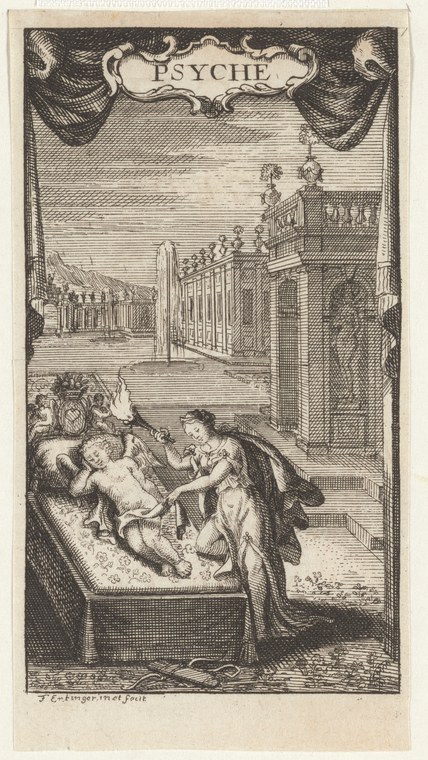
A woman in classical drapery reclines on a bed or couch in the foreground, her body turned toward the viewer in a languorous pose. A winged putto (cupid) hovers above and beside her, reaching toward her face in an intimate gesture. The setting is a grand classical interior with marble columns, a crenellated tower or fortification visible through the middle ground, and draped curtains framing the upper portion of the composition. The engraving is rendered in fine parallel lines that create a silvery, dreamlike atmosphere. The title "Psyché" appears in a decorative cartouche at the top, flanked by crescent moons.
The dancing
The woman's body is fully recumbent, weight distributed across the bed, her head tilted back slightly to receive the putto's touch. Her arm lies across her body in a gesture of yielding surrender. The putto hovers weightlessly, his small body animated and reaching downward with one arm extended, his wings spread. There is no partnered dance hold here; instead, the relationship between the two figures is one of mythological encounter and romantic entanglement rather than ballroom technique.
The dance depicted
This engraving depicts a narrative moment rather than a structured dance, though the composition and the figures' grace invoke the language of Baroque theatrical representation. The image illustrates the myth of Psyche and Cupid from Ovid's Metamorphoses: the moment of their intimate encounter. While not a dance proper, the work belongs to the visual culture of court spectacle and allegorical ballet de cour, where mythological scenes were staged as danced drama. The reclining pose and the putto's hovering weightlessness suggest the ethereal, suspended quality valued in Baroque theatrical movement.
How it was made
This is an engraving, executed in fine parallel lines (hatching) that create tone and shadow. The technique allows precise linear detail and fine gradation of light, making it ideal for the delicate rendering of drapery, flesh, and atmospheric space. The quality of the line work and the fineness of the plate suggest a professional print workshop production, likely produced for a cultivated audience familiar with classical mythology and court culture. The cartouche framing the title and the architectural setting indicate this was likely part of a larger series or emblem book on mythological or allegorical subjects.
About this work
This engraving translates classical mythology into the visual language of Baroque court spectacle. The myth of Psyche—a figure central to Renaissance and Baroque artistic imagination—appears here in a moment of private, suspended intimacy rendered through the conventions of courtly grace. Although not a dance in the strict sense, the image participates in the broader Baroque culture of allegorical ballet and spectacle, where classical narratives were staged as danced drama and where such prints served both as documentation and as inspiration for choreographers and dancers. The work exemplifies how dance and visual art intersected in the circulation of courtly ideals.
How to look at it
Attend to the precise moment the engraver chose: not a narrative climax, but a suspended instant of tenderness and vulnerability. The putto's weightless hover and the woman's yielding recline create a sense of timelessness and transcendence characteristic of Baroque court aesthetics. Note how the artist has used the architectural setting—the columns, the fortification, the drapery—to frame and elevate the mythological encounter, lifting it from the merely erotic into the realm of allegory and transformation. The fine, parallel hatching creates an atmosphere of silvery mystery, appropriate to a moment of divine or supernatural intervention.
The period
The engraving dates from the early modern period, likely 16th or 17th century, when printed mythological scenes were widely circulated in Northern Europe. This was the era of the ballet de cour in France and of allegorical spectacles throughout aristocratic courts, in which dancers performed narratives drawn from Ovid and other classical sources. Prints such as this one served multiple functions: as finished works of art for collectors, as models for choreographers and costume designers, and as instruments of cultural education for the courtly elite. The cult of Psyche was particularly intense during the Renaissance and Baroque periods, when her story was interpreted as an allegory of the soul's journey and of love's transformative power.
Where it lives
This engraving is held in the New York Public Library's collection of prints depicting dance. It is catalogued as part of a broader archive of visual representations of movement and spectacle, reflecting the library's mission to document the intersections of visual art and performance.
Dance in this work
Questions about this work
Is this a dance?
Not in the ballroom sense. This is a mythological narrative moment. However, it belongs to the world of Baroque court ballet, where such classical scenes were regularly staged as danced spectacles. The print likely served as inspiration or documentation for choreographers and dancers working in that tradition.
Who is Psyche?
Psyche is a figure from Ovid's Metamorphoses, a mortal woman beloved by Cupid (Eros). Her story was an allegory of the soul's journey and of love's trials and transformations. During the Renaissance and Baroque periods, she was a favorite subject in art, literature, and court spectacle.
What does the architectural setting signify?
The classical columns and fortification evoke an idealized, timeless realm—the space of allegory and myth rather than ordinary reality. The drapes and formal setting elevate the intimate encounter into a scene of cosmic or divine significance, as was conventional in court spectacle and allegorical art.
More dance artwork





