49 works in this view — arrow keys or swipe to move between them.
Dance in Art
Nijinsky in Spectre de la rose
Unknown artist
- Collection:
- Prints depicting dance
- Source:
- New York Public Library
- Rights:
- Public domain — free to use, share and adapt.
- Recorded as:
- Public Domain
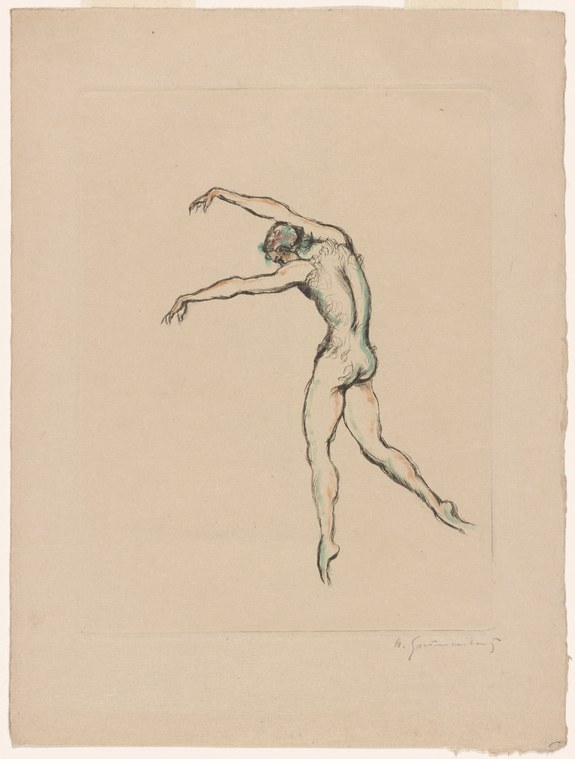
Spectre de la rose was a defining work of the Ballets Russes and Nijinsky was the dancer who made it unforgettable. This image documents one of the most celebrated moments in dance history at a moment when photography was still unable to capture the quality of movement clearly, making drawn and painted records the primary means of circulating images of great performances to a wide audience.
What you are looking at
A single male dancer is depicted in a dynamic leap or suspension, captured mid-air against a blank ground. The figure is drawn in brown ink with minimal anatomical shading, the musculature lightly indicated. His body describes an elegant arch: the torso curves backward, the right arm extended upward and slightly back, the left arm stretched forward at shoulder height with fingers splayed delicately. His head is tilted back, gaze lifted. Both legs are extended, the right leg slightly bent at the knee, the left leg stretching behind. The pose conveys weightless flight—a moment of suspension rather than a moment of takeoff or landing. A signature appears in the lower right corner of the sheet.
The dancing
A single dancer in a deliberately graceful, almost ethereal pose. The torso arches in a gentle backward bend, the arms are held in a soft, rounded frame characteristic of early ballet vocabulary, and the legs extend with pointed feet suggesting trained classical technique. The figure demonstrates the controlled, lifted quality of balletic movement, with emphasis on verticality despite the horizontal extension of the limbs. The weight appears suspended rather than grounded.
The dance depicted
The title identifies this as Nijinsky in Spectre de la rose, the famous 1911 solo choreographed by Michel Fokine for the Ballets Russes. The pose captures the characteristic moment of the Rose Spirit's iconic leap—a movement of ethereal, romantic fantasy rather than technical display. Nijinsky's interpretation of this role became legendary for its apparent defiance of gravity and its blending of acrobatic power with lyrical delicacy. The image records not narrative action but a single suspended moment of maximum beauty and illusion, the essence of what made the role transformative.
How it was made
This is a drawing, most likely a hand-colored ink sketch or watercolor on paper, executed with economical line work and delicate tonal washes. The technique favors suggestion over detail: anatomical forms are indicated rather than fully rendered, allowing the viewer to complete the image mentally. This approach suits the dance subject—the dancer's body is read through its silhouette and the direction of its lines. The relative informality of the medium, combined with the signature, suggests this was a working study or a commercial print created to circulate knowledge of a celebrated performance rather than a formal exhibition work.
About this work
This is a study of Vaslav Nijinsky in the Rose Spirit's leap from Michel Fokine's Spectre de la rose, one of the most celebrated moments in early twentieth-century ballet. The work captures not the narrative of the ballet—a young woman's dream of an idealized rose—but the technical and poetic apotheosis of that dream: a male body suspended in air, weightless, graceful, and seemingly impossible. The drawing records a moment that became iconic in dance history, when Nijinsky's physical gifts and artistic sensibility redefined what male classical dancing could express.
For a gallery of dance in art, the work is significant not as a record of costume or setting but as an attempt to arrest and communicate the quality of a singular performance. The artist understood that the power lay not in narrative detail but in the isolation of a perfect moment—the leap frozen at its apex, gravity suspended, human effort invisible.
How to look at it
Observe the arch of the body and the extension of the limbs—the artist has isolated the moment of suspension, not effort. The lifted quality of the pose and the delicate pointing of the feet signal classical training. The backward tilt of the head and the soft, rounded arm positions belong to the vocabulary of romantic ballet, a style that prized apparent effortlessness and emotional expression over technical display. The blank ground is essential: it throws the figure into relief and suggests the dreamlike, bodiless space of theatrical illusion. The economy of line invites the viewer to complete the image, making us active participants in reading the dance.
The artist
The catalogue record does not identify the artist. The signature is present but not legible in reproduction. The work likely dates from the years immediately following the ballet's Paris premiere in 1911, when demand for images of Nijinsky and the Ballets Russes was at its height. Many commercial illustrators and fine artists produced such studies during this period, some working from memory or description rather than from direct observation.
The period
This drawing was made during the height of the Ballets Russes' dominance of European avant-garde culture (1909–1929). Michel Fokine's choreography, which emphasized natural, expressive movement over academic convention, was revolutionary; Nijinsky's interpretation of the Rose Spirit became the defining image of romantic male ballet in the modern era. Simultaneously, artists across media—from commercial illustrators to fine painters—were fascinated by the possibilities of capturing dance, and drawing offered an immediacy that oil painting could not match. The informality and economy of this sketch reflect the period's hunger for fresh, contemporary images of performance.
Where it lives
The work is held in the New York Public Library's collection of prints depicting dance. It is catalogued without artist attribution, medium specification, or secure date, suggesting it entered the collection as part of a broader acquisition of dance-related ephemera or commercial prints rather than as an individually documented artwork.
Dance in this work
Questions about this work
What is Spectre de la rose?
A one-act ballet choreographed by Michel Fokine to music by Carl Maria von Weber, first performed by the Ballets Russes in Paris in 1911. The narrative is simple: a young woman dreams of being visited by the spirit of a rose she has received. Nijinsky danced the Rose Spirit, and his performance became legendary. The role demands a fusion of balletic technique with an almost supernatural lightness and grace.
Why is this pose important?
The leap shown here became the iconic image of the ballet and of Nijinsky's artistry. It was the moment of maximum illusion—when the dancer appeared to defy gravity and exist in a dreamlike realm. Contemporary accounts speak of the gasp that audience members gave when Nijinsky executed this movement, and it became the image most frequently reproduced in photographs, drawings, and prints.
Who was the artist?
The catalogue record does not identify the artist. The signature visible in the lower right corner is not legible in this reproduction. It was likely created by a commercial illustrator or fine artist working in the years immediately after the ballet's premiere, when demand for images of Nijinsky and the Ballets Russes was enormous.
Why is a drawing better than a photograph for showing dance?
Photography of the era was slow and could not freeze rapid movement clearly. Drawing allowed the artist to isolate a perfect moment and emphasize the qualities that mattered most—the line of the body, the grace of the pose, the illusion of weightlessness—without the distraction of costume detail, stage setting, or photographic accident. The sketch also conveyed something of the artistic intention behind the movement.
More dance artwork





