49 works in this view — arrow keys or swipe to move between them.
Dance in Art
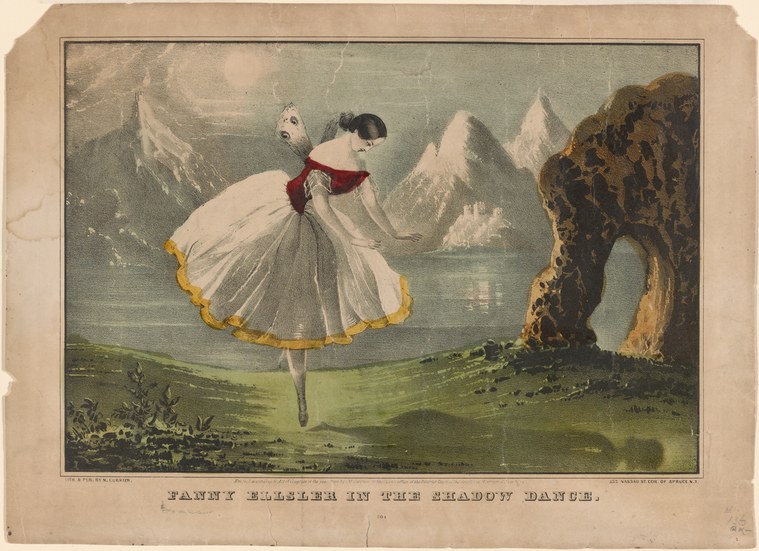
Fanny Ellsler [sic] in The shadow dance
Unknown artist
- Collection:
- Prints depicting dance
- Source:
- New York Public Library
- Rights:
- Public domain — free to use, share and adapt.
- Recorded as:
- Public Domain
This print documents Fanny Elssler at the height of her fame and illustrates how Romantic ballet imagery circulated visually and became mass commodity. It shows us what Romantic ballet looked like to its contemporary audience: not the codified technique we see in later reconstructions, but a vision of otherworldly femininity and elevation. The work is also a rare image of a major historical dancer, preserving a moment of performance culture at a crucial moment in ballet's evolution.
What you are looking at
A young female dancer in a white tulle skirt with gold trim stands en pointe in the center of a mountainous landscape. She wears a dark bodice and a crimson ribbon or sash, her arms positioned gracefully overhead as if captured mid-movement. The setting is decidedly Romantic—steep snow-capped peaks frame the background, a serene alpine lake reflects the mountains, and rocky crags border the foreground. The composition places the dancer as the sole human figure in this sublime natural world, emphasizing the otherworldly, ethereal quality of the subject. The hand-coloring is delicate: greens and browns for the earth, cool grays and whites for the mountains, pale flesh tones, and the luminous white of the skirt contrasting with darker accents.
The dancing
The dancer stands in a fully turned-out fifth position en pointe, her weight centered on the balls of her feet. Her torso is upright and elongated, her arms raised in a gentle, naturalistic overhead position rather than the strict symmetry of classical codification. Her head is tilted slightly in profile, and her gaze directed upward, creating a mood of reverie and aspiration. The pose suggests a moment of pause or transition within a longer phrase of movement, captured at a moment of balance and elegance characteristic of early nineteenth-century Romantic ballet technique.
The dance depicted
This depicts Romantic ballet, the dominant theatrical dance form of the 1830s–1840s. The title identifies the subject as Fanny Elssler, one of the two supreme ballerinas of her era (the other being Marie Taglioni); Elssler was celebrated across Europe and North America for her technical brilliance and dramatic presence. 'The Shadow Dance' likely refers to a solo or scene from her repertoire—the shadowy or silhouetted dance was a Romantic-era novelty that played on the interplay of light and figure. Elssler was known for balancing classical virtuosity with earthy, demotic movement vocabularies unusual for the ballet stage of her time, though this image emphasizes the ethereal and transcendent ideal of Romantic femininity.
How it was made
This is a hand-colored lithograph or engraving, a reproductive print technique that allowed wide circulation and affordable distribution of images of celebrated performers. The soft, painterly quality suggests lithography; the fine line work and the quality of the hand-coloring indicate commercial art production aimed at a broad middle-class and theater-going public. This type of celebrity image was mass-produced and collected; it served as both souvenir and advertisement, anchoring the fame of stage performers in the homes of admirers who might never see them perform.
About this work
Fanny Elssler in The Shadow Dance is a hand-colored print celebrating one of the greatest dancers of the Romantic era in a pose that synthesizes the period's visual ideals. The image captures the characteristic aesthetic of 1830s–1840s ballet imagery: the ballerina as ethereal, elevated, and suspended between the earthly and the transcendent, placed against sublime landscape elements. The work is both a portrait of a specific performer and a manifesto of Romantic ballet values—the pointe shoe, the tulle skirt, the upward gaze, the isolation of the female body as the sole focus of an idealized natural world.
How to look at it
Notice the artist's choice to suspend the dancer in a moment of stillness rather than motion—the raised arms and upright posture suggest equilibrium and balance rather than a dynamic leap or turn. The Romantic principle at work is the elevation of the dancer above the natural world; she does not dance *in* the landscape but *above* it, presented as a vision or apparition. Look at the hand-coloring technique: the pale, almost luminous white of the skirt is made more striking by the surrounding earth tones and grays, and the crimson accent of the ribbon draws the eye upward. The lithographic line remains visible beneath, giving the print a graphic clarity that coexists with painterly softening.
The artist
The artist is unknown, as is typical for commercial theatrical prints of this period. These images were produced by publishing houses and lithographic workshops across Europe and America as part of the celebrity culture surrounding opera and ballet. Elssler's fame was so widespread that multiple versions of her image—in different poses, costumes, and settings—were issued by competing publishers.
The period
This print dates to the height of Romantic ballet, the period (1830s–1850s) when the ethereal ballerina in white tulle became the dominant icon of theatrical dance. Marie Taglioni had premiered La Sylphide in 1832, establishing the aesthetic of the otherworldly, supernatural female dancer; Fanny Elssler rose to rival prominence in the mid-1830s. Theatrical prints and lithographs were the primary visual record of dance in this era—photography was in its infancy and not yet applied to performance documentation. These prints shaped public understanding of ballet style and were collected avidly. Elssler toured internationally and was the subject of intense fandom; her image circulated in multiple versions and contexts, from theater lobby displays to parlor albums.
Where it lives
This print is held in the NYPL's collection of dance-related prints and ephemera. It is a commercial theatrical print of the type produced and distributed internationally during the 1830s–1840s, likely issued in multiple impressions and variants by a publishing house in London, Paris, or New York.
Dance in this work
Questions about this work
Who was Fanny Elssler?
Fanny Elssler (1810–1884) was an Austrian prima ballerina of the Romantic era, famous throughout Europe and the Americas for her technical virtuosity and distinctive interpretive style. She was a rival and contemporary of Marie Taglioni. She starred in major roles in ballets including La Volière, La Tarantule, and Esmeralda, and toured extensively in the United States. She was celebrated for combining classical technique with earthy, sensual movement qualities that were considered novel and controversial for ballet.
What is 'The Shadow Dance'?
The title likely refers to a specific scene or solo in one of Elssler's ballets—such works were popular novelties in Romantic-era theater, often featuring optical effects, silhouettes, or dancing in dim light. Without a dated playbill or libretto, the exact work cannot be identified with certainty, but such scenes capitalized on the era's fascination with the supernatural and the visual drama of the ballerina's lit figure against darker backgrounds.
Why was she printed so many times?
Fanny Elssler was an international celebrity of the first magnitude. Her tours—especially her extended American tour of 1840–1842—drew enormous crowds and generated immense fan culture. Publishers capitalized on this demand by issuing multiple images of her in different roles, costumes, and poses. These prints were collected like trading cards or posters today, sold at theaters, through bookshops, and by subscription.
How do we know this is Fanny Elssler?
The title is printed directly on the image: 'FANNY ELLSLER [sic] IN THE SHADOW DANCE.' The misspelling of her name (Ellsler instead of Elssler) is common in period prints and suggests this is a contemporary commercial publication rather a later reproduction.
More dance artwork





