49 works in this view — arrow keys or swipe to move between them.
Dance in Art
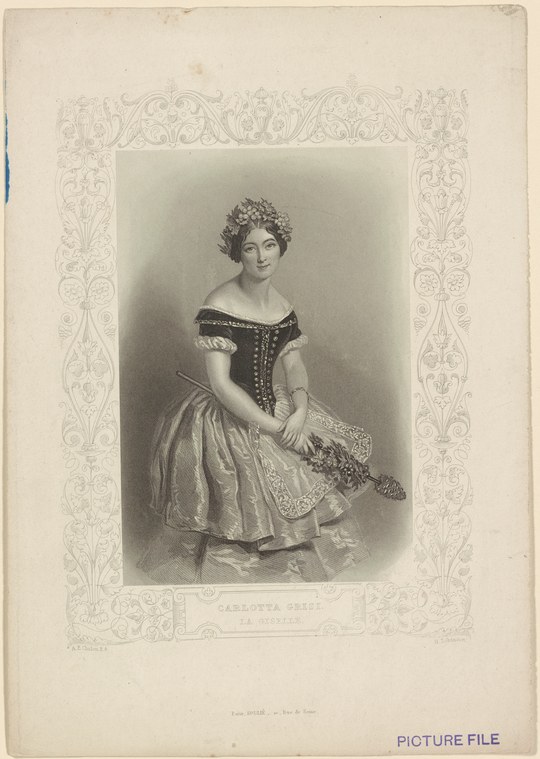
Carlotta Grisi. La Giselle
Unknown artist
- Collection:
- Prints depicting dance
- Source:
- New York Public Library
- Rights:
- Public domain — free to use, share and adapt.
- Recorded as:
- Public Domain
Carlotta Grisi's *Giselle* (1841) is one of only two surviving ballets from the Romantic era—the historical period that defined what we now call classical ballet. This portrait documents the precise visual conventions—costume, posture, hair, aesthetic—that shaped how Romantic femininity was understood through dance. For anyone studying nineteenth-century theatre, dance, or visual culture, the image is a primary document of how a female performer and her role became inseparable from an image of the ideal female body.
What you are looking at
A three-quarter-length portrait of a young woman in Romantic-era costume, presented against a soft, graduated background within an ornamental decorative border. She wears a dark corseted bodice with off-shoulder sleeves and a pale, voluminous skirt gathered at the waist—the silhouette characteristic of 1840s ballet costume. Her dark hair is arranged in ringlets atop her head. She holds a bouquet of flowers in one hand and gazes toward the viewer with a composed, dignified expression. The figure is centered and formally posed, her weight appearing to rest evenly; this is a portrait of a dancer in her stage costume rather than a depiction of movement or narrative action.
The dancing
The single figure stands upright in a neutral stance, shoulders back, arms relaxed at her sides except for the raised hand holding flowers. There is no indication of balletic position or port de bras; the posture is that of a studio or portrait sitting rather than a moment frozen mid-choreography. The costume and direct gaze suggest a portrait meant to commemorate the dancer herself and her association with a particular role.
The dance depicted
This is a portrait of Carlotta Grisi, an Italian-Swedish dancer who became famous across Europe in the 1840s for her role in *Giselle* (1841), one of the foundational works of Romantic ballet. The title identifies her with *La Giselle*, the character that made her internationally celebrated. The pale tutu, off-shoulder bodice, and ringletted hair are the costume conventions of Romantic ballet as it had crystallized by the early 1840s—a style emphasizing ethereal, sylph-like femininity. Grisi was known for her technical virtuosity and her dramatic intensity; this engraved portrait does not show us her dancing, but rather presents her as a star and an icon of the role.
How it was made
This is a steel or copper engraving, a print medium that allowed mass distribution and was the standard way theatrical portraits circulated in the mid-nineteenth century. The delicate stippling and cross-hatching create tonal gradation, particularly in the face and the folds of the skirt. The ornate decorative border—executed in fine, repetitive linework—is typical of printed theatrical portraiture of the 1840s–1850s and signals that this is a commercial print made for circulation among theatre-goers and collectors, not a unique artwork. The print format meant that Grisi's image as Giselle could be widely owned and kept as a souvenir.
About this work
This is a commercial engraved portrait of Carlotta Grisi in her most famous role, Giselle, the titular character of the 1841 Romantic ballet that remains central to classical ballet repertoire. The image records not a moment of dancing but the visual identity of a star performer and the costume that defined the Romantic ballet aesthetic—the pale tutu, the off-shoulder corseted bodice, the ethereal silhouette. As a steel engraving in ornamental mounting, it is a product of the nineteenth-century theatre-portrait industry, designed to be collected, displayed, and circulated among audiences of the period.
For historians of dance, the image documents the material reality of Romantic ballet costume and the centrality of the female dancer as a visual spectacle. For art historians, it shows how theatrical fame was manufactured and circulated in the mid-nineteenth century through the marriage of engraving technique and celebrity portraiture. Grisi herself was a crucial figure in establishing the Romantic ballet as the dominant theatrical dance form of her era, and this portrait is one of the many images through which her celebrity was sustained.
How to look at it
Attend to the costume as historical evidence: the off-shoulder bodice, the pale voluminous skirt, the arrangement of the hair are all markers of Romantic ballet aesthetic and the 1840s moment. The formal, symmetrical pose and the decorative border show that this is not a candid moment but a carefully constructed celebrity image, designed to be framed and kept. The artist has chosen to present Grisi as a dignified figure rather than as a dancing body in motion—a choice that emphasizes her status as a celebrated performer and the iconic nature of her role.
The artist
The catalogue record does not identify the engraver, which was common practice for reproductive prints of this kind. The work was made from a painting or original design (also not identified in the record) and circulated as a mass-produced theatrical portrait—a standard commercial product of the mid-nineteenth-century print trade. The style and execution are consistent with the output of London and Paris print publishers who specialized in theatre portraiture during the 1840s–1850s.
The period
Carlotta Grisi danced *Giselle* at the Paris Opéra in 1841, created for her by choreographers Jean Coralli and Jules Perrot with music by Adolphe Adam. The 1840s were the height of the Romantic ballet era, when ethereal, otherworldly female characters—sylphs, ghosts, spirits—dominated the stage and when the pale silk tutu became the defining silhouette of theatrical femininity. This was also the moment when theatre portraiture became a mass commodity: photographers and engravers produced and sold thousands of prints of celebrated performers, allowing audiences to own images of their favorite stars. The ornamental border and engraved medium place this work squarely in that commercial culture of theatrical celebrity.
Where it lives
The work is held in the New York Public Library's collection of prints depicting dance, part of their broader performing arts archives. It is a commercial theatrical portrait, one of thousands produced in the nineteenth century as souvenirs and collectibles for theatre audiences.
Dance in this work
Questions about this work
Who was Carlotta Grisi?
Carlotta Grisi (1819–1899) was an Italian-Swedish dancer who became one of the most celebrated performers of the Romantic ballet era. She is best known for creating the title role of *Giselle* in 1841, which became the defining role of her career and one of the cornerstone works of classical ballet. She was known for both her technical virtuosity and her dramatic intensity, and she performed across Europe to great acclaim.
What is this image showing?
This is a portrait of Carlotta Grisi in the costume of Giselle, the heroine of the 1841 ballet. It does not show her dancing but rather presents her as a star performer in her most famous role. It is an engraved print, a common form of theatrical souvenir in the nineteenth century, designed to be collected and displayed by theatre audiences.
What does the Romantic tutu look like and why did it matter?
The Romantic tutu, visible in this portrait, is a pale, full, knee-length skirt made of layers of tulle or silk, worn with a tightly corseted bodice and off-shoulder sleeves. It was designed to create an ethereal, weightless silhouette that emphasized the idealized female body of Romantic aesthetics. The costume became synonymous with the supernatural female characters central to Romantic ballet—sylphs, spirits, and ghosts.
Is Giselle still danced today?
*Giselle* is one of only two surviving ballets from the Romantic era and remains a cornerstone of classical ballet repertoire worldwide. It is regularly performed by major ballet companies and is considered an essential work for understanding the history and technique of ballet. The role of Giselle is one of the most demanding and celebrated in all of classical ballet.
More dance artwork





