49 works in this view — arrow keys or swipe to move between them.
Dance in Art · 2023
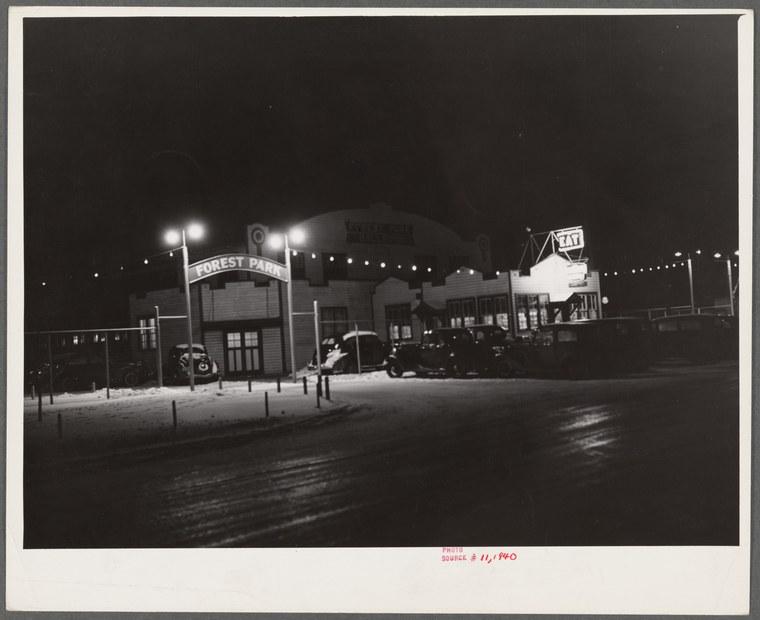
Dance hall, Saturday night. Marshalltown, Iowa
Unknown artist
- Source:
- New York Public Library
- Rights:
- Public domain — free to use, share and adapt.
- Recorded as:
- public_domain
Dance hall venues were crucial sites for the development and transmission of American social dancing, yet they are rarely preserved in visual documentation. This photograph is rare evidence of the architectural and social context in which ordinary Americans encountered and learned to dance. For historians of vernacular dance and rural American culture, the venue itself is the subject.
What you are looking at
This is a night-time photograph of a dance hall in Marshalltown, Iowa, shot from outside looking in. The building is a modest, single-story structure with a simple Art Deco or early modernist façade, brightly lit by strings of white bulbs and two strong spotlights mounted above the entrance. The lit windows reveal interior activity—silhouettes of figures visible inside suggest the venue is in use. A few parked automobiles sit in front, dating the photograph to the early-to-mid twentieth century based on their styling. The wet ground and patches of snow suggest the photo was taken in winter. The modest scale and rural setting, combined with the bright decorative lighting, typify the small-town American entertainment venues of the 1930s–1940s era.
The dancing
Silhouettes visible through the windows suggest multiple figures inside the building, but the photograph's distance and exterior vantage point prevent detailed observation of body position, hold, or footwork. No specific dance posture or frame can be discerned from outside the lit structure.
The dance depicted
This is a documentation of a social dance venue rather than a depiction of a specific dance style or technique. The "dance hall" was a standard feature of rural and small-town American culture in the early twentieth century, hosting social dances—likely including swing, foxtrot, waltz, or regional variations of country and ballroom social dancing. The name 'Saturday night' in the title signals the weekly social function these halls served. Without access to the interior, the specific style of dance cannot be identified, but the venue type itself is historically significant as the setting for vernacular social dancing in America.
How it was made
This is a black-and-white photograph, likely taken with available light and artificial illumination from the venue itself. The technique is documentary or journalistic photography, possibly part of a systematic record of American working-class life and entertainment venues. The exterior night shot required fast film and exposure technique suited to low-light conditions. The quality and style suggest professional or semi-professional photography from the 1930s–1940s era.
About this work
This photograph documents the exterior of a small-town American dance hall at night, capturing the physical setting where rural and working-class social dancing took place. The bright decorative lighting and modest architecture are consistent with the dance halls that served as primary entertainment venues in communities too small to support theaters or large clubs. Such venues were central to twentieth-century American social dance culture, hosting the swing, foxtrot, waltz, and regional country dances that defined popular movement in the era. The photograph is valuable not for depicting a specific dance technique but for recording the infrastructure and social function of vernacular American dance.
How to look at it
Attend to the decorative lighting strategy—the bright bulbs and spotlights signal a modest investment in making the venue attractive and welcoming, consistent with the social function of dance halls as festive spaces. The parked automobiles indicate the draw of the venue across a local region. The wet ground and winter setting note that social dancing was a year-round activity, not seasonal. The photograph's exterior vantage point preserves the building as a social landmark rather than focusing on the dance itself.
The period
In the 1930s and 1940s, dance halls were ubiquitous in American towns and cities. They served as the primary social space for courtship, community gathering, and leisure among working and rural populations. The weekly 'Saturday night' dance was a standard feature of small-town social life. These venues hosted live bands and featured the ballroom and swing dances that dominated popular culture. Documentary photographers of the era, often associated with projects like the Farm Security Administration, recorded American life in comprehensive detail, including entertainment and leisure spaces.
Where it lives
The photograph is held in the New York Public Library collections, which maintain extensive photographic documentation of American life, including vernacular architecture and social venues.
Questions about this work
What dances would have been performed in a hall like this?
Rural and small-town dance halls in the 1930s–1940s hosted social ballroom and swing dances, including the foxtrot, waltz, lindy hop, jitterbug, and regional variations of country and folk dances. The specific styles varied by region and the preferences of the resident band.
Why is the venue photographed from outside?
The exterior shot emphasizes the dance hall as a community landmark and social institution, rather than privileging the dance itself. Documentary photographers often recorded buildings and venues as markers of how people lived and socialized.
How do we know this is from the era indicated?
The automobile styles, building architecture, lighting technology, and photographic technique all place the image in the 1930s–1940s. The title references Marshalltown, Iowa, and the NYPL records confirm the location and era.
More dance artwork