49 works in this view — arrow keys or swipe to move between them.
Dance in Art
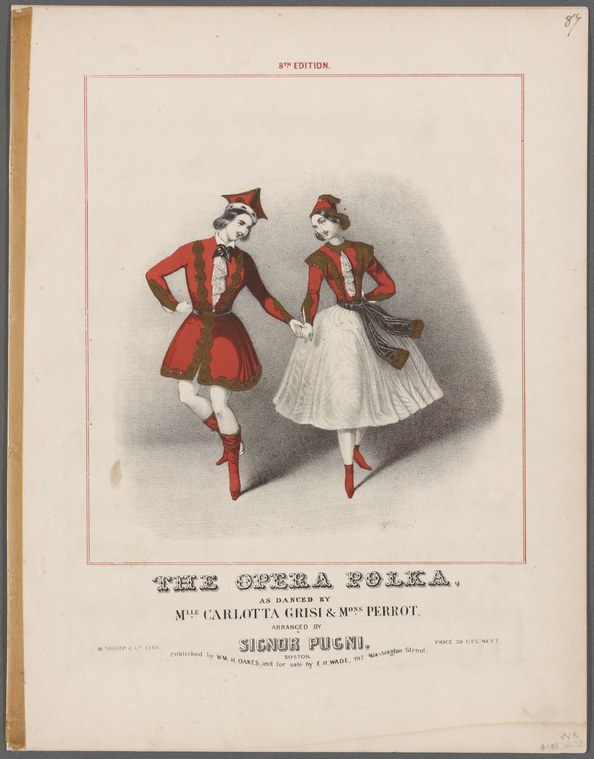
The opera polka, as danced by Mlle Carlotta Grisi & Mons. Perrot.: Arranged by Signor Pugni. 8th edition
Unknown artist
- Collection:
- Prints depicting dance
- Source:
- New York Public Library
- Rights:
- Public domain — free to use, share and adapt.
- Recorded as:
- Public Domain
The polka represents a rare moment when a folk dance moved rapidly into ballroom culture and then onto the theatrical stage, carried by its irresistible vitality and the star power of dancers like Grisi. For dance historians, this print is evidence of how nineteenth-century stage performance worked: choreography was collaborative, credited to composers and arrangers, and successful numbers were circulated widely in print so audiences could own and discuss them. For anyone studying the polka's history, seeing how two trained ballet dancers performed the step reveals the boundary between social and theatrical forms—and how performers calibrated elevation, precision, and control while preserving the dance's essential bouncing energy.
What you are looking at
Two female dancers in mid-performance occupy the center of the composition, posed against a neutral background rendered in soft gray tones typical of mid-nineteenth-century theatrical prints. Both wear red jackets with contrasting trim and white skirts, their costumes elegant and coordinated. The dancer on the left stands with weight on one leg, arm bent at the elbow in a lively gesture, her body angled slightly in profile; the figure on the right mirrors this energy, leaning forward with an extended arm and raised skirt that catches the light. Their poses are vivid and dynamic—neither is in repose—suggesting a moment of quick, spirited movement rather than a formal tableau. The print's title identifies this as "The Opera Polka, as danced by Mlle Carlotta Grisi & Mons. Perrot," and the 8th edition notation indicates this was a popular image of a celebrated performance, circulated widely and reprinted multiple times.
The dancing
Both dancers are shown in energetic, forward-leaning positions with bent knees and raised heels, characteristic of the polka's bouncing, springing movement. The dancer on the left extends her right arm forward while her left arm bends inward, while the dancer on the right mirrors this with her arms in the opposite position, creating visual balance. Their skirts are rendered mid-swirl, lifted to show the leg action beneath, and both dancers appear to be captured at the moment just after a hop or spring—the core of polka technique. The postures show a clear understanding of the dance's vigorous, upright frame and the quick ascending and descending action of the step.
The dance depicted
This is a representation of the "Opera Polka," a theatrical adaptation of the social ballroom polka that became wildly fashionable in the 1840s. Carlotta Grisi was one of the era's most celebrated Romantic ballet dancers, and the presence of both her name and that of Jules Perrot (a renowned male dancer and choreographer of the period) suggests this was a popular duet or featured number. The polka had entered the European stage from ballroom culture and was frequently incorporated into ballet and theatrical performances. The 8th edition status indicates enormous demand for this image—audiences wanted to remember and discuss the performance, and prints like this were primary means of circulating knowledge of celebrated dancers and choreography before photography.
How it was made
This is a hand-colored lithograph, evident from the soft tonal modeling in the background, the fluid contours of the figures, and the delicate chromatic rendering of the costumes and flesh tones. Lithography allowed for rich color and tonal subtlety at lower cost than hand-painted work, making it the ideal medium for theatrical prints aimed at a broad middle-class audience. The title and publication information at the base identify the arrangers and printers: "Signor Pugni" as arranger (Luigi Pugni was a major ballet composer of the era) and publisher information for London. The edition number suggests this was reprinted and revised multiple times, pointing to steady commercial success and continued demand for images of this celebrated performance.
About this work
This is a theatrical dance print documenting a mid-nineteenth-century stage performance of the polka by two of the era's most celebrated dancers. The polka itself was a phenomenon of the 1840s—a vigorous social dance from Bohemia that captivated Europe and was rapidly incorporated into ballroom culture, social events, and stage performances. Grisi and Perrot were stars of Romantic ballet, and their decision to perform a polka speaks to the dance's prestige and mainstream appeal even among elite theatrical performers. The print's multiple editions attest to its popularity; audiences wanted visual records of celebrated performances and dancers. This image documents not just a dance, but a cultural moment when a folk form became international fashion and when theatrical dance began to absorb and elevate popular social dances.
How to look at it
Watch the legs and feet in these poses: the dancers are shown with weight on the balls of the feet, knees bent and ready to spring, which is exactly the mechanism of the polka's basic step. The artist has captured the moment of maximum lift and extension—just at the peak of the hop—which conveys the dance's characteristic buoyancy. Notice how both dancers lean slightly forward from the ankles, not the waist; this forward inclination is essential to the polka's frame and distinguishes it from the more upright carriage of ballet. The raised skirts expose enough of the leg to show the action beneath; this was a convention of theatrical dance prints—showing enough to communicate the movement while maintaining decorum. The matching costumes and mirrored poses suggest this was a duet for two dancers of roughly equal prominence, a format typical of era's theatrical performance.
The period
The 1840s were a moment of extraordinary ferment in European dance. Romantic ballet—with its emphasis on the female dancer, ethereal costuming, and pointe work—was at its height, with Carlotta Grisi among its leading stars. Simultaneously, the polka had exploded from a Bohemian folk dance into an international craze: it appeared in ballrooms, drawing rooms, and streets across Europe and America. The polka's energy and relative accessibility made it democratic by the standards of the era; unlike the quadrille or cotillion, it required less formal instruction and could be danced by people of varying skill. That major ballet dancers performed it on stage, and that prints of these performances sold in large quantities, shows how permeable the boundaries between social and theatrical dance were. This was also the era when lithography had made theatrical prints affordable and collectible for the middle class, creating a new form of celebrity culture around dancers.
Where it lives
This lithograph is held in the New York Public Library's collection of prints depicting dance. It is labeled as an 8th edition, indicating it was reprinted multiple times, and the publication information shows it was produced in London by a commercial theatrical print publisher, making it a mass-market item rather than a unique work.
Dance in this work
Questions about this work
Who were Carlotta Grisi and Jules Perrot?
Carlotta Grisi (1819–1899) was an Italian ballet dancer and one of the leading stars of Romantic ballet in the mid-nineteenth century. Jules Perrot (1810–1894) was a celebrated French male dancer, choreographer, and ballet master who collaborated with Grisi in numerous productions. Both were prominent in London's theatrical world in the 1840s, when this print was made. Their presence in a polka performance reflects how prestigious stage dancers were willing to perform fashionable social dances as featured numbers.
What is the polka and where did it come from?
The polka is a spirited couple dance in 2/4 time that originated in Bohemia (now the Czech Republic) in the 1830s. It spread rapidly across Europe and became an international phenomenon in the 1840s–1850s, performing in both ballrooms and on stage. Unlike formal court dances, the polka was energetic, fun, and relatively easy to learn, which partly explains its popularity. The basic step involves a hop on one foot followed by three quick steps, creating a bouncing, forward-moving action.
Why would a ballet dancer perform a polka?
By the 1840s, the polka was fashionable enough that theatrical dancers incorporated it into performances as a novelty or specialty number. For audiences, seeing celebrated ballet stars perform a popular social dance was entertaining and gave the polka cultural prestige. For dancers, it allowed them to showcase a different, more energetic and earthy style of movement than the ethereal, otherworldly aesthetic of Romantic ballet. This print documents that cultural moment.
What does the edition number mean?
The "8th edition" indicates this print was reprinted at least eight times. Successful theatrical prints were issued and reissued to meet ongoing demand from audiences who wanted to own images of celebrated performances and dancers. Multiple editions mean the performance was popular and the print commercially successful—it circulated widely and was affordable enough that middle-class consumers bought copies.
More dance artwork





