49 works in this view — arrow keys or swipe to move between them.
Dance in Art
Rosita Mauri
Unknown artist
- Collection:
- Prints depicting dance
- Source:
- New York Public Library
- Rights:
- Public domain — free to use, share and adapt.
- Recorded as:
- Public Domain
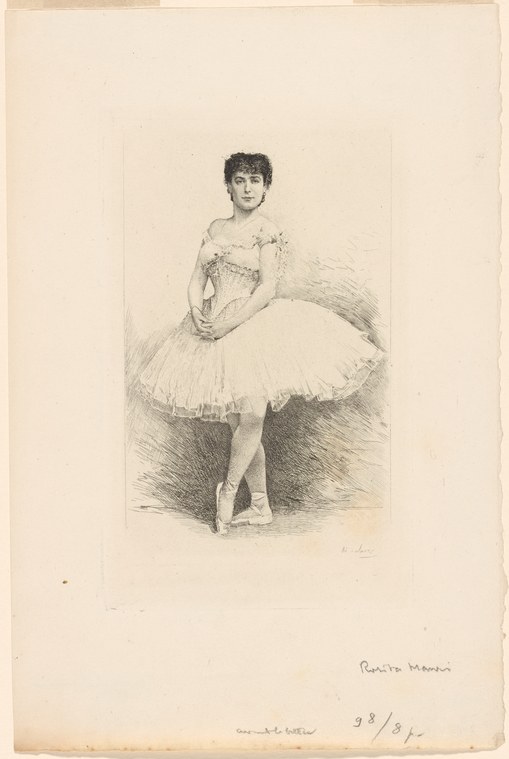
Rosita Mauri was a major international prima ballerina of the late nineteenth century, and this portrait preserves a record of how she presented herself and was presented to the public. The image documents not only her appearance but the material reality of romantic ballet costume and the conventions of how dancers were represented in printed media—as idealized, posed figures rather than candid movement studies.
What you are looking at
A young female dancer in a tutu is shown in a three-quarter pose against a lightly sketched background. She stands in a classical ballet position, her body held with the upright carriage and turned-out legs characteristic of academic ballet. The dancer wears a fitted bodice with short sleeves and a full, layered skirt that falls to knee-length—a romantic tutu typical of mid-to-late nineteenth-century ballet costume. Her dark hair is arranged in a style fashionable for the period. The artist has rendered her face with particular attention, giving her a direct, frontal gaze despite the angled body position. The background is minimally developed, with loose hatching that suggests drapery or stage architecture without defining it precisely. The overall effect is of a studio study or preparatory work, concentrating attention entirely on the dancer's figure and bearing.
The dancing
The dancer stands in a classical ballet fourth or fifth position, with one leg supporting and the other extended or prepared. Her arms are held in a soft, classical frame—one raised, the other lower—in a position that suggests a moment within a formal enchainement rather than a static pose. The turnout is evident in the leg position and the set of the hips. Her posture is elongated and refined, with the weight carried high and centered. The artist demonstrates understanding of ballet's vertical line and the proportional relationship between the body and the voluminous skirt.
The dance depicted
This is a portrait study of a ballet dancer, almost certainly a professional performer of the Romantic era, rendered in the style of a theatrical or celebrity print. The costume, technique, and presentation all confirm classical ballet of the nineteenth century—specifically the period when the romantic tutu and pointe work had become standard. The dancer's name appears to be recorded in the inscription, suggesting this was a commissioned or published portrait of a known performer. The pose is not mid-movement but rather a composed theatrical attitude intended to display both the dancer's elegance and the distinctive silhouette of romantic ballet costume.
How it was made
This is an etching or engraving, rendered in black ink on paper, most likely a print made for circulation as a theatrical portrait or souvenir. The technique is linear and controlled, with fine parallel hatching used to model the figure and suggest depth in the background. The artist's signature is visible in the lower margin. The relative simplicity and clarity of the line work, combined with the printed paper support, suggests this was made for public distribution—likely sold as a portrait print to theatre patrons or as part of a series of celebrity dancers. Etching and engraving were the standard media for theatrical portraiture of this period, allowing for multiple impressions and wide circulation.
About this work
This is a nineteenth-century portrait print of a ballet dancer identified in the inscription as Rosita Mauri. It exemplifies the theatrical celebrity culture that surrounded professional ballet in the Romantic era, when individual dancers—particularly women—became public figures and their likenesses were reproduced and sold. The work combines documentary evidence (the precise rendering of costume and technique) with the conventions of idealizing portraiture, presenting the dancer in a composed, flattering attitude rather than candid motion. As a printed image, it represents both the artist's engagement with dance as a subject and the period's appetite for images of celebrated performers.
How to look at it
Observe the dancer's posture and the clarity with which the artist has rendered the turned-out leg position and the upright carriage of the torso—these are precise records of ballet technique. Notice the contrast between the carefully finished face and the more sketchy background; the artist's priority was the dancer's likeness and presence rather than theatrical context. The tutu itself is rendered with attention to its structure—the layers of the skirt and the way it sits on the hips—which tells us about both costume construction and the dancer's body shape. The composition is deliberately formal: facing the viewer while angled slightly away, the dancer presents herself as both accessible and untouchable, a convention of theatrical portraiture.
The artist
The artist's name is inscribed on the print but is not recorded in the catalogue. The signature style and technique are consistent with professional theatrical portraiture of the 1870s–1890s. The level of finish and the publisher's marks (if any) would help establish whether this was a major theatrical print house production or a smaller studio work.
The period
This print was made during the height of the Romantic ballet tradition, when the tutu, pointe work, and the cult of the prima ballerina were fully established. The late nineteenth century saw the rise of international ballet touring and the reproduction of dancers' portraits as commodities. In Paris, London, and other major cities, theatrical portrait prints were enormously popular and formed an important part of the economics of theatrical promotion. This image participates in that culture while also documenting the technical and aesthetic standards of academic ballet at the period.
Where it lives
This work is held in the New York Public Library's collection of prints depicting dance. It is part of a larger body of nineteenth-century theatrical portraiture documenting performers and performance styles of the era.
Dance in this work
Questions about this work
Who was Rosita Mauri?
Rosita Mauri was a prominent ballet dancer of Italian descent who had a major international career in the late nineteenth century. She performed in major European cities and was known for her technique and stage presence during the height of the Romantic ballet tradition. She was one of the celebrated prima ballerinas of her era, and her image was widely circulated in portrait form.
What is a romantic tutu?
The romantic tutu is a knee-length, bell-shaped skirt made of many layers of gauze or tulle, fitted at the waist and sewn to a corset bodice. It emerged in the 1830s and became the standard costume for classical ballet. Unlike the short tutus of later periods, the romantic tutu created a ethereal, elongated line and was designed to enhance the illusion of weightlessness and the supernatural qualities valued in romantic ballet.
Why were theatrical portraits printed and sold?
In the nineteenth century, theatrical portraits were commodities sold to the public much as celebrity photographs are today. Audiences wanted images of famous dancers to keep as souvenirs or to collect. Prints were relatively affordable and could be mass-produced via engraving or etching, making them accessible to theatre patrons and the wider public. Dancers' images were also promotional—circulated to build reputation and draw audiences to performances.
What does the pose tell us about the dance?
The pose is not a moment of action but a composed attitude—a classical ballet position presented as a formal portrait. It demonstrates the turned-out legs, elongated carriage, and geometric clarity that are fundamental to academic ballet technique. The pose was conventional for theatrical portraiture and allowed the artist to display both the dancer's body and the distinctive silhouette of romantic ballet costume.
More dance artwork





