49 works in this view — arrow keys or swipe to move between them.
Dance in Art
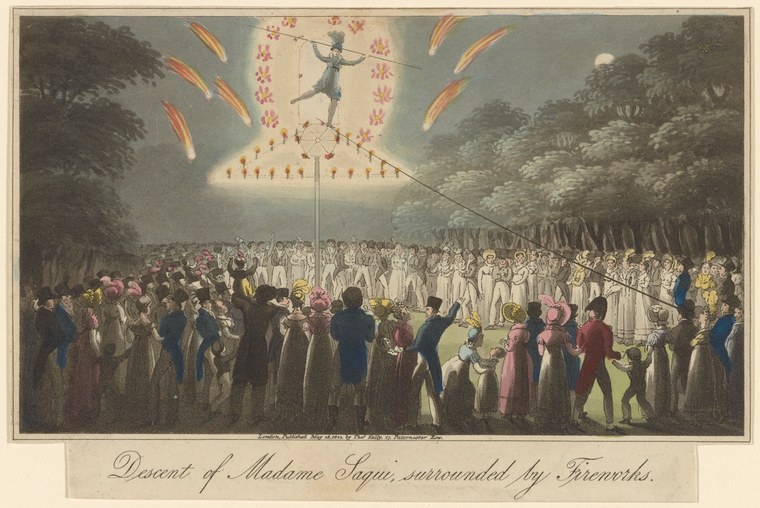
Descent of Madame Saqui, surrounded by fireworks
Unknown artist
- Collection:
- Prints depicting dance
- Source:
- New York Public Library
- Rights:
- Public domain — free to use, share and adapt.
- Recorded as:
- Public Domain
Madame Saqui (c. 1786–1866) was one of the first European women to achieve independent international fame as a performer based on acrobatic and aerial skill, and her image was reproduced more widely and more often than almost any other female entertainer of her era. This print is evidence of how women performers in the early 19th century navigated the category of 'dance'—not as trained social dancers or ballet artists, but as acrobats and rope-workers whose bodies performed feats of strength, flexibility, and courage that challenged contemporary assumptions about female physicality. Understanding Saqui's career and circulation through prints like this one is essential to writing a history of women in performance and in dance that includes bodies and disciplines outside the ballet canon.
What you are looking at
A nighttime gathering in a wooded clearing, densely populated with spectators in 19th-century dress arranged in a broad semicircle around a central performance pole. At the apex of the composition, a solo female figure appears suspended or elevated against a luminous backdrop, her body arched in a dramatic pose with one leg extended. The sky above glows with supernatural light and is filled with streaking meteors or fireworks in gold and orange, along with red starburst shapes that frame the ascending performer. The crowd below is rendered in muted tones—browns, dark blues, reds, pinks—their heads and upper bodies visible as they face the spectacle. Trees frame both sides of the clearing, their silhouettes dark against the luminous center. A full moon or additional light source appears in the upper right. The overall effect is of a public spectacle or celestial event, with the isolated figure at the center commanding all attention.
The dancing
The central figure is in a strong vertical lift or suspension, arched backward with arms extended upward and one leg raised diagonally—a dramatic, acrobatic pose that dominates the composition. The spectating crowd forms a passive surround, their bodies upright and stationary, their gaze directed toward the performer. No closed holds or partnered movement is visible. The isolated positioning and elevated placement of the dancer against a luminous field creates a clear visual hierarchy in which the solo performer is the subject and the crowd the audience.
The dance depicted
This print depicts Madame Saqui, a celebrated ropedancer and acrobat of the early 19th century, performing her signature feat of ascending an inclined rope or wire while executing dramatic contortions and aerial poses. Saqui was famous throughout Europe for her performances on the tightrope and inclined rope, often set within spectacular theatrical productions involving fireworks, music, and large public crowds. The arched body position and suspended elevation are consistent with the acrobatic, flexibility-based movement vocabulary of rope and wire dancing of the period. This is theatrical acrobatic performance rather than social dance, and the fireworks framing the figure emphasize the spectacular, entertainment-focused context.
How it was made
This is a hand-colored engraving or aquatint, identifiable by the fine line work defining figures and landscape, the uniform plate tone, and the application of color in discrete zones—yellows, reds, and pinks in the sky; muted earth tones in the crowd and foliage. The technique allowed for mass production and wide distribution of images of popular entertainers and public spectacles, making Saqui's fame accessible to viewers across Europe who could not attend her performances in person. The hand-coloring, likely applied after printing, indicates this was a commercial popular print of some quality.
About this work
This print documents one of the most celebrated and widely imitated acrobatic performers of the early 19th century, Madame Saqui, at the moment of her most famous feat: the ascent of an inclined rope under dramatic lighting and before a large public audience. Saqui's performances bridged acrobatics, dance, and theater, and her image became iconic across Europe. The work is both a record of a specific performer's repertoire and an artifact of the period's appetite for public spectacle and the emerging celebrity culture of entertainment. Within a gallery of dance in art, it represents the historical boundary between theatrical dance, acrobatics, and the male-dominated world of physical exhibition—a boundary that Saqui herself transgressed, establishing a solo career as a female performer of extraordinary skill and visibility.
How to look at it
The artist has chosen the moment of maximum elevation and maximum arch—the climax of the ascent, when the performer's body is most dramatically contorted and most fully suspended above the crowd. The viewer's eye is drawn upward by the converging lines of the spectators' heads and the composition's vertical axis, arriving at the luminous figure at the apex. The surrounding pyrotechnics—meteors, starbursts—are not incidental ornament but part of the spectacle's meaning: they situate the performer within a frame of light and wonder, suggesting that her feat transcends the merely athletic and enters the realm of the magical or the divine. The frozen moment captures what would have been a continuous, sustained movement in the live performance.
The artist
The artist is not recorded. The print was produced commercially and circulated widely; such spectacle prints were a staple of early 19th-century popular publishing in France and England, often unsigned or credited only to the engraver or publisher rather than the designer. The anonymous production and wide circulation is itself typical of the popular print market.
The period
In the early 19th century, rope-dancing and acrobatic performance were among the most popular forms of public entertainment in Europe, often competing with ballet and pantomime for audience attention and resources. The Romantic era's fascination with the spectacular, the supernatural, and the limits of the human body found expression in circus arts and acrobatic theater as much as in ballet d'action. Saqui's career coincided with the Napoleonic Wars and the post-war period, and her performances were often framed within nationalist and patriotic spectacles. The print medium—hand-colored engravings and aquatints—was the dominant vehicle for the reproduction and promotion of images of popular entertainers before photography, and these prints were the most common way that ordinary people encountered images of famous performers.
Where it lives
This work is held in the New York Public Library's Prints collection, a repository of popular prints, theatrical images, and graphic ephemera. It is one of many hand-colored engravings depicting Saqui's performances, which were produced and sold across Europe during and after her active career. The proliferation of such images attests to her celebrity and to the commercial value of her image.
Dance in this work
Questions about this work
Was Madame Saqui a dancer or an acrobat?
Both categories are modern and historically fuzzy. Saqui trained in rope-dancing and acrobatics and performed in theatrical spectacles that combined music, dance, and aerial feats. She would have been called a 'ropedancer' or 'acrobat' in her own time, but the boundary between acrobatics and dance in the early 19th century was fluid, especially in theatrical contexts. What matters is that she was a celebrated solo performer known for extraordinary physical skill and control.
How common was it for women to perform as acrobats or rope-dancers?
It was not common, and Saqui was unusually famous and successful. Women acrobats and rope-dancers did exist, but they were far fewer in number than male performers and usually worked within family-based circus troupes. Saqui's achievement was to establish herself as an independent, celebrated solo performer with her own production, which gave her unusual control over her career and her image.
What is the purpose of the fireworks in this image?
The fireworks are part of the spectacle itself, not merely decorative. Saqui's performances were often set within larger theatrical productions that combined music, lighting effects, and pyrotechnics to create a sense of the extraordinary and the magical. The fireworks framing her body visually elevate the performance and align her acrobatic feat with the sublime and the celestial.
How did this print circulate, and who would have seen it?
Hand-colored engravings like this one were produced commercially and sold as prints to be purchased and displayed in homes or kept in collections. They were also pasted into albums, newspapers, and theatrical programs. They reached a broad audience of people who could afford modest prints—not just the wealthy, but the educated urban middle class. Such prints were a primary way that famous performers became known to audiences who could not attend live performances.
More dance artwork





