49 works in this view — arrow keys or swipe to move between them.
Dance in Art
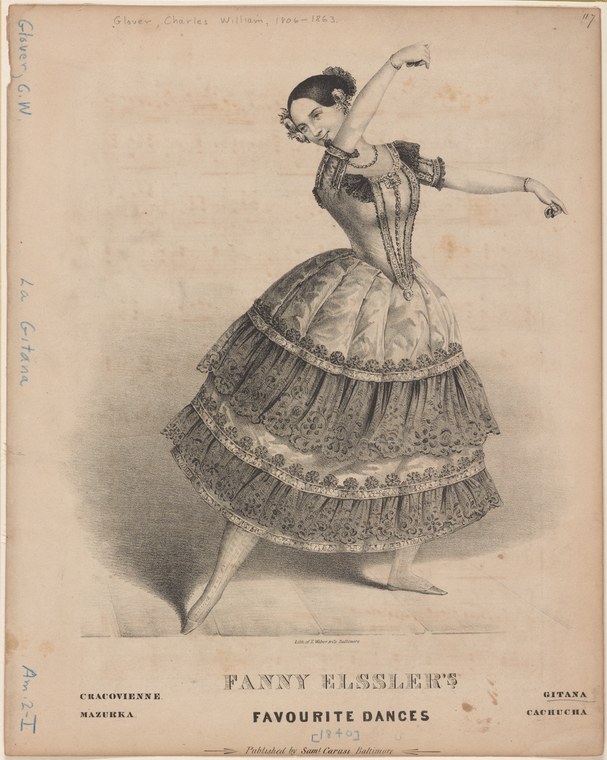
Fanny Elssler's favourite dances: Cracovienne, Gitana, Mazurka, Cachucha
Unknown artist
- Collection:
- Prints depicting dance
- Source:
- New York Public Library
- Rights:
- Public domain — free to use, share and adapt.
- Recorded as:
- Public Domain
Fanny Elssler was one of the defining figures of Romantic-era dance, and this portrait documents both her appearance and the elaborate costume that was central to her fame. The print provides visual evidence of how the 'exotic' character dances that made Elssler's reputation—as distinct from the ethereal, otherworldly dancing of her rivals—were actually presented, dressed, and framed for audiences. For scholars of 19th-century dance, popular culture, and the visual representation of performance, this work is a primary source.
What you are looking at
A single female dancer is depicted in a three-quarter pose against a plain background, captured mid-movement in an attitude of balletic grace. She wears a fitted corseted bodice with short puffed sleeves and an ornately decorated full skirt composed of multiple layered tiers, each trimmed with detailed embroidery or beading. The skirt, rendered with careful attention to its construction, rises to mid-calf and reveals the dancer's legs and pointe shoes. Her hair is pulled back smoothly, and she wears what appears to be decorative earrings. Her arms are extended with studied elegance—one raised and one lowered—and her body is turned in a classical pose that suggests the moment captured is deliberate and choreographed. The composition is that of a theatrical portrait: the dancer occupies the full height of the frame, and the plain background focuses all attention on her figure and costume. The engraving technique renders the image in fine black lines and careful cross-hatching to suggest form and shadow, giving the work a formal, documentary quality characteristic of 19th-century theatrical prints.
The dancing
The dancer's posture is upright and elongated, with weight seemingly shifted to one leg while the other is extended or lightly placed. Her arms are positioned in a studied manner—one raised near shoulder height with the hand delicately gestured, the other extended to the side—typical of the balletic port de bras of the Romantic era. Her body presents a clear profile-to-three-quarter orientation that shows off both the line of her silhouette and the construction of her costume. The overall frame is that of a trained classical dancer demonstrating grace and control, rather than a moment of dynamic action; this is a pose for display rather than an arrested instant of vigorous movement.
The dance depicted
This is a theatrical portrait of Fanny Elssler, the legendary Austrian dancer of the Romantic period, shown in one of her signature national or character dances. The print explicitly names four of her 'favourite dances': Cracovienne (Polish), Gitana (Spanish), Mazurka (Polish), and Cachucha (Spanish). The costume—particularly the tiered, decorated skirt and the fitted bodice—is consistent with the character dance costumes of the 1830s–1840s, when Elssler was at the height of her fame. These were exotic dances that allowed her to display technical brilliance while performing national character, and they formed a crucial part of her reputation as a rival to the ethereal, sylph-like dancing of her contemporary Marie Taglioni. The pose here is one of presentation rather than narrative action, designed to showcase both the dancer's formal training and the rich costume that was integral to these performances.
How it was made
This is a black-and-white engraving, likely a steel or copper engraving based on the fine line work and consistent crosshatching visible throughout. The technique allowed for the sharp definition of both the dancer's form and the intricate patterning of her costume, which would have been crucial for a theatrical portrait intended for widespread circulation. The print's formal presentation—with the dancer centered and filling the frame—and its dedication to a famous performer suggest this was published as a standalone theatrical souvenir or as part of a series documenting celebrated dancers of the era. Such prints were common merchandise in the 19th century, sold to audiences who attended performances or to collectors of theatrical imagery, and they served both as mementos and as advertisements for the dancer's virtuosity.
About this work
This is a theatrical portrait engraving of Fanny Elssler, one of the most celebrated dancers of the Romantic era, depicted in the costume of one (or a composite representation) of her famous character dances. The print captures the aesthetic and technical ideals of Romantic-era theatrical dance: a trained, elongated body; a richly decorated national costume; and a posed presentation designed to display both the dancer's grace and the spectacle of the performance. The work belongs to a rich tradition of 19th-century dance imagery in which prints like this one documented the appearance and costume of celebrated performers for audiences who could not attend the theater, or who wished to preserve a memory of a performance they had seen. For dance historians, such prints are invaluable evidence of how these dances were understood, dressed, and presented to the public.
How to look at it
The pose here is not a moment of dynamic action, but rather a formal presentation—the dancer showing her figure, her costume, and her trained bearing to the viewer. Notice how the artist has chosen a three-quarter view that allows the full skirt and its ornament to be displayed while keeping the dancer's face and upper body clearly visible. The careful rendering of the costume details—each tier of the skirt, the embroidery, the bodice seams—suggests that the appearance of the dress was as important to the image as the dancer's form. This is a portrait of a performer in a role, not a snapshot of movement; the dancer is asking to be looked at and admired, just as she would have been on stage.
The artist
The artist is not recorded in the catalogue, but the print's title, dedication format, and high production quality suggest it was a commercial theatrical print issued by a professional engraver or print publisher in London or a major European city during Elssler's active performing years (1830s–1840s). Such prints were often created by specialized theatrical publishers who worked from sketches, descriptions, or live observation to produce images that would be sold as souvenirs and promotional material.
The period
This print dates to the height of the Romantic ballet era, when Fanny Elssler and Marie Taglioni were the two dominant female dancers in Europe. Where Taglioni represented the ethereal, supernatural ideal—dancing sylphs and spirits in works like La Sylphide—Elssler embodied a different kind of excellence: technical brilliance, earthiness, sensuality, and the performance of 'national character.' Her Cachucha (Spanish), Cracovienne (Polish), and Mazurka dances were celebrated for their vivacity and for Elssler's ability to combine technical mastery with a more vigorous, grounded style of movement. In the 1830s–1840s, these character dances were at the cutting edge of theatrical fashion, and prints like this one were part of how they circulated visually through European society. The engraving technique itself was the standard medium for the mass reproduction of theatrical imagery before photography became widespread.
Where it lives
This print is held in the New York Public Library's collection of prints depicting dance. It is a commercial theatrical print, likely published in the 1830s–1840s during Elssler's active performing career, and represents the kind of mass-produced theatrical souvenir that would have been sold to audiences and collectors in the 19th century.
Dance in this work
Questions about this work
Who was Fanny Elssler?
Fanny Elssler (1810–1884) was an Austrian dancer who became one of the most celebrated performers of the Romantic era. She was famous for her technical brilliance and for her 'character dances'—performances of Spanish, Polish, and other national dances that showcased a more vigorous and sensual style than the ethereal supernatural dancing associated with her rival, Marie Taglioni. She performed throughout Europe and the Americas and was a major star of the 1830s and 1840s.
What are the dances named on this print?
The four dances listed—Cracovienne, Gitana, Mazurka, and Cachucha—were all part of Elssler's famous repertory. The Cracovienne and Mazurka are Polish dances; the Gitana is Spanish (gypsy dance); the Cachucha is also Spanish. These were 'character dances,' performed in elaborate national costume, and they allowed Elssler to display both technical mastery and a more dramatic, earthbound performance style than the otherworldly ballet of the era.
Is this an engraving or a lithograph?
Based on the fine line work, the consistent crosshatching, and the overall technique visible in the image, this appears to be an engraving—likely a steel or copper engraving. This was the dominant technique for mass-producing theatrical prints in the 1830s and 1840s, before lithography became the standard method for color theatrical prints.
Why was this print made?
This print was made as a commercial theatrical souvenir—a piece of merchandise sold to audiences who attended Elssler's performances, or to collectors of theatrical imagery. Such prints served both as mementos and as advertisements for the dancer's appearance and fame. Before photography, they were the primary visual record of how performers actually looked on stage, and they circulated widely through European and American society.
More dance artwork





