49 works in this view — arrow keys or swipe to move between them.
Dance in Art
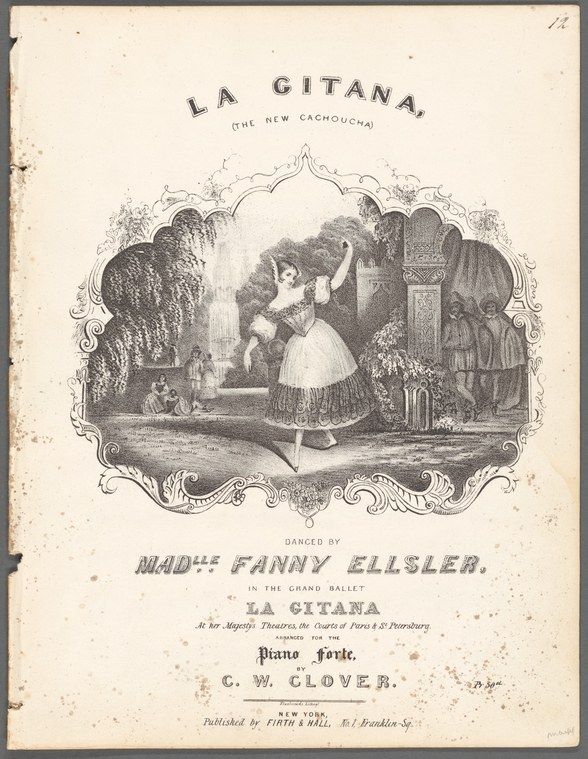
La gitana (the new cachoucha) danced by Madlle. Fanny Ellsler [sic] in the grand ballet La gitana ... arranged for the piano forte by C.W. Clover
Unknown artist
- Collection:
- Prints depicting dance
- Source:
- New York Public Library
- Rights:
- Public domain — free to use, share and adapt.
- Recorded as:
- Public Domain
Fanny Elssler was a pivotal figure in Romantic ballet, rivaling Marie Taglioni in fame and influence, yet she is less well-documented in visual records than her contemporary. This print captures her in a signature role that showcased both her technical prowess and her gift for dramatic characterization—a quality that distinguished her approach to dance. The Cachoucha, an imported Spanish dance adapted for the ballet stage, represents the Romantic fascination with exotic character and national style, and this image preserves how that fusion actually looked in performance.
What you are looking at
A theatrical scene set indoors, rendered in engraved line work with careful cross-hatching for depth and shadow. A woman in a voluminous white or pale skirt dominates the foreground, captured mid-movement with one arm raised expressively. She wears what appears to be period theatrical costume—a fitted bodice and the full skirt characteristic of Romantic-era ballet. The setting includes architectural elements: an ornate doorway or arch visible to the left, and draped curtains or tapestries suggesting an interior palace or private chamber. In the background, several figures in darker dress observe the scene—likely attendants, musicians, or fellow dancers. The composition frames the dancer at the center of attention, her body angled to show movement and extension. The ornamental border surrounding the entire scene—a rococo scrollwork frame—emphasizes that this is a formal theatrical image, likely a published print commemorating a specific performance.
The dancing
The central figure is a single soloist in an upright, expressive pose with one arm raised and extended, suggesting a moment of lyrical or narrative intensity rather than technical virtuosity. Her weight appears shifted, with the body oriented in three-quarter view to the audience. The full skirt's volume and the angle of her torso suggest a turn or traveling step rather than a static position. The surrounding figures are secondary, maintaining distance and a supporting role. There is no visible pointe work or the extreme ankle articulation that would characterize later classical ballet; the posture is more upright and the skirt proportions (full but not extremely short) consistent with Romantic-era costume.
The dance depicted
This is a dance from a theatrical ballet, specifically *La gitana* (The Gypsy), choreographed to feature the Cachoucha, a Spanish character dance that was fashionable in European theaters during the 1830s–1840s. The work was danced by Fanny Elssler, one of the most celebrated dancers of the Romantic period, and was a showcase for her technical brilliance and dramatic presence. The title's parenthetical reference to "the new cachoucha" indicates a theatrical adaptation or elaboration of the Spanish folk dance for ballet. The image captures a moment of the Spanish-inflected narrative dance—the raised arm, the turned posture, and the theatrical setting all consistent with how the Cachoucha was performed on the European stage as part of a larger narrative ballet.
How it was made
This is a steel or copper engraving, a reproductive print technique that allowed wide circulation of theatrical imagery in the 19th century. The fine parallel lines (hatching and cross-hatching) create tonal gradation and volume, particularly in the folds of the skirt and the modeling of the figure's form. The ornamental border is integral to the composition, suggesting this is a formal commemorative print—likely published for sale to audiences and admirers of the ballet. The engraving technique allowed for sharp detail and delicate line work, making it suitable for both publication in theatrical journals and framing for collectors. The credit line indicates the dance was arranged for piano by C.W. Clover and published in New York, confirming this as a commercial theatrical print of the period.
About this work
This is an engraved theatrical print commemorating a performance of *La gitana* by Fanny Elssler, one of the Romantic era's most celebrated ballerinas. The image preserves a single iconic moment from the ballet—the Spanish-inflected Cachoucha dance at its center—showing how the character and spectacle of this work appeared to contemporary audiences. It belongs in a dance gallery as evidence of both the technical demands and the narrative drama of Romantic ballet, and as a record of how 19th-century audiences encountered and remembered dance: not as a ephemeral performance, but as a reproducible theatrical image they could own and display.
The print also documents the transatlantic circulation of European ballet: Elssler's fame extended to American stages, and this New York publication shows how American audiences and music publishers participated in the cult of Romantic ballet. The shift from ballet as pure technique to ballet as theatrical narrative—staged in painted interiors, with dramatic costume and character—is visible in both the scene depicted and the formal, dramatic framing of the print.
How to look at it
Notice the moment the artist has chosen: not a static position, but a captured instant of movement—the raised arm, the shifted weight, the turn of the body—that conveys energy and narrative intensity. The ornamental frame is not merely decorative; it marks this as a formal, documented theatrical moment, a record of a specific star dancer in a specific role. Look at the costume: the full Romantic-era skirt with its volume and detail, the fitted bodice, the absence of the extremely shortened skirt and pointe emphasis that would characterize later classical ballet. The architectural interior setting grounds the dance in narrative—this is not an abstract display of technique, but a character dance within a story.
The artist
The engraver is not named on this print; only C.W. Clover, who arranged the music for piano, is credited. Theatrical engravings and lithographs of this period were often anonymous or credited only to the publisher. The style and execution are consistent with commercial theatrical prints of the 1830s–1840s, likely created by a professional reproductive engraver working from a sketch or design provided by the publisher. The ornamental frame and careful rendering of costume and setting suggest a workshop experienced in theatrical illustration.
The period
The 1830s–1840s were the height of the Romantic ballet era, when dancers like Taglioni and Elssler became international celebrities, and when ballet shifted from pure technical display to narrative and character-driven spectacle. The Cachoucha craze was part of a broader Romantic appetite for exotic and national character dances—Spanish, Hungarian, Polish, and Italian dances were incorporated into ballets to add local color and dramatic interest. This was also the era when theatrical prints became a major medium for disseminating images of famous dancers to a mass audience; before photography, engravings and lithographs were the primary way audiences outside major theatrical centers could see what celebrated dancers looked like. Fanny Elssler's tours of Europe and America in the 1830s–1840s created enormous demand for her image.
Where it lives
This is a commercial theatrical print published in New York, likely sold to audiences and admirers of Fanny Elssler's performances and to music enthusiasts. It comes from the New York Public Library's "Prints depicting dance" collection, which preserves theatrical ephemera—images created for circulation and consumption, now held as documentary evidence of performance history.
Dance in this work
Questions about this work
Who was Fanny Elssler?
Fanny Elssler (1810–1884) was an Austrian dancer and one of the two most celebrated ballerinas of the Romantic era, rivaling Marie Taglioni. She was famous for her technical brilliance, her dramatic presence, and her gift for character dancing—particularly Spanish and Italian character dances. She toured extensively in Europe and America, where she was treated as a celebrity; her performances generated enormous demand for her image in prints and engravings.
What is the Cachoucha?
The Cachoucha is a Spanish folk dance that was adapted for the European ballet stage in the 1830s–1840s. In theatrical form, it became an exotic character dance, often performed as a solo or featured moment within a larger ballet, and it was closely associated with Fanny Elssler. The dance showcased a different aesthetic than pure classical ballet—more dramatic, more grounded, and incorporating elements of Spanish style and rhythm.
Why was this print made?
Theatrical prints like this were created to commemorate celebrated performances and to capitalize on the fame of star dancers. They were sold to audiences who wanted to remember and display images of their favorite performers, and to music enthusiasts who wanted to own the piano arrangement of the ballet music. Before photography, these engravings and lithographs were the primary way audiences could possess an image of how a famous dancer looked on stage.
How does this dance differ from classical ballet?
Romantic ballet of the 1830s–1840s was characterized by narrative, character, and dramatic storytelling, often incorporating national or exotic dances like the Cachoucha. The costume and posture visible here are consistent with Romantic-era style: the skirt is full but not extremely short, and the dancer's position emphasizes expression and dramatic gesture rather than the extreme turnout and ankle articulation that would become central to classical ballet later in the century.
More dance artwork





