49 works in this view — arrow keys or swipe to move between them.
Dance in Art
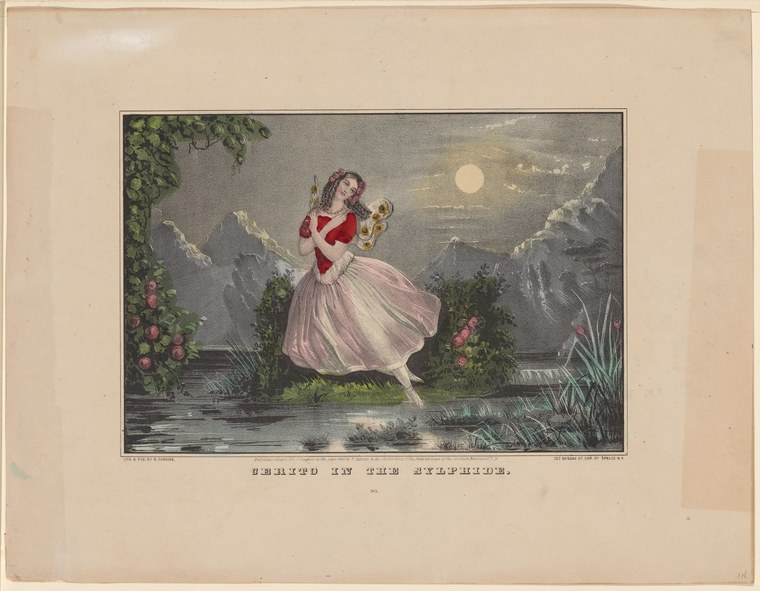
Cerito [sic] in the Sylphide
Unknown artist
- Collection:
- Prints depicting dance
- Source:
- New York Public Library
- Rights:
- Public domain — free to use, share and adapt.
- Recorded as:
- Public Domain
This print preserves the visual language of Romantic ballet at the height of its popularity and influence. For dancers and historians, it documents not only a specific performer and a specific role, but also how the sylph—one of the most enduring and codified figures in ballet—was imagined, costumed, lit, and presented to audiences. The image tells us what audiences of the 1840s expected from a dancer portraying a supernatural being: weightlessness, rapture, a body suspended between earth and air.
What you are looking at
A young woman in Romantic-era dress dominates a moonlit landscape. She wears a deep red bodice and a pale pink tulle skirt that extends to mid-calf, her posture weightless and buoyant as she appears to hover above the ground. Her arms are raised and curved gracefully, her head tilted back in an expression of rapture or abandon. The setting is a theatrical nocturne: a full moon glows pale in a stormy sky, dark mountains or cliffs frame the composition on either side, and in the foreground a shallow stream or pool reflects the scene. Climbing roses and other flowering plants bloom in the margins—on the left in pink profusion, on the right among reeds and water plants. The entire composition is composed and lit to emphasize the dancer's ethereal ascent, as if she has become a supernatural being, weightless and transported. This is the visual language of the Romantic ballet.
The dancing
A single female dancer, captured mid-movement with her body turned in a spiraling or rising gesture. Both arms are raised and gently curved, the right arm higher than the left, creating an open upper frame. Her torso is arched and lifted, her legs barely visible beneath the voluminous tulle skirt, creating the impression of balletic elevation or even flight. The positioning suggests the dancer is en pointe or in a sustained jump, with no visible contact with the ground. The gesture is introverted and ecstatic rather than directional—the dancer is not moving across the stage toward the viewer but rather suspended in a moment of inner transformation.
The dance depicted
This is unmistakably a Romantic ballet, most likely a scene from La Sylphide (the ballet, not its later sibling La Sylphe). The catalogue title 'Cerito in the Sylphide' identifies the dancer as Fanny Cerito, one of the great ballerinas of the 1840s, though the image's lack of identifying inscription and the uncertain date mean this attribution should be treated as a working hypothesis rather than fact. The sylph is the archetypal Romantic figure—a supernatural spirit of the air, neither fully human nor entirely otherworldly—and the image captures the key visual marker of sylph portrayal: the dancer rendered weightless, ascending, and separated from the earthly realm by landscape and lighting. The pink tulle skirt, the pointe work implied by the raised body, and the moonlit setting are all signature elements of how sylph characters were visualized on the 1840s stage.
How it was made
This is a hand-colored lithograph or engraving, evident from the fine black outlines defining all forms, the careful stippled or cross-hatched modulation of tone in the sky and distant mountains, and the precise registration of the colored inks. The technique is characteristic of theatrical publicity or souvenir prints of the 1840s–1850s—relatively refined and suitable for circulation to an educated middle-class audience who frequented the opera house. The hand-coloring is accomplished and subtle, particularly in the gradation of the sky from dark storm clouds to pale moonlight, and in the luminosity of the figure's skin and the translucence of the tulle. This was a commercial reproductive medium designed to commemorate and disseminate images of celebrated dancers and celebrated roles.
About this work
This is a hand-colored print documenting a moment from the Romantic ballet—specifically the dream of weightlessness and supernatural transcendence that defined the sylph roles of the 1840s. The inscription attributes the role to Fanny Cerito, a Neapolitan ballerina celebrated for her technical brilliance and dramatic presence. The image is not a scene-painting or a narrative moment, but rather an idealized portrait of a dancer in a celebrated role, designed for sale to admirers and for circulation among the ballet-going public. It sits at the intersection of theater history, dance portraiture, and the visual culture of Romanticism—a moment when ballet had become a major art form and ballerinas had become public figures worthy of commemoration.
How to look at it
Look first at the dancer's relationship to gravity. The artist has rendered her in a moment of impossible suspension—her feet barely suggested beneath the skirt, her body arched and ascending, her arms open to the night air. This is not a naturalistic representation of a human body at rest; it is an idealization designed to convey weightlessness, ecstasy, and supernatural agency. Notice also the landscape: it is not background but atmosphere, a created world of darkness, moonlight, water, and flowers that reinforces the dancer's transformation. The artist has chosen the moment of greatest elevation and opening—not a moment of technical display (a turn, a jump) but a moment of transcendence. This was the language Romantic audiences expected from the sylph.
The period
This print was made during the heyday of the Romantic ballet, the 1840s, when the genre dominated European and American stages. Fanny Cerito (1817–1909) was among the most celebrated ballerinas of that decade, known for her technical virtuosity and her dramatic power. La Sylphide (1832, choreography attributed to Jean-Baptiste-Augustin Hus, with Jean Schneitzhoeffer's music) was the foundational text of Romantic ballet—a narrative of mortal love and supernatural temptation that became the template for sylph roles. The ballet featured the first extended use of pointe work in theatrical dance and introduced the ethereal white tulle costume that became synonymous with the Romantic ballerina. Prints like this one were as much a part of ballet culture as the performances themselves: they circulated among patrons, fans, and dancers, shaped public memory of celebrated dancers and celebrated roles, and created a visual archive of an ephemeral art.
Where it lives
This print is held in the New York Public Library's collection of prints depicting dance. It appears to be a commercial theatrical print or souvenir, distributed during or shortly after Cerito's performance of the role.
Dance in this work
Questions about this work
Who was Fanny Cerito?
Fanny Cerito (1817–1909) was an Italian ballerina and choreographer, born in Naples, who became one of the most celebrated dancers of the Romantic era. She was known for her technical brilliance, her dramatic power, and her ability to move audiences. She performed across Europe and created several ballets of her own. She was also the first to dance the role of the Sylph in London after the ballet's Paris premiere.
What is La Sylphide?
La Sylphide is a romantic ballet in two acts with a libretto by Adolphe Nourrit and choreography attributed to Jean-Baptiste-Augustin Hus, first performed in Paris in 1832 with music by Jean Schneitzhoeffer. It tells the story of a mortal man who falls in love with a sylph—a supernatural spirit of the air—and abandons his earthly love to pursue her, with tragic consequences. The sylph became the archetypal Romantic ballet role.
Why did Romantic ballerinas wear such long skirts?
The long tulle skirt—called a tutu—became the visual signature of the Romantic ballerina in the 1830s and 1840s. It served multiple purposes: it concealed the mechanics of pointe work and made the dancer appear weightless and ethereal, it allowed for dramatic use of fabric in motion, and it communicated the supernatural or otherworldly nature of the characters (sylphs, naiads, spirits) that dominated Romantic ballet narratives.
How do we know this is a lithograph?
The fine black outlines, the careful cross-hatching and stippling used to build tone in the sky and mountains, and the way the hand-coloring sits on top of a printed black key-plate are all characteristic of hand-colored lithography or engraving. These techniques were the standard way to produce and circulate theatrical prints in the 19th century.
More dance artwork





