49 works in this view — arrow keys or swipe to move between them.
Dance in Art
Les fragments
Unknown artist
- Collection:
- Prints depicting dance
- Source:
- New York Public Library
- Rights:
- Public domain — free to use, share and adapt.
- Recorded as:
- Public Domain
For historians of early modern dance and spectacle, this engraving documents the aesthetic and social context in which ballet de cour and courtly entertainments developed—showing the formal costume, spatial arrangement, and gestural vocabulary of courtly culture. The work is significant evidence of how Renaissance court culture was recorded, circulated, and preserved through the medium of engraving, and it illustrates the close relationship between theatrical costume, social performance, and dance in this period.
What you are looking at
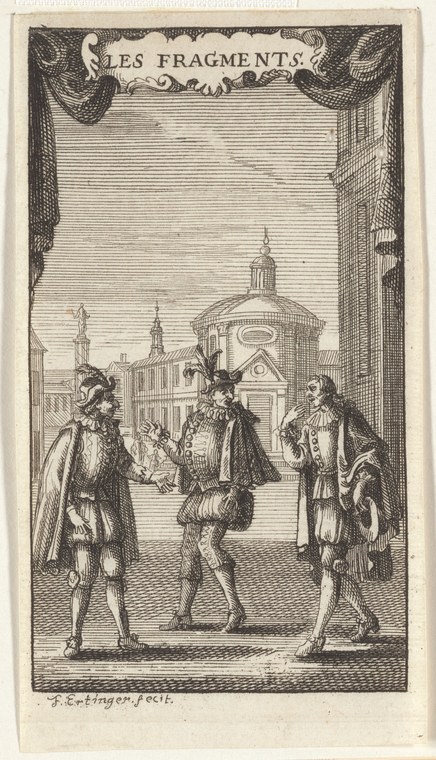
This engraving depicts a formal gathering of three elegantly dressed men in a paved urban square before a domed classical building. The central figure, in a feathered hat and flowing cloak, gestures expressively toward his companions. The two flanking figures are similarly attired in the fashion of the late 16th or early 17th century—doublets, hose, cloaks with elaborate trim, and feathered headwear. The architectural setting suggests a Renaissance or early baroque city square, with the domed structure rising prominently in the background and a colonnade visible to the left. The engraving employs fine parallel hatching throughout to create depth and shadow, particularly in the costumes and the architectural elements. The overall composition is formal and symmetrical, with the three figures arranged in a deliberate spatial relationship that suggests a choreographed social interaction or entertainment.
The dancing
The three men occupy distinct positions within the composition: the central figure stands frontally with animated arm gestures, suggesting speech or instruction; his left arm extends outward in an open, expansive movement. The flanking figures are turned slightly inward toward the center, their postures receptive and attentive. The bodies are upright and controlled, their weight evenly distributed. There is no visible embrace, hand-holding, or the close proximity typical of partner dances; instead, the spatial relationship suggests a master-and-student or performer-and-audience dynamic. The gestural language appears rhetorical rather than choreographed—these are not bodies in motion through a learned step vocabulary.
The dance depicted
This engraving most likely documents an act of courtly entertainment or instruction rather than the depiction of a recognizable dance form. The title 'Les Fragments' suggests fragmentary scenes or moments extracted from a larger narrative—possibly a theatrical work, ballet de cour, or court entertainment. The formal attire, urban classical setting, and the three-figure composition point to aristocratic or courtly culture of the Renaissance or early baroque period. The central figure's expressive gestures could represent a dancing master demonstrating technique or a performer engaging an audience. The work appears closer to documentation of courtly social practice than to the representation of a specific, identifiable dance style, though the theatrical costume and gestural vocabulary suggest the work belongs within the world of court dance and ballet.
How it was made
This is an engraving executed on paper, as indicated by the fine parallel hatching lines (cross-hatching) and the linear quality of the linework throughout. The technique involves incising lines into a copper or steel plate, which creates the characteristic crisp, precise articulation visible here. The artist has employed sophisticated spatial modeling through the use of line density and direction—denser hatching creates shadow and volumetric form in the cloaks and the building, while open lines define the foreground figures. The signature at the bottom left is partially legible and appears to be in the hand of the engraver. The technique allowed for mass reproduction and distribution through printing, indicating this work was intended for a relatively broad educated audience rather than a unique, singular commission. The fine quality of execution and the allegorical or narrative subject suggest a work of some status and circulation within Renaissance or early baroque artistic culture.
About this work
This engraving presents a formal scene of three aristocratic figures in a classical urban setting, rendered in the sophisticated linear technique of Renaissance engraving. The work is titled 'Les Fragments,' suggesting it documents a scene or moment drawn from a larger theatrical or courtly context—possibly from a ballet de cour, court entertainment, or allegorical performance. The figure and composition place it squarely within the world of 16th- and 17th-century court culture, where dance, gesture, rhetoric, and spectacle were deeply intertwined. The engraving survives as a record of courtly social and performative practice, capturing not necessarily a moment of dancing itself but rather a moment of courtly interaction, instruction, or entertainment that took place within the broader culture that produced and consumed ballet and dance spectacle.
How to look at it
Look first at the spatial relationship between the three figures: they are arranged in a deliberate, balanced composition that suggests choreography or formal social ritual rather than spontaneous movement. The central figure's expanded arm gestures and frontal orientation suggest he is the focus of attention—a master, teacher, or performer. The turned postures and attentive stance of the flanking figures suggest receptive observation or instruction. The clothing—the elaborate doublets, cloaks, and feathered hats—was the costume of courtly aristocratic life, and the classical architectural setting reinforces the idea that this documents a moment within a formal, elite cultural context. The fine linear technique of the engraving itself should be appreciated as both a technical achievement and as a medium of circulation—this image was designed to be reproduced and distributed in multiple impressions.
The artist
The engraver's name appears only partially legible on the plate. The style of the engraving and the signature form suggest a working artist of some skill operating within the tradition of Renaissance reproductive engraving, likely in the late 16th or early 17th century. The precision and sophistication of the technique indicate professional training and likely significant circulation of this artist's work through printed impressions.
The period
This engraving dates to the period when ballet de cour was developing as a major form of court spectacle in France and Italy. In this era, dance was intimately connected to courtly deportment, gesture, and entertainment. Engraving emerged as a powerful tool for documenting and circulating images of courtly life, theatrical costume, and performance across Europe. The classical architectural setting and the formal, symmetrical composition reflect the Renaissance revival of classical ideals, while the subject matter—elegant figures in courtly dress engaged in some form of social or theatrical interaction—reflects the courtly culture of the late 16th and 17th centuries.
Where it lives
This engraving is held in the New York Public Library's collection of prints depicting dance. It is catalogued with minimal documentation; the artist's name and the date are uncertain, and the work's full title and original context remain unknown.
Dance in this work
Questions about this work
Is this a scene from a specific ballet or court entertainment?
The title 'Les Fragments' suggests it may derive from a larger theatrical work, but without additional documentation, the specific source cannot be confirmed. The work may represent a scene extracted from a ballet de cour, a court entertainment, or simply a formal moment within courtly social practice. The engraving documents the visual and gestural language of court culture rather than a named, documented work.
What is the central figure doing—is he dancing?
The central figure appears to be demonstrating, instructing, or addressing his companions rather than performing a recognizable dance step. His open, expansive arm gestures and frontal orientation suggest rhetorical or instructional gesture rather than the vocabulary of a specific dance form. He may represent a dancing master, a performer engaging an audience, or a speaker within a theatrical or courtly context.
Why is this in a gallery of dance in art?
This engraving documents the aesthetic, social, and gestural world of Renaissance courtly culture, within which dance, theatrical performance, and formal social gesture were inseparable. It provides visual evidence of courtly costume, spatial arrangement, and the integration of gesture and spectacle in early modern court life—the cultural matrix from which ballet and court dance emerged.
What does the title 'Les Fragments' mean?
The title suggests 'The Fragments' or fragmentary scenes. This implies the engraving may have been one scene or moment within a larger narrative work—possibly a ballet de cour, court entertainment, or illustrated narrative. The fragmentary title suggests the work circulated as a discrete image extracted from a larger whole, or that it was intentionally designed as a scene or moment to be viewed on its own.
More dance artwork





