49 works in this view — arrow keys or swipe to move between them.
Dance in Art
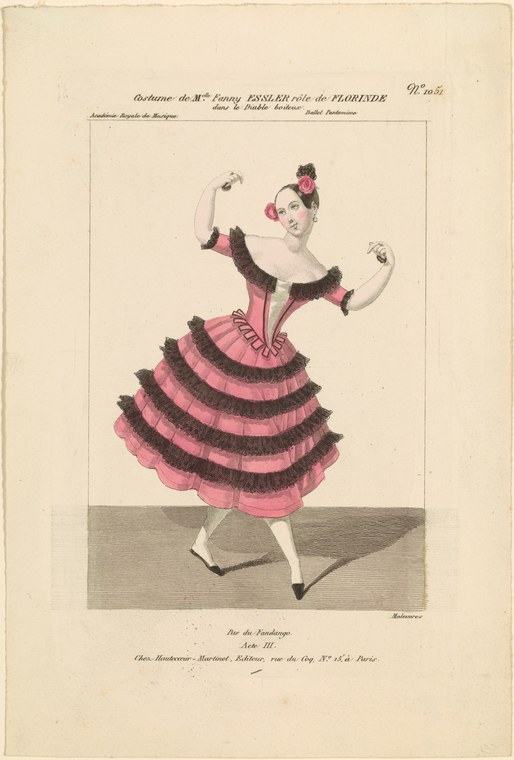
Costume de Melle Fanny Essler [sic] rôle de Florinde dans Le diable boiteux.: Ballet pantomime, Acte III, Pas du fandango, Academie Royale de Musique
Unknown artist
- Collection:
- Prints depicting dance
- Source:
- New York Public Library
- Rights:
- Public domain — free to use, share and adapt.
- Recorded as:
- Public Domain
Fanny Elssler was one of the two most important ballerinas of the 1830s–40s, yet her legacy has been overshadowed by that of her rival Marie Taglioni. This costume plate is direct evidence of her stage presence and of the repertory for which she was celebrated—a repertory centered on character and national dances rather than the ethereal Romantic ideal. For historians of dance, it documents how the fandango and other Spanish forms were adapted for European theatrical consumption, and how a leading female dancer of the era was visually constructed and marketed.
What you are looking at
A single female dancer in a buoyant pose dominates the composition. She wears a striking pink silk skirt with deep horizontal ruffles of darker fabric—likely black or dark brown—that create a dramatically tiered silhouette. The skirt extends from a fitted bodice and sits well above the ankle, revealing white stockings and black slippers. Above, she wears a dark (burgundy or brown) short-sleeved jacket or bolero with what appears to be fur or feathered trim at the edges. Her pale arms are raised in a lively gesture, with both hands turned outward at the wrists in a characteristically Spanish pose. Her dark hair is styled with a pink ornament or flower pinned at the crown. She stands on a shallow gray platform against a plain cream background. The figure is rendered in hand-colored engraving or lithograph, with delicate facial features and careful attention to the texture and movement of the fabric.
The dancing
The dancer is captured in a single, exuberant moment—weight appears to rest on the balls of the feet, suggesting active movement or a preparatory stance. Both arms are raised to shoulder height with elbows slightly bent and hands rotated outward in an open, expressive gesture characteristic of Spanish or Latin dance. The pose conveys energy and buoyancy; the body is elongated and the head tilts slightly upward. The posture is that of a trained professional performer: the spine is extended, the carriage upright, and the limbs articulate with precision.
The dance depicted
This is a costume plate for a theatrical ballet scene, specifically the Fandango from Act III of *Le Diable boiteux* (*The Devil on Two Sticks*), a popular pantomime ballet of the Romantic era. The inscription identifies this as the costume of Mademoiselle Fanny Elssler, one of the most celebrated dancers of the 1830s–40s. The fandango is a Spanish dance form, and Elssler was famous for her interpretation of Spanish and exotic dances, which she danced in a style distinct from the ethereal, otherworldly Romantic ballet of her rival Marie Taglioni. The tiered ruffled skirt, the bolero jacket, and the Spanish arm positions are all markers of the theatrical fandango as performed on the European stage during this period. The image documents not the full choreography but a single characteristic attitude from the dance.
How it was made
This is a hand-colored engraving or lithograph, a print medium that allowed for mass reproduction and wide circulation. The base image shows fine linear work defining the figure and drapery; the hand coloring (watercolor or gouache) has been applied afterward in flat, bright tones—particularly the vivid pink of the skirt and the flesh tones of the face and arms. This technique was standard for theatrical costume plates in the 1830s–40s, intended for circulation among theater patrons, costume makers, and dancers themselves. The clarity of detail and the careful rendering of textile effects suggest a professional print house, likely Parisian.
About this work
This is a costume plate documenting the stage appearance of Fanny Elssler in a celebrated role during the 1830s, at the height of Romantic ballet. It records not a moment of abstract beauty but a specific professional costume worn in a specific dance—the fandango from a popular pantomime-ballet. The image is a primary document of how Spanish dance was theatricalized and exoticized on the European stage during the Romantic period, and of how a leading dancer of the era was visually promoted and remembered. Elssler's fame rested partly on her ability to dance demi-caractère roles—dances with national or ethnic associations—with technical brilliance, and this plate preserves the visual identity of one of her signature performances. The work belongs to a substantial body of theatrical prints that served both as souvenirs and as working documents for the theater industry.
How to look at it
Attend to the specificity of the costume: every element—the bolero, the ruffled skirt, the Spanish arm position, the ornament in the hair—signals a particular national or regional style within ballet. Note the raised, outward-turning arm position: this is not the rounded, lifted arm of Romantic ballet, but an open, presenting gesture associated with Spanish and Latin dances. The pose is active and grounded, with weight in the feet and the body energized, rather than weightless and elongated. The print is a costume study, designed to be legible and to show the garment in motion; the artist has chosen an attitude that displays the silhouette and movement quality of the skirt and jacket together.
The period
This print dates to the height of the Romantic ballet era (circa 1830s–1840s). The theatrical print industry was booming in Paris during this period; engravings and lithographs of celebrated dancers and their costumes were major commercial products, sold to theater-goers as souvenirs and collecting items. *Le Diable boiteux* was first choreographed by Jean-Auguste Domilecourt and Joseph Mazilier in 1836 and became one of the most frequently performed pantomime ballets of the era, with multiple revisions and casts. The visual promotion of dancers through prints was essential to their fame and market value; Elssler's image circulated widely in this form. At this moment, ballet was splitting into two distinct styles: the ethereal, supernatural Romantic ballet of Taglioni, and the demi-caractère or character ballet of Elssler, which incorporated national dances, folk elements, and a more earthy, sensual aesthetic.
Where it lives
This print is held in the New York Public Library's collection of prints depicting dance. It is a hand-colored theatrical costume plate, a commercial print product from the 1830s–1840s Parisian theater industry, intended for circulation among subscribers, theater professionals, and patrons.
Dance in this work
Questions about this work
Who was Fanny Elssler?
Fanny Elssler (1810–1884) was an Austrian dancer and one of the two most celebrated ballerinas of the Romantic era, rivaling Marie Taglioni. While Taglioni was known for ethereal, supernatural roles, Elssler specialized in character and national dances—Spanish, Italian, Polish—and was celebrated for her technical brilliance, sensuality, and theatrical presence. She danced in major European and American cities and was a major cultural celebrity of her era.
What is the fandango in ballet?
The fandango was a Spanish dance that became a popular subject for theatrical ballet in the 19th century. European choreographers adapted it for the stage, creating stylized versions that incorporated Spanish arm positions, rhythmic footwork, and characteristic costume. Elssler's interpretation in *Le Diable boiteux* was one of her signature roles and was frequently performed and revived.
Why are so many costume plates from this era?
Theatrical prints were major commercial products in 19th-century Paris and London. They served multiple functions: as souvenirs for theater patrons (like today's theater programs or playbills), as marketing for famous dancers, as reference documents for costume makers and dancers, and as collectibles. A successful dancer's image might be printed and reprinted in multiple versions and distributed across Europe.
How was this print made?
This is a hand-colored engraving or lithograph. An artist first created the design in fine linear work; the print was then run on a press and hand-colored afterward using watercolor or gouache. This technique allowed for both the precision of engraving and the visual appeal of color, and it was economical enough to produce prints in quantity for commercial sale.
More dance artwork





