49 works in this view — arrow keys or swipe to move between them.
Dance in Art
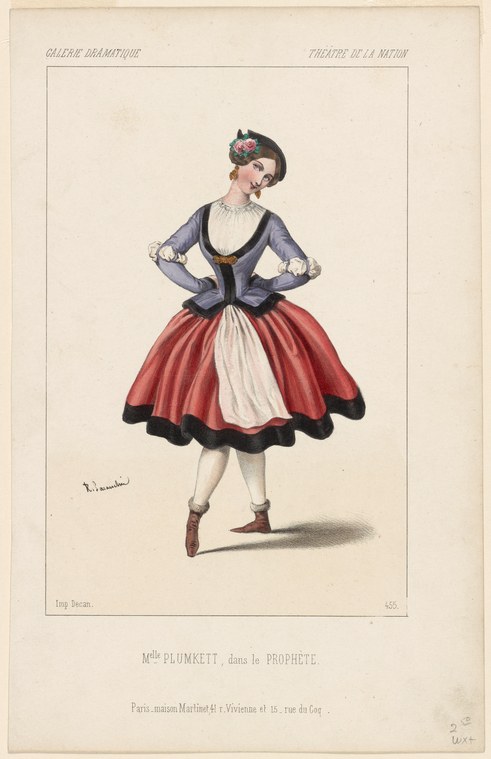
Melle. Plumkett [sic], dans Le prophète, Théâtre de la Nation
Unknown artist
- Collection:
- Prints depicting dance
- Source:
- New York Public Library
- Rights:
- Public domain — free to use, share and adapt.
- Recorded as:
- Public Domain
This image documents the professional identity and trained body of a working theatrical dancer at a moment when women in ballet were becoming major figures in European cultural life. The costume and pose reveal the visual and physical language through which Romantic ballet presented character and femininity on the commercial stage. For historians of dance and fashion, this is primary evidence of how dancers dressed, how they were marketed, and what their professional status looked like in material terms.
What you are looking at
A young woman stands in a graceful contrapposto pose against a plain background, her weight shifted onto one leg. She wears a theatrical costume of the mid-19th century: a navy blue bodice with a low, wide neckline, long sleeves with white cuffs, and a full skirt composed of red outer layers with a white panel down the center, bordered in black. Her hair is arranged in the fashionable style of the period, adorned with flowers and feathers. Her arms are held at her sides with hands positioned at hip level, fingers slightly extended. She wears pink ballet pointe shoes and her stance suggests the trained posture of a professional dancer. The palette is muted—cream background, careful use of color in the costume—and the style is that of a hand-colored theatrical print or engraving, likely from a series documenting stage performers and their roles.
The dancing
A single female figure, evidently a trained ballet dancer, stands in a relaxed yet composed pose with one leg supporting her weight, the other at ease. Her torso is upright, her shoulders back and level. Her arms are at her sides, hands at hip level, a pose that suggests readiness rather than mid-movement. The contrapposto stance and the upright carriage indicate balletic training. The pointe shoes confirm professional classical ballet practice. The entire composition conveys a moment of repose rather than dynamic action—a portrait pose such as would be used in theatrical publicity.
The dance depicted
This is a portrait of Mlle. Plumkett in the role of a character from the opera-ballet *Le Prophète* (Meyerbeer, 1849). The costume identifies the specific role and the theatrical production. The image documents a dancer of the mid-19th century European stage in formal theatrical dress, in the idiom of Romantic ballet. The pose and pointe shoes confirm her training in classical ballet technique, though the image captures her not mid-performance but in a formal portrait stance used for publicity and souvenir prints distributed to audiences.
How it was made
This is a hand-colored lithograph or engraving, likely a theatrical publicity print. The technique allowed for rapid production and distribution to theater audiences and collectors. The clean lines, careful composition, and hand-applied color are characteristic of commercial theatrical portraiture of the 1840s–1860s. Such prints served as both souvenirs and promotional materials, circulating among the affluent audiences who attended opera and ballet. The print bears a publisher mark (Imp. Becquet, Paris) identifying it as a commercial Parisian production.
About this work
This is a mid-19th-century theatrical portrait of a professional ballet dancer in the character costume of Mlle. Plumkett from Meyerbeer's opera *Le Prophète*. It is a hand-colored print produced for commercial distribution to theater audiences, documenting both the dancer's professional status and the visual conventions of Romantic ballet costume. The work sits within a substantial archive of theatrical portraiture from the period, a form that merged portraiture, fashion documentation, and promotional commerce. It belongs in a gallery of dance imagery both as evidence of historical practice and as a record of how dancers were commodified and celebrated in mid-19th-century popular culture.
How to look at it
Observe the deliberate contrast between the professional formality of the pose and the highly decorative, fantastical costume. The dancer is not captured mid-leap or in an attitude of dynamic virtuosity; instead, she stands composed and frontal, a presentation of self as a professional and as an object of admiration. Note the meticulous rendering of the costume—the color, the layering of the skirt, the precise detail of the cuffs and bodice—which reflects that costume design was a major attraction of theatrical ballet. The pink pointe shoes ground her in the specific practice of classical ballet, while the theatrical costume removes her into the world of fable and character that Romantic ballet inhabited.
The artist
The print is unsigned by the artist but carries publication marks identifying it as a Parisian commercial product. The style is consistent with mid-century theatrical portraiture workshops that produced such prints in quantity for the Paris opera and theater market. These enterprises employed trained colorists and lithographers to create standardized, repeatable images of celebrated performers.
The period
This print dates to the era of Romantic ballet in Europe, when ballet had shifted from a court entertainment to a commercial theatrical spectacle dependent on star performers (primarily women) and large public audiences. *Le Prophète* premiered at the Paris Opéra in 1849 and was a landmark work blending grand opera and ballet spectacle. The 1840s–1850s were the height of the Romantic ballet boom in Paris, when dancers like Marie Taglioni and Fanny Elssler commanded celebrity status and their images circulated as commercial commodities. Theatrical portraiture was a major business; prints of famous dancers sold to audiences and to collectors in large numbers. This image reflects both the artistic ambitions of Romantic ballet and its status as a commercial entertainment industry dependent on the marketability of the female body.
Where it lives
The print is held in the NYPL Prints collection documenting dance. It bears publisher information (Imp. Becquet, Paris; 15, rue du Coq) identifying it as a commercial Parisian print of the mid-19th century. Such prints were sold individually and in bound volumes to theater subscribers and collectors.
Dance in this work
Questions about this work
Who was Mlle. Plumkett?
She was a professional ballet dancer active in Paris in the mid-19th century, cast in roles in major operatic works of the era. Beyond her name and association with roles such as this one in *Le Prophète*, little biographical information survives. Her principal trace in the historical record is through images such as this print.
What is *Le Prophète* and why would it include ballet?
*Le Prophète* is a grand opera by Giacomo Meyerbeer, first performed at the Paris Opéra in 1849. In the 19th century, grand opera routinely incorporated substantial ballet sequences as a spectacle within the dramatic action. Professional ballet dancers were contracted as part of the opera house ensemble and performed in these sequences, often in roles specific to the opera's plot.
Why is this a theatrical portrait rather than an action scene?
Theatrical portraiture served multiple functions: as publicity for the production and the performer, as a souvenir for audiences, and as a record of costume design. Dancers were typically posed formally for these prints rather than captured mid-performance, emphasizing their professional identity and the beauty of their costumes rather than the dynamics of their movement.
What can we learn from the costume?
The costume reveals the Romantic-era aesthetic of ballet: a mix of contemporary fashion (the blue bodice and white cuffs reflecting 1850s daywear) with fantastical elements (the elaborate skirt, the decorative headdress with flowers and feathers). This hybrid approach—part historical, part invented—was standard in Romantic ballet and allowed dancers to embody both contemporary femininity and allegorical character.
More dance artwork





