49 works in this view — arrow keys or swipe to move between them.
Dance in Art
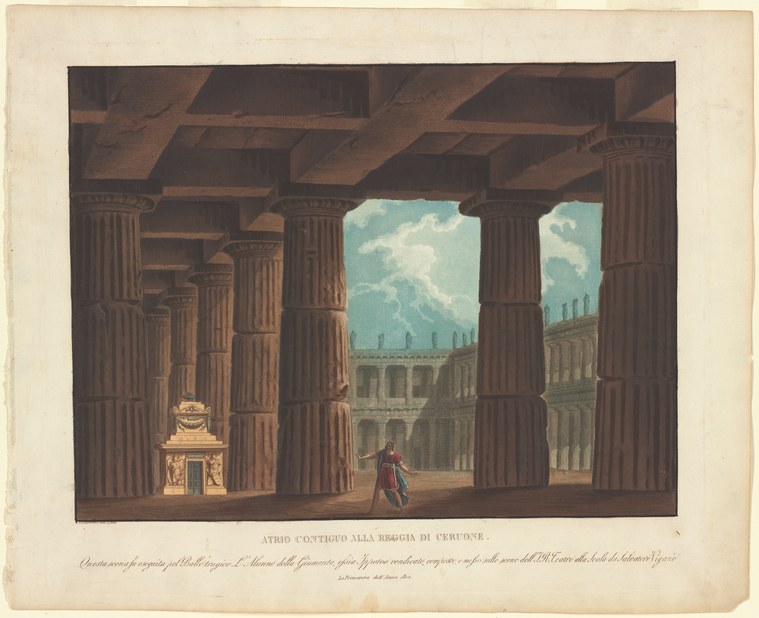
Atrio contiguo alla reggia di Ceruone: Questa scena fu eseguita pel ballo tragico L'alunno della giumenta, ossia Ippotoo vendicato, composto, e messo sulle scene dell'I. R. Teatro alla Scala da Salvatore Viganò, la primavera dell'anno 1812
Unknown artist
- Collection:
- Prints depicting dance
- Source:
- New York Public Library
- Rights:
- Public domain — free to use, share and adapt.
- Recorded as:
- Public Domain
Viganò was the most influential choreographer of his era and *L'alunno della giumenta* was one of his signature works. This design document shows how theatrical dance in the early nineteenth century was inseparable from architectural spectacle and classical revival. The isolated figure in the vast neoclassical space reveals how the tragic male body—not the female corps de ballet—was the vehicle for narrative and emotion in this period.
What you are looking at
A grand interior colonnade in the Antique style opens onto a palatial courtyard and mountain landscape. Two fluted Doric columns frame the foreground on either side, their capitals and entablature rendered in warm brown tones. The colonnade recedes in perspective, with paired columns marching back into shadow. The pavement is a pale stone. Through the middle distance, a monumental building with regular fenestration and a balustrade occupies the right side of the composition. Beyond the courtyard, a mountain peak rises against a blue-green sky with white clouds. A single figure in dark clothing and a plumed headdress stands centre-stage on the foreground pavement, leaning slightly on what appears to be a staff or sword. The lighting is theatrical, with the background brightly lit and the colonnade in cool shadow, creating a dramatic stage set effect.
The dancing
A single male figure dominates the composition, posed in a formal, noble stance with weight on one leg, the other slightly extended. He holds a staff or sword vertically, one arm raised in a gesture of authority or emotion. His bearing is upright and dignified, the posture of a tragic hero or warrior. The figure's isolation within the vast architectural space suggests soliloquy or a moment of dramatic revelation. No ensemble work is visible; this is a moment of individual heroic expression.
The dance depicted
This is a scene design for a tragic ballet by Salvatore Viganò, the dominant choreographer of European theatrical dance in the early nineteenth century. The work depicted is *L'alunno della giumenta, ossia Ippotoo vendicato* (The Student of the Mare, or Hippotos Avenged), which premiered at La Scala, Milan in spring 1812. The title refers to the Greek legend of Hippolytus, transformed through classical tragedy into a vehicle for Viganò's pantomimic ballet. The figure's solitary pose and heroic bearing are consistent with the tragic ballet style—a form that emphasized narrative, emotion, and the plasticity of the male body in classical drapery. Viganò was celebrated for his ability to convey narrative and psychology through bodily gesture rather than pure dance steps.
How it was made
This is a hand-coloured engraving or aquatint, a common medium for disseminating theatre designs and providing a permanent record of productions for audiences who could not attend. The technique allowed for fine linear detail in the architectural rendering while the watercolour wash could establish atmosphere and spatial depth. The print is evidence of Viganò's international reputation: these designs were published and circulated to document his innovations in theatrical spectacle, which united neoclassical architecture, historical narrative, and bodily expression in ways that influenced ballet across Europe.
About this work
This is a scene design for Salvatore Viganò's tragic ballet *L'alunno della giumenta*, which premiered at La Scala in 1812. It shows the atrium of a classical palace—a Doric colonnade opening onto a palatial courtyard—as a stage for a solitary male figure in an attitude of heroic pathos. The work exemplifies the early-nineteenth-century European tragic ballet, a form in which narrative and emotion were conveyed through pantomimic gesture and the classical body rather than through the vocabulary of social dance. Viganò's ballets were celebrated across Europe for their integration of neoclassical design, historical authenticity, and psychological depth, making them as much spectacle as dance.
How to look at it
Look at the scale of the architecture relative to the human figure. The colonnade is vast and the figure small—not a compositional accident, but a choice that emphasizes the loneliness of the tragic moment and the weight of fate or circumstance. Notice the figure's pose: not a step or a movement captured mid-execution, but a held attitude of emotion. The hand on the staff, the angle of the torso, the forward-leaning head—these are the vocabulary of pantomimic gesture, not of dance steps. The architectural setting is rendered with archaeological precision because it authenticates the classical narrative and frames the body as a vehicle for serious emotional expression.
The artist
The design is attributed to the printmaking tradition of theatre documentation at La Scala rather than to a named visual artist. Salvatore Viganò (1769–1821) was a Genoese dancer, choreographer, and mime who revolutionized ballet by abandoning pure dance steps in favour of expressive pantomime and narrative structure. He worked across European capitals—Venice, Rome, London, Paris—before settling at La Scala, where he created works that commanded international attention and were documented through engravings and descriptions. His influence on the development of narrative ballet and on the work of later choreographers (notably August Bournonville) was profound.
The period
The early nineteenth century saw a turn toward serious, emotionally charged subjects in ballet, aligned with Romantic literary interests in legend, psychology, and historical drama. Simultaneously, neoclassical architecture and design became the dominant aesthetic for theatre interiors and stage scenery across Europe. Viganò's work sat at this intersection: he rejected the frivolous courtly spectacle of the eighteenth century in favour of tragic narratives drawn from classical antiquity, expressed through bodily gesture and mime supported by archaeologically informed architectural settings. This was the seed-bed from which Romantic ballet would grow in the 1830s and 1840s.
Where it lives
The work is held in the New York Public Library's collection of prints depicting dance. It is an engraved or aquatinted design document, part of the print culture through which major theatrical productions, especially those of celebrated choreographers, were documented and disseminated to an educated public.
Dance in this work
Questions about this work
Who was Salvatore Viganò?
Viganò (1769–1821) was a Genoese choreographer and dancer who revolutionized European ballet in the early nineteenth century by replacing pure dance steps with expressive pantomime and emotionally driven narrative. He worked at major theatres across Europe before becoming the dominant artistic figure at La Scala, Milan. His ballets were known for their integration of classical themes, historical authenticity in design, and psychological depth, and his influence on later Romantic ballet was immense.
What is *L'alunno della giumenta*?
It is a tragic ballet by Viganò that premiered at La Scala in spring 1812. The title refers to a classical legend involving Hippolytus. Viganò transformed Greek mythology into a vehicle for pantomimic ballet, using the narrative to explore emotion and heroic pathos through bodily gesture rather than social dance.
What is pantomimic ballet?
Pantomimic ballet prioritizes narrative and emotional expression conveyed through gesture, mime, and spatial positioning rather than through codified steps or formal technique. Viganò pioneered this approach, which became foundational to Romantic ballet and influenced the work of later choreographers including August Bournonville and Marius Petipa.
Why is this a design document and not a painting of an actual dance?
This is a hand-coloured engraving—a print made from a copper plate—that documents the visual spectacle of a theatrical production: the architecture, lighting, and compositional framing. It served to record and circulate knowledge of a celebrated production to audiences and artists who could not attend the premiere. Such prints were the primary way major ballet productions were documented and their influence spread internationally.
More dance artwork





