49 works in this view — arrow keys or swipe to move between them.
Dance in Art
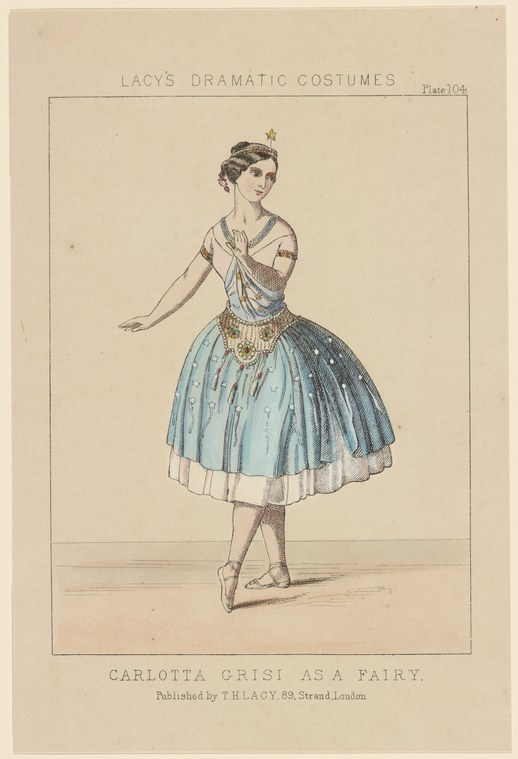
Carlotta Grisi as a fairy
Unknown artist
- Collection:
- Prints depicting dance
- Source:
- New York Public Library
- Rights:
- Public domain — free to use, share and adapt.
- Recorded as:
- Public Domain
Carlotta Grisi was a foundational figure in Romantic ballet and created or premiered roles in some of its most important works; this image is a primary document of how she appeared in character and how she was publicized. The print format and hand coloring reveal the infrastructure through which nineteenth-century dance reached audiences beyond the theater—democratizing access to images of celebrated performers while allowing for profitable mass production.
What you are looking at
A young woman in mid-nineteenth-century theatrical dress stands alone against a neutral background, posed in a graceful contrapposto stance. She wears a pale blue tulle skirt of mid-calf length with a cream-colored underskirt and hem, typical of Romantic-era ballet costume. Her bodice is a darker blue or teal, with short puffed sleeves that leave the shoulders bare, and she wears a jeweled belt or girdle at the waist. A small tiara or ornamental headdress sits atop her dark hair, which is styled up and back in the fashion of the 1840s. Her right arm extends gently outward at roughly shoulder height, palm open and relaxed, while her left hangs at her side. She stands en relevé—rising onto the balls of her feet in the classical ballet position—with her weight distributed lightly across both feet, her posture upright and her gaze directed downward and away in the demure manner of theatrical portraiture. The print is colored by hand in soft watercolor tones, with careful attention to the translucent quality of the tulle.
The dancing
The figure is a solitary dancer posed in a classical ballet stance. She rises onto the balls of her feet in the characteristic relevé position, demonstrating the lightness and verticality central to Romantic ballet technique. Her upper body is still and composed, with the raised arm held at an elegant but not exaggerated height; the gesture is refined rather than dramatically extended. Her posture and the softness of her expression—gazing down rather than out toward an audience—suggest the introspective quality of the Romantic ballet aesthetic, where ethereal grace superseded technical display.
The dance depicted
This is a theatrical portrait of a Romantic-era ballet dancer, most likely representing a specific performance or character rather than a generalized image of ballet. The title identifies the subject as Carlotta Grisi performing as a fairy—a common character type in the ballet of the 1840s, when Grisi was at the height of her fame. The costume, pose, and styling are consistent with the fairy roles that populated works like Giselle (1841), which Grisi created, and other ballets of that decade. The en relevé stance and the restrained arm position reflect the Romantic ballet technique of the period, in which dancers cultivated an illusion of weightlessness and otherworldly grace. The image records not how the dance moved in performance, but how a celebrated dancer wished to be remembered in a starring role.
How it was made
This is a hand-colored lithographic or engraved print, a standard format for theatrical publicity and souvenir imagery in the 1840s and 1850s. The base image was likely printed in black or sepia, then finished with watercolor washes in blue, cream, and flesh tones, applied by hand to individual impressions. This technique allowed for rapid, affordable production of multiple copies while retaining the appearance of a fine art object—ideal for sale to audiences as a keepsake of a celebrated performance or dancer. The delicate coloring and refined line work indicate this was aimed at a middle- to upper-class market, people who attended the opera house and could afford such prints.
About this work
This is a hand-colored theatrical print of Carlotta Grisi, one of the greatest Romantic ballet dancers of the nineteenth century, depicted in a fairy role of the sort she famously performed in the 1840s. The image captures the aesthetic ideals of Romantic ballet: ethereal grace, weightless elevation, refined technique, and the theatrical persona of a celebrated star. It is both a document of mid-nineteenth-century ballet costume and a record of how dancers of that era were marketed and memorialized through the popular print trade. The work belongs in a dance history collection not as art but as evidence—of a specific moment in ballet practice, of the materials through which performances entered popular memory, and of how a canonical dancer of the period was publicly represented.
How to look at it
Look first at the pose: the dancer is caught in the moment of rising, suspended on the balls of her feet, which was the foundation of Romantic ballet technique and an emblem of the weightlessness the style aspired to represent. The restrained arm position and downward gaze are equally characteristic—Romantic dancers favored introspection and stillness in portraiture, contrasting with the more ostentatious display of earlier ballet. The costume details—the short tulle skirt, the bare shoulders, the modest tiara—establish this as a performer of the 1840s and also signal a particular class of role: the supernatural female figure that dominated Romantic ballet. The hand coloring and the delicate line work are typical of how theatrical celebrity was packaged and sold to a mass audience in this period.
The artist
The print is credited to T. H. Lacy, a London publisher specializing in theatrical prints and playscripts. The artist or engraver is not recorded. Lacy's series of theatrical costume prints was a popular and profitable venture in the mid-nineteenth century, providing both keepsakes for theatergoers and material for costume reference.
The period
This print dates to the height of Romantic ballet in Europe, a period (roughly 1830–1850) when ballet became dominated by the figure of the ethereal, otherworldly ballerina—often a sylph, sprite, or supernatural being. Carlotta Grisi was one of the four greatest dancers of this era, alongside Marie Taglioni, Fanny Cerrito, and Lucile Grahn. The 1840s saw the consolidation of pointe work as a standard technique, the development of the tulle tutu as the canonical costume, and the emergence of the dancer as a celebrated public figure whose image could be reproduced and sold. Theatrical prints like this one were a booming market, reflecting the growing mass audience for opera and ballet and the development of new lithographic technologies that made color printing affordable.
Where it lives
This print is held in the New York Public Library's collection of prints depicting dance. It is one of many such theatrical prints published by T. H. Lacy of London, a major producer of theatrical imagery and dramatic texts in the mid-nineteenth century. The print was likely sold as a souvenir at the theater or through print shops, making it a commercial object designed for a broad audience rather than a fine art work.
Dance in this work
Questions about this work
Who was Carlotta Grisi?
Carlotta Grisi (1819–1899) was an Italian-born dancer who became one of the four canonical Romantic ballet dancers of the 1840s. She created the role of Giselle in the 1841 premiere of Giselle, one of the foundational works of classical ballet, and was celebrated across Europe for her technical mastery, dramatic presence, and ethereal quality. She retired from stage in the 1850s but remained a celebrated figure in dance history.
What does 'en relevé' mean in ballet?
Relevé means to rise up on the balls of the feet, lifting the heels off the ground. It is a fundamental technique in classical ballet and was especially important in Romantic ballet, where it created the illusion of weightlessness and otherworldly grace. In pointe work, dancers rise even higher, balancing on the tips of reinforced pointe shoes.
Why was 'fairy' a common role in 1840s ballet?
Romantic ballet drew heavily on folklore, fantasy, and the supernatural. Fairies, sylphs, spirits, and other magical beings populated the ballets of the period because they justified the ethereal, weightless style that dancers cultivated and because they offered a contrast between the mortal and immortal worlds that choreographers could explore. The otherworldly femininity of fairy roles aligned perfectly with the Romantic aesthetic of the age.
How were these prints made and sold?
These were lithographic or engraved prints produced from a prepared stone or metal plate, then hand-colored by workers applying watercolor to each impression. They were sold in print shops and often at the theater itself after performances, making them accessible to middle-class theatergoers as affordable souvenirs. Bulk production and hand coloring by assembly allowed publishers like Lacy to profit while keeping individual prints inexpensive.
More dance artwork





