49 works in this view — arrow keys or swipe to move between them.
Dance in Art
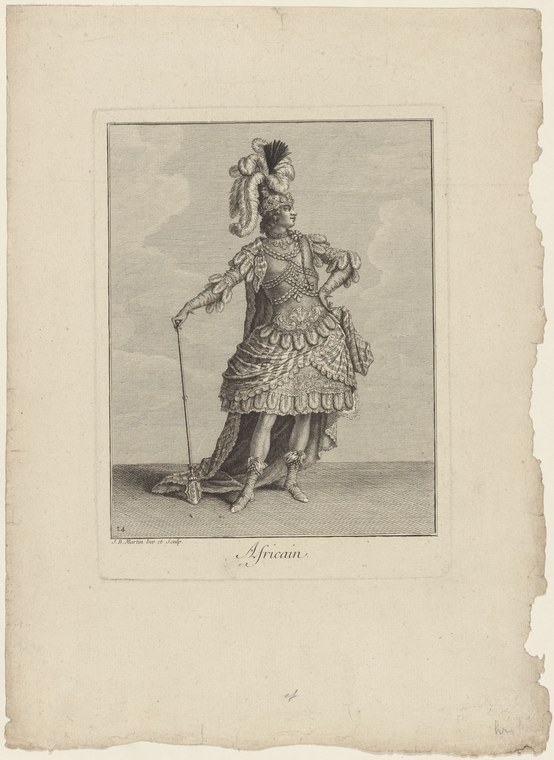
Africain: J. B. Martin inv. et sculp
Unknown artist
- Collection:
- Prints depicting dance
- Source:
- New York Public Library
- Rights:
- Public domain — free to use, share and adapt.
- Recorded as:
- Public Domain
This image is essential to understanding how European theatrical dance incorporated and distorted African and non-European performance traditions. It shows the machinery of exoticisation: how costume, headdress, and theatrical gesture were deployed to construct a racial and cultural category for entertainment. For historians of race in dance, theatre, and visual culture, this print is primary evidence of what 18th-century European stages meant by 'African' dance.
What you are looking at
A solitary figure stands against a plain ground in the classical manner of theatrical portraiture. The dancer wears an elaborate costume of the 18th-century stage: a plumed headdress rises from the crown, a decorated tunic with scalloped or draped hemlines descends to mid-thigh, and ornamental leg coverings or stockings extend to the feet. The garment is densely patterned, suggesting embroidery or appliqué work. The figure holds a cane or walking stick in one hand, with the other arm extended in a gesture of presentation or address. The body stands in a relaxed contrapposto, neither in motion nor in a posed balletic attitude—this is a portrait of a dancer in character rather than a captured moment of dance.
The dancing
The single standing figure displays a neutral upright carriage with weight settled on one leg. The free arm extends outward at roughly shoulder height in a gesture neither codified as ballet vocabulary nor drawn from pantomime; it reads as a conversational or theatrical gesture of address. The arm holding the cane rests naturally. The posture is aristocratic and assured, the frame broad and frontal, with no turnout or the lifted epaulement that would characterize formal classical training. The body speaks authority and character rather than technique.
The dance depicted
This is almost certainly a portrait of a dancer from the commedia dell'arte or theatrical tradition, possibly in the role of an African or 'exotic' character—a standard figure in 18th-century European entertainment. The label 'Africain' indicates this. The costume, headdress, and cane are consistent with stage dress for such roles. The image records costume and character type rather than actual African dance practice; it belongs to European theatrical convention and the history of race and representation in performance. Whether the dancer depicted here was African, European in blackface or exotic costume, or a white actor in character cannot be established from the image alone.
How it was made
This is an engraving or etching (the technique itself is not recorded, but the image shows the characteristics of intaglio printing: fine line work, cross-hatching for tone, and the formal rectangular border typical of 18th-century print publication). The inscription at the base reads 'Africain' and bears what appears to be a signature or mark, suggesting this was a published print, possibly part of a series of character studies or a theatrical costume book. The paper is aged and the margins worn, consistent with a historical object that circulated as a separate print rather than in a bound volume.
About this work
This engraving documents a theatrical character type from 18th-century European dance and performance: a figure identified as 'Africain,' dressed in an ornate stage costume that reflects European fantasies of exoticism rather than African dance practice or dress. The artist J. B. Martin signed the plate as both inventor and engraver (inv. et sculp), indicating he designed the character and cut the plate. The work belongs to a tradition of theatrical portraiture that used dance and costume to explore fantasies of otherness—a visual archive of how non-European bodies were staged, imagined, and consumed by European audiences. It is a valuable historical document precisely because it reveals the conventions of representation rather than the reality of performance.
How to look at it
Attend to the costume first: every element is European theatrical convention, not documentation of actual African dress or adornment. The plumed headdress, the scalloped tunic, the decorated stockings are all stage inventions. Notice the cane: it is an attribute of gentility and command, not an implement of African dance. The pose is stationary and frontal, designed to display the costume to the audience; there is no captured moment of movement, no dance vocabulary on view. This is a portrait of a character type, not a dancer in action.
The artist
J. B. Martin is recorded as inventor and engraver of this plate (inv. et sculp); beyond that the record is silent. The practice of signing as both designer and engraver was common in the 18th century and suggests either a printmaker of some standing or an actor-manager or theatrical designer who worked with an engraver. Without further research, no reliable context can be given.
The period
In the 18th century, European court and theatrical dance was codifying itself as ballet through Italian and French academies; the language of turned-out positions, lifted carriage, and refined gesture was becoming the standard of 'good' dancing. Simultaneously, theatrical dance incorporated 'exotic' characters—Turks, Chinese figures, Africans, Native Americans—as foils to classical refinement or as comic relief. These characters were played by European dancers in costume and typically danced in a more naturalistic or 'earthy' style meant to contrast with ballet's ethereal verticality. The 'Africain' figure belongs to this ecosystem of exoticisation.
Where it lives
The work is held in the Prints collection at the New York Public Library, catalogued as part of a group of prints depicting dance. It is a separate sheet, likely pulled from an 18th-century publication or portfolio of theatrical character studies or costume designs.
Dance in this work
Questions about this work
Is this an image of actual African dance?
No. This is a European theatrical costume and character type. The 'Africain' label reflects how 18th-century European theatre named and imagined non-European performance, not a documentation of African dance practice or aesthetic. The costume, headdress, and pose are entirely European in invention and purpose.
Who was this character and where would it have been performed?
This was likely a character from commedia dell'arte or court ballet, possibly a named role in a specific production or a stock type used across multiple works. Such figures appeared in both courtly entertainments and public theatre. Without additional documentation, we cannot identify the specific performance context.
What does the signature tell us?
J. B. Martin signed the plate as both inventor (inv.) and engraver (sculp.), meaning he designed the character and cut the printing plate. This suggests he was either a skilled printmaker working from a theatrical design, or a theatrical designer who also worked in print. The full identity and biography of Martin remain unclear from the record.
More dance artwork





