49 works in this view — arrow keys or swipe to move between them.
Dance in Art
Divinité infernale
Unknown artist
- Collection:
- Prints depicting dance
- Source:
- New York Public Library
- Rights:
- Public domain — free to use, share and adapt.
- Recorded as:
- Public Domain
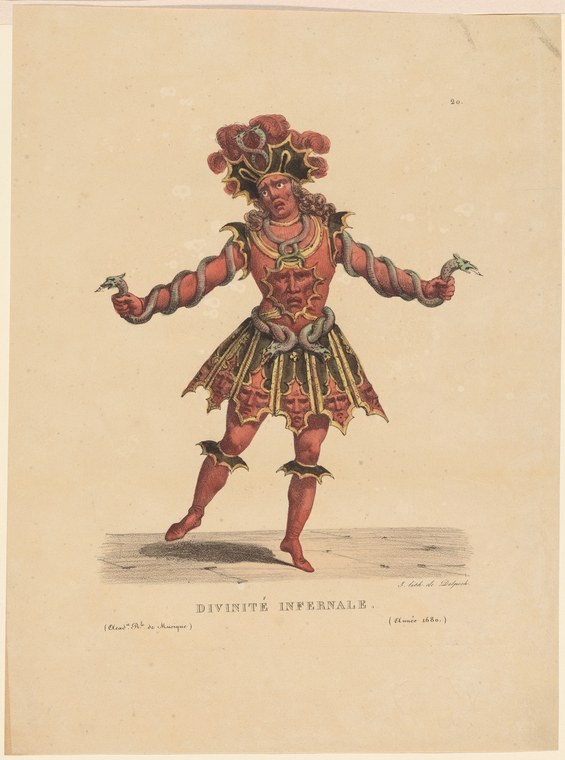
This image captures how early modern spectacle used costume, demonic characterisation, and bodily display to entertain and provoke. It shows that not all dance in art is beautiful or flowing; some is deliberately grotesque, aggressive, and meant to unsettle. For historians of performance, it documents the visual vocabulary of theatrical otherness that persisted across centuries of European entertainment.
What you are looking at
A single figure dominates the composition, staged against a plain background in a pose of theatrical display. The dancer wears an elaborate costume in deep reds and golds: a short, jagged-hemmed skirt decorated with ornamental patterning, fitted hose or tights, and curled-toe shoes that suggest eastern or fantastical dress. The torso is corseted and adorned with gold trim and jewels. Most striking is the headdress—a large construction of curled horns or scrolls in reddish-brown, rising high above the head and framing the face dramatically. The figure stands in a splayed, confrontational stance with arms spread wide and weight distributed evenly, confronting the viewer directly. The face is darkened or masked, with emphatic features rendered in profile-influenced style. The entire figure is rendered as a kind of demon or infernal deity: theatrical, aggressive, and deliberately othering.
The dancing
A single dancer fills the frame in a wide, assertive stance. Both arms are extended outward at shoulder height or slightly higher, palms apparently open or gesturing, with the elbows bent. The legs are planted firmly apart, and the body faces forward with no weight shift or flowing line—instead a rigid, confrontational frame. The posture is that of display or summoning rather than propulsion or lyrical extension. The stance reads as deliberately non-naturalistic: this is costume and attitude performing a character or archetype rather than executing a dance step.
The dance depicted
This appears to be a theatrical character or figure from court spectacle or commedia dell'arte tradition, rather than a recognisable social or ballet idiom. The title *Divinité infernale* (Infernal Divinity) and the demonic costume suggest a grotesque or comic role—possibly a devil figure, exotic deity, or carnival mask brought into a formalised theatrical setting. The stance and presentation are consistent with 16th- or 17th-century court entertainment or the masked performances of Italian popular theatre, where such figures would have been danced or mimed by performers in full costume. The image tells us this was a character meant to provoke through unfamiliarity and exoticism rather than grace.
How it was made
This is a hand-coloured engraving or print, executed with fine line work that defines the figure and its ornamentation with precision. The colouring—applied by hand in reds, golds, greens, and flesh tones—emphasises the costume's richness and the figure's otherworldliness. The technique allowed for multiple impressions to be circulated, suggesting this was a record or souvenir of a spectacle rather than a unique artwork. The fine detail and the care taken in rendering fabric, jewels, and features indicate this was made for a cultured audience familiar with courtly entertainment.
About this work
This is a print documenting a theatrical character or masked performer, most likely from 16th- or 17th-century court spectacle or carnival tradition. The figure is identified by costume and pose as a supernatural or infernal being—an exotic, dangerous, and laughable outsider introduced into formal entertainment. The work sits at the intersection of theatre history, costume documentation, and the long tradition of using dance and bodily performance to stage the uncanny or forbidden. It belongs in a gallery of dance because the entire effect—the stance, the display, the confrontation—depends on the performer's embodied presence and the audience's recognition of a performed role.
How to look at it
Observe the stance first: this is not a dancer in motion but a performer presenting a character, frozen in confrontation. The spread legs, extended arms, and frontal gaze create an aggressive geometry—unstable, wide, and deliberately unsettling. Note how the costume dominates; the darkened face and the exaggerated horns transform the body into a mask or emblem rather than a person. This is a moment of pure presentation, not transition. The artist has chosen to show not a step or turn but the performer in full character, as if the viewer has just encountered this figure on stage.
The period
Court entertainments and carnival traditions of the 16th and 17th centuries regularly featured masked figures, demons, and exotic characters danced or mimed by costumed performers. These figures derived from Italian commedia dell'arte, medieval mystery plays, and the masquerade traditions of Italian and French courts. Spectacles would blend music, dance, elaborate costume, and scripted character to create fantastical narratives. Such figures were often grotesque or sexually transgressive, allowing performers and audiences to temporarily license behaviour forbidden in ordinary courtly life. The print tradition emerged as a way to record and circulate images of these spectacles to a wider, literate public.
Where it lives
The work is held in the New York Public Library's collection of prints depicting dance. The inscription at the base gives the title in French and a date notation; the object is a hand-coloured print from the collection's holdings of historical dance imagery.
Dance in this work
Questions about this work
What is an 'infernal divinity' and why would it be danced?
In court spectacle and carnival tradition, supernatural and demonic figures were stock characters, danced or mimed by costumed performers to entertain and shock. These roles licensed grotesque, aggressive, or transgressive behaviour, letting performers embody danger or otherness safely within fiction. The figure advertised itself as dangerous and alien—the opposite of the refined courtier.
Is this a recognisable dance style?
Not in the sense of a defined technique like ballet or a social form like the minuet. This is a theatrical character or role, performed through posture, costume, and gesture. The 'dance' lies in the embodied display and the performer's ability to hold and project the character's attitude.
How do we know this was actually performed?
The print was made to record and circulate an image of the spectacle, suggesting it was a known and repeatable performance. The inscription and careful documentation imply this figure was a recognised character type in theatrical circles, likely seen in multiple productions.
More dance artwork





