49 works in this view — arrow keys or swipe to move between them.
Dance in Art
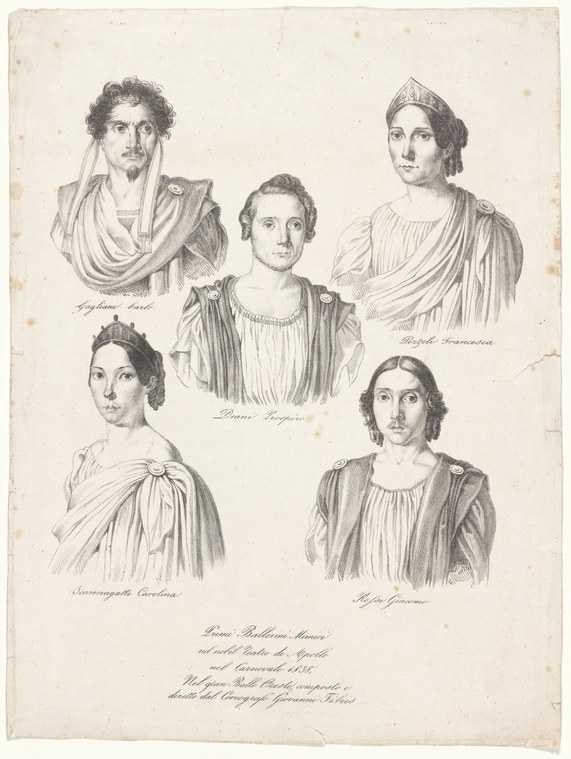
Primi Ballerini Mimici nel nobil Teatro di Apollo nel Carnevale 1838. Nel gran Ballo Oreste, composto e diretto dal Coreografo Giovanni Fabris
Unknown artist
- Collection:
- Prints depicting dance
- Source:
- New York Public Library
- Rights:
- Public domain — free to use, share and adapt.
- Recorded as:
- Public Domain
This image is one of the few surviving cast records from a significant 1838 Rome ballet, preserving the names and idealized likenesses of dancers who would otherwise vanish from the historical record. It demonstrates that mime was a star profession in early Romantic ballet, worthy of the same public promotion and portraiture accorded to principal dancers, and shows how theatre used engraving to build audience investment in known performers.
What you are looking at
Five figures are arranged on the page in a formal portrait format, each rendered as a bust-length engraved study. All wear neoclassical drapery — simple gathered chitons and draped mantles — shown in idealized, statuesque poses. The figures are positioned singly or in groups: two seated or reclining figures in the lower half of the composition, three standing or semi-reclining above, all gazing outward or upward with the serene expressions and refined features typical of neoclassical portraiture. The engraving is executed in fine parallel lines and cross-hatching, creating a sense of sculptural volume. Below the figures, a dedication in italic script identifies them as performers in a specific theatrical production. The page has aged to a cream tone with foxing spots, consistent with early 19th-century paper.
The dancing
The five figures display formal, composed posture with minimal bodily engagement. Arms are draped naturally across the body or extended in gestures of repose; weight appears centered and static rather than shifted in any direction suggesting movement. The heads are held upright, faces frontal or in three-quarter view, with refined classical features. There is no evidence of the contracted frame, extended leg, or dynamic weight shift characteristic of dancers in action. These are character studies presented as if for identification and record, not captured mid-performance.
The dance depicted
The title identifies these as *Primi Ballerini Mimici* — principal mime dancers — in the opera-ballet *Oreste* (Orestes), presented at the Teatro Apollo in Rome during Carnival 1838, choreographed and directed by Giovanni Fabris. Mime was a formal theatrical language in 19th-century ballet, distinct from the virtuosic dancing that occupied the stage simultaneously. The five individuals were likely principal mimes, responsible for narrating the classical plot through gesture and facial expression rather than dance technique. The image serves as a cast record, documenting the performers whose fame was attached to these roles, rather than a scene from the action itself.
How it was made
This is a copper-plate engraving, identified by the fine parallel hatching, the precise linear technique, and the method of reproduction. Engraving was the standard medium for theatrical portraiture and documentation in the early 19th century, allowing multiple impressions to be pulled and distributed. The format — multiple portrait busts on a single sheet with a printed dedication — was a conventional way for theatres and publishers to circulate cast information to patrons, critics, and collectors. The refinement of the line work and the idealized neoclassical dress indicate a high-quality commercial engraving, likely produced in Rome or circulated through the papal capital.
About this work
This is a cast portrait engraving documenting five principal mimes from the 1838 Rome production of *Oreste*, a major ballet of the Romantic era. Rather than depicting the ballet in performance, it functions as an official record of the performers who embodied key dramatic roles, presented in the neoclassical style favored for theatrical publicity of the period. The work sits at the intersection of theatrical promotion, portraiture, and dance history, offering evidence of the high status and public recognition of mime specialists in early 19th-century opera-ballet. For researchers, it documents both the cast hierarchy and the visual conventions used to market performances to the public.
How to look at it
The viewer should read this as a *document* rather than an *action image*. Each figure is positioned to be individually recognized and remembered. Look at the faces: the engraver has taken care to differentiate features and expressions, suggesting these were recognizable public figures rather than generic performers. The classical drapery and upright posture underscore the dignity of these mime roles — they are serious dramatic artists, not dancers. The layout — ordered, frontal, didactic — is the visual language of the theatre directory or cast list made portable and collectible.
The period
The early 19th century saw the rise of Romantic ballet across Europe, with Italy — particularly Rome and Milan — serving as a major production center. *Oreste*, based on classical mythology, was typical of the era's taste for dramatic ballet d'action, in which a coherent narrative was told through dance and mime over a full evening. Giovanni Fabris was an active choreographer in Rome during this period. The neoclassical aesthetic of the engraving reflects the contemporary ideal of dance and theatre, where performers were presented as refined, dignified figures in elevated costume rather than as entertainers in contemporary dress. Engraved cast portraits were standard publicity; many were collected, bound, or kept as souvenirs, and surviving examples provide crucial evidence of performance history.
Where it lives
The print is held in the New York Public Library's prints collection documenting dance. It is a commercial engraving, one of an unknown number of impressions, produced for distribution to audiences, critics, and collectors at the time of the 1838 production.
Dance in this work
Questions about this work
What is a 'Primo Ballerino Mimico'?
A principal mime dancer — a specialist in the dramatic, gestural language of classical ballet. Mime was not a minor or comic role in Romantic ballet; it was a serious artistic profession, often assigned to senior performers. The mime told the narrative through expressive gesture, facial movement, and spatial relationships while other dancers danced around them.
Was *Oreste* a famous ballet?
It was a significant production in the 1838 Rome carnival season, choreographed by the notable Giovanni Fabris. While not as widely documented as the most celebrated Romantic ballets of the Paris or Milan stages, its survival in prints like this indicates it had enough prestige to warrant formal cast documentation and wide promotion.
Why are the performers shown in classical dress rather than in a scene from the ballet?
This is a cast record, not a scene illustration. It served to introduce the audience to the performers and their roles before they saw the production. The classical drapery reflects both the subject matter (the Orestes myth) and the visual convention of the period, which treated dancers and actors as dignified public figures worthy of formal portraiture.
How do I know this is an engraving and not a drawing or lithograph?
The fine parallel lines (hatching) and the precise, regular cross-hatching are characteristic of copper-plate engraving. The quality of the line, the tonal gradation, and the uniformity of the medium all point to this technique. Lithography, which was available at the time, produces softer, more granular tones.
More dance artwork





