49 works in this view — arrow keys or swipe to move between them.
Dance in Art
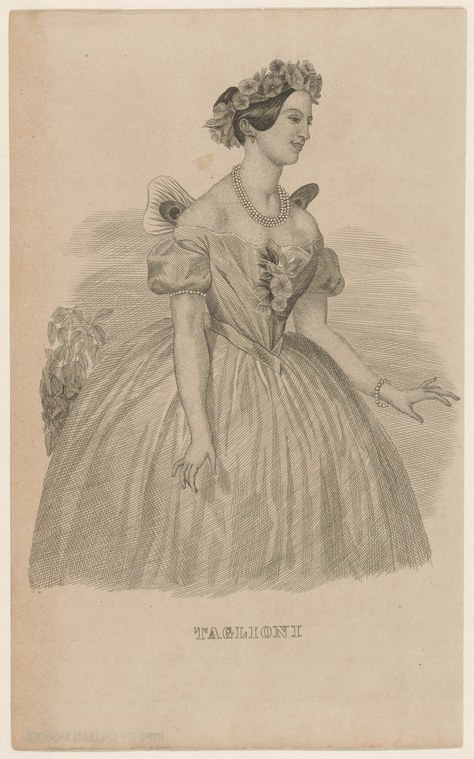
Taglioni
Unknown artist
- Collection:
- Prints depicting dance
- Source:
- New York Public Library
- Rights:
- Public domain — free to use, share and adapt.
- Recorded as:
- Public Domain
Taglioni defined Romantic ballet and this image is one of thousands of contemporary prints that shaped how people imagined the Romantic ballet body. The print itself is evidence of how 19th-century dancers achieved fame and how their image was commodified and circulated. For historians of dance and visual culture, this work documents the moment when ballet became a spectacle of the individual performer rather than the ensemble or the narrative.
What you are looking at
A three-quarter-length portrait of a woman in elaborate Romantic-era ballroom dress, rendered in fine engraving. She stands in a graceful contrapposto pose, her weight shifted to one leg in a manner that suggests forward motion or the moment just after a turn. The woman wears a full-skirted gown with characteristic puffed sleeves, delicate drapery at the waist, and a corseted bodice; the skirt's voluminous pleats are rendered with careful cross-hatching to show its weight and movement. Her hair is styled in a fashionable coiffure with a decorative comb or tiara, and she wears a simple pearl necklace. The background is neutral and lightly suggested with parallel lines, focusing attention on the figure. Her right arm extends downward with natural grace, while her left arm is positioned at her side; her posture conveys both dignity and the physical ease of a trained dancer.
The dancing
The figure presents the upright carriage and refined port de bras characteristic of early 19th-century ballroom and theatrical dancing. The weight distribution suggests a dancer at ease in the turned-out positions of classical technique, with the body elongated and the shoulders held back. The arm and hand position—particularly the extended right arm with slightly curved fingers—reflects the delicate arm movements taught in ballroom etiquette and romantic ballet. There is a single figure shown in isolation, posed as though caught between steps or in a moment of poised stillness.
The dance depicted
This is almost certainly a portrait of Marie Taglioni, the Swedish-Italian ballerina who revolutionized Romantic ballet in the 1830s and 1840s. The title inscription 'TAGLIONI' at the base of the print confirms this identification. Taglioni was renowned for her ethereal, weightless quality and for dancing *La Sylphide* (1832), which defined the Romantic ballet aesthetic. The engraving captures the idealized image of Taglioni that circulated widely through prints and lithographs during her career—presenting her in street dress or semi-theatrical costume rather than in full stage character, which was the convention for celebrity dancer portraits of the period. The pose and carriage are consistent with how Taglioni's contemporaries described her: supremely elegant, technically refined, and possessed of an almost supernatural lightness.
How it was made
This is a steel or copper engraving, a reproductive medium that allowed fine detail and wide distribution. The technique is evident in the careful parallel-line hatching used to model form and suggest fabric texture, particularly in the rendering of the skirt's pleats and the subtle shading of the face and neck. Engraving was the primary medium for circulating celebrity images of dancers in the 19th century, before photography, and this print format suggests it was made for popular sale—likely as a souvenir or memento for admirers of Taglioni's performances. The quality of execution indicates a professional engraver and a substantial publisher, not a cheap broadside.
About this work
This is a professional engraved portrait of Marie Taglioni, the defining ballerina of the Romantic era, created at some point during or shortly after her performing career (1822–1847). The image presents her in the fashionable dress of her day, posed with the refined carriage and gentle arm position that made her famous on stage. It belongs in a dance gallery because it documents not only how a legendary dancer was visualized in her own time, but also the conventions of celebrity representation in 19th-century dance—the print format, the pose, the combination of street dress and theatrical grace that allowed audiences to imagine the dancer as both accessible and extraordinary.
Taglioni's image was distributed in thousands of prints across Europe, and this engraving is an artifact of the first modern celebrity culture of dance. It shows how a dancer's fame was materialized and circulated, and how the body and carriage of a single performer could become the visual standard for an entire aesthetic movement.
How to look at it
Attend to the pose: the dancer is poised in a moment of refined repose, not dynamic action, yet the positioning of the weight and the extension of the arm suggest readiness to move. The artist has chosen to show Taglioni as an image of grace and control rather than virtuosity. Notice how the engraver has used fine parallel lines to suggest the weight and flow of the skirt—an important detail because the Romantic tutu, longer and fuller than the Classical skirt, was fundamental to the aesthetic. The neutral background and the isolation of the figure emphasize Taglioni as an icon rather than as a performer in a narrative scene, which reflects the conventions of celebrity portraiture in this period.
The period
This engraving dates to the height of Romantic ballet, a movement that emerged in the 1830s and prioritized ethereal, supernatural, and emotional content over the technical display of Classical ballet. Marie Taglioni's debut in *La Sylphide* in 1832 defined the aesthetic: the ballerina as a weightless, otherworldly creature, dancing on pointe (though not exclusively), with an emphasis on verticality and the illusion of effortlessness. The fashion for Taglioni was immense; she was the first international ballet superstar and the first dancer whose image was mass-produced and circulated as merchandise. The engraving format placed this portrait within the market for celebrity prints that flourished in the 1830s and 1840s, when lithography and engraving were the primary means of visual reproduction and distribution. The dress and styling of the portrait—the full skirt, the delicate arms, the elegant posture—all reflect the Romantic ideal that Taglioni embodied on stage.
Where it lives
This engraving is part of the New York Public Library's collection of prints depicting dance. It is undated and the artist/engraver is not recorded in the available catalogue data, which is not unusual for reproductive prints of this era, especially where the subject—the celebrity dancer—mattered far more to purchasers than the maker's name.
Dance in this work
Questions about this work
Who was Marie Taglioni?
Marie Taglioni (1804–1884) was a Swedish-Italian ballerina who became the first international superstar of dance. She famously created the title role in *La Sylphide* (1832), a ballet that defined the Romantic movement in dance. Taglioni was renowned for her ethereal quality, technical refinement, and the illusion of weightlessness—she was the first ballerina to dance an entire role on pointe, though this was revolutionary rather than routine as it became later. Her performances captivated European audiences and made her a celebrity; her image was reproduced in thousands of prints.
Why is this image just a portrait and not a scene from a ballet?
Celebrity dancer portraits of the 19th century typically showed the performer in fashionable street dress or semi-theatrical costume rather than in full stage character. This convention served multiple purposes: it made the dancer accessible and human to fans, it allowed the portrait to be timeless rather than tied to a single role, and it emphasized the dancer's own body and presence rather than a character. This format was also practical for mass production and sale as a souvenir.
What technique was used to make this print?
This is an engraving, a printmaking technique in which an image is incised into the surface of a metal plate (usually copper or steel) and ink is forced into the grooves. Engraving allowed for fine detail and subtle tonal effects, as you can see in the careful modeling of the face and the rendering of the fabric. It was more expensive and time-consuming than lithography but produced prints of higher durability and quality.
What does her posture tell us about how Romantic ballerinas moved?
The upright carriage, the turned-out position of the legs, the gentle extension of the arm, and the overall vertical alignment all reflect the technique and aesthetic of Romantic ballet. The pose suggests ease and control rather than exertion; the goal was to appear weightless and ethereal. The refinement of the arm position and the softness of the hand gesture are especially important—Romantic ballet valued graceful port de bras and an overall impression of floating rather than jumping.
More dance artwork





