49 works in this view — arrow keys or swipe to move between them.
Dance in Art
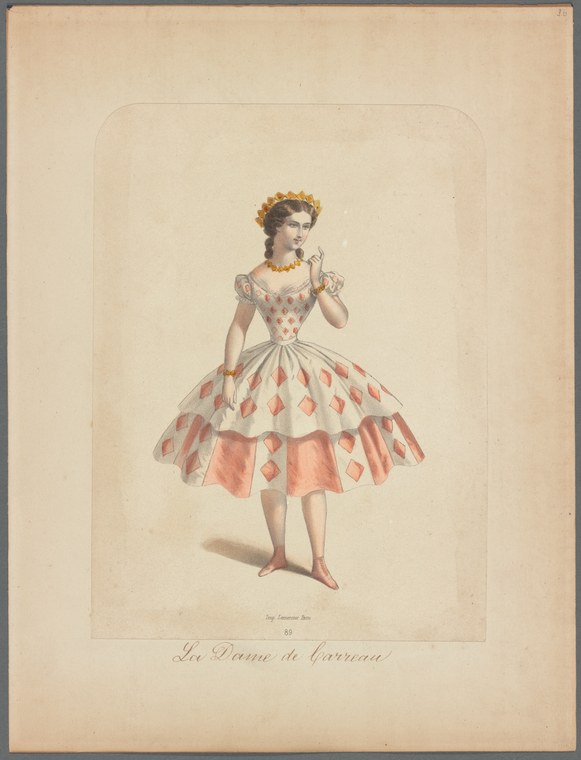
La dame de carreau
Unknown artist
- Collection:
- Prints depicting dance
- Source:
- New York Public Library
- Rights:
- Public domain — free to use, share and adapt.
- Recorded as:
- Public Domain
This image documents the visual conventions of romantic-era ballet—the costume, the ideal body, the pose, and the way dancers were commodified and celebrated as public figures. For historians of dance, theatrical fashion, and nineteenth-century celebrity culture, such portraits are primary sources showing how ballet was promoted, consumed, and remembered by its public. The widespread circulation of such prints in the nineteenth century also reveals the infrastructure of theatrical celebrity and the central role of the ballerina as a marketable, collectible figure.
What you are looking at
A single female dancer stands in a classical pose against a pale, neutral background, wearing an elaborate mid-nineteenth-century tutu and headdress. The tutu is constructed in the romantic style—white silk or tulle with a deep border of coral or salmon-pink diamond or lozenge-shaped panels arranged around the hem, creating a tiered, sculptural silhouette that extends to mid-calf. She wears a fitted bodice with a low, square neckline and short puffed sleeves, both embellished with the same coral diamond motifs that ornament the skirt. Her hair is styled in a centre-parted updo crowned with a decorative circlet or tiara. Her posture is upright and composed: weight appears centered, one leg straight and one slightly bent, arms held in a graceful frame—the nearer arm raised with a curved wrist, the far arm extended. She wears pink point shoes. A soft shadow cast beneath her feet anchors the figure in space. The hand-coloured quality and the delicate tonal gradations suggest this is a printed work—likely a lithograph or engraving—that has been finished with watercolour or similar pigment.
The dancing
The dancer's frame is classical and controlled: shoulders level, head held upright with a graceful tilt, arms rounded and expressive without tension. Her weight is poised rather than committed to movement, suggesting a moment of balance or preparation rather than the apex of a jump or turn. One leg bears weight; the other is softly pointed but not extended in a marked développé or battement. The hand positions—particularly the raised arm with curved fingers—conform to mid-nineteenth-century ballet convention. Her feet in pink pointe shoes suggest she is trained in academic ballet, though the pose itself is restrained and static rather than dynamic.
The dance depicted
This is a portrait of a romantic-era ballet dancer, likely a principal or prima ballerina, depicted in a pose that could serve as a generic representation of the ballet art rather than illustration of a specific choreography. The costume—the tutus with diamond decoration, the headdress, the pointe shoes—all identify this as theatrical ballet of the 1840s–1860s. The title 'La dame de carreau' (The Queen of Diamonds, from the playing card) suggests this is either a named character role (the dancer as a card suit or similar theatrical conceit) or a generic portrait with a playful title. The restrained pose and formal presentation suggest this is a portrait carte-de-visite or a promotional image of a named dancer rather than documentation of a specific ballet or a choreographic moment.
How it was made
This is a hand-coloured print, most likely a lithograph or steel-engraved plate that has been finished with watercolour or gouache applied to individual sheets. The technique allowed for mass production of theatrical portraiture and was the primary medium for distributing images of celebrated dancers to a wide public during the mid-nineteenth century. The soft modelling of the face, the delicate detail in the costume, and the subtle tonal gradations in the background and flesh tones are characteristic of skilled hand-finishing applied to lithographic prints. The New York Public Library's holding suggests this is part of a series of similar theatrical portraits, a common format for collecting and distributing images of performers to fans and theatre-goers.
About this work
This is a mid-nineteenth-century hand-coloured theatrical portrait of a ballet dancer in romantic-era costume, almost certainly issued as a popular print or carte-de-visite during the 1840s–1860s. The figure wears the quintessential costume of the romantic ballet: a tutted skirt with decorative diamond motifs, headdress, and pointe shoes. The artist is unknown, but the work belongs to a large tradition of portraiture that celebrated individual dancers and circulated their images to a theatre-going public. Such prints were both souvenirs of performances and promotional images that helped establish the reputation and celebrity of celebrated artists. The formal composition and static pose are typical of nineteenth-century dance portraiture: the dancer is presented as a finished artist in a characteristic silhouette rather than captured mid-movement or in a dramatic moment from a specific ballet.
How to look at it
Attend to the careful rendering of the costume: the diamond motifs on the tutu are not arbitrary but a signature detail, and they may indicate a specific role or a specific dancer's signature costume. Note the hand and arm positions, which follow a recognizable classical vocabulary—this is not a naturalistic representation but a stylized embodiment of ballet training and taste. The pose is balanced and restful rather than dramatic, suggesting this is a portrait in the sense that a formal photograph is a portrait: a presentation of the dancer in her professional identity rather than a snapshot of a moment in performance. The flat, clear background and the careful symmetry of the composition emphasize the dancer's formal status as a public figure rather than situating her in a narrative or dramatic scene.
The period
This work belongs to the era of the Romantic Ballet (c. 1830–1870), when the ballerina became the dominant figure in the art form and the ethereal, supernatural, and exotic became the primary subjects of choreography. The romantic tutu—the bell-shaped skirt worn from the knee or mid-thigh to mid-calf or ankle—became the defining costume of the era and remains the standard form for classical ballet. The proliferation of such hand-coloured theatrical portraits reflects the growth of mass culture and celebrity during the nineteenth century: dancers like Marie Taglioni, Fanny Elssler, and later figures became international stars whose images were collected, traded, and displayed in homes and theatres. The production of such prints was a significant commercial enterprise, with London, Paris, and New York all producing and distributing theatrical portraiture on a large scale.
Where it lives
The work is held by the New York Public Library's Dance Division or a related collection devoted to prints depicting dance. It is part of a large archival collection of theatrical portraiture, costume studies, and performance documentation spanning multiple centuries and continents.
Dance in this work
Questions about this work
Who was the dancer in this portrait?
The catalogue record does not identify the dancer. The title 'La dame de carreau' (The Queen of Diamonds) may be a character name, a playful pseudonym, or a generic title applied to the print. The costume and style are consistent with the 1840s–1860s, when many such portraits were produced, but without an artist's signature or publisher's mark, the dancer's identity cannot be determined from the image alone.
What does the diamond pattern on the tutu mean?
The diamond motif may be a decorative detail specific to a particular role or ballet, or it may have been a signature embellishment associated with a particular dancer's costumes. In the nineteenth century, principal dancers often had personalized or distinctive costume elements that helped identify them to the audience. Without additional documentation, the precise significance of this motif is uncertain, but it was clearly intentional and noteworthy enough to be preserved in the portrait.
How were these portraits distributed?
Such hand-coloured prints were sold by theatre box offices, by print sellers in major cities, and by mail order. They were collected by theatre enthusiasts, pasted into albums, displayed at home, and traded among fans. The format—a single figure on a neutral background—allowed for easy framing and display and made the portraits highly collectible. Some were issued as part of series, allowing collectors to assemble complete sets of celebrated dancers.
What is the dance style?
This is theatrical ballet in the romantic style, danced en pointe and characterized by ethereal, weightless movement and an emphasis on the ballerina as the primary focus. The pose itself is static and does not illustrate a specific step or choreographic moment but rather presents the ballerina in a characteristic attitude of classical ballet. The costume is the romantic tutu, which became the standard form for ballet and remains the classical uniform today.
More dance artwork





