49 works in this view — arrow keys or swipe to move between them.
Dance in Art
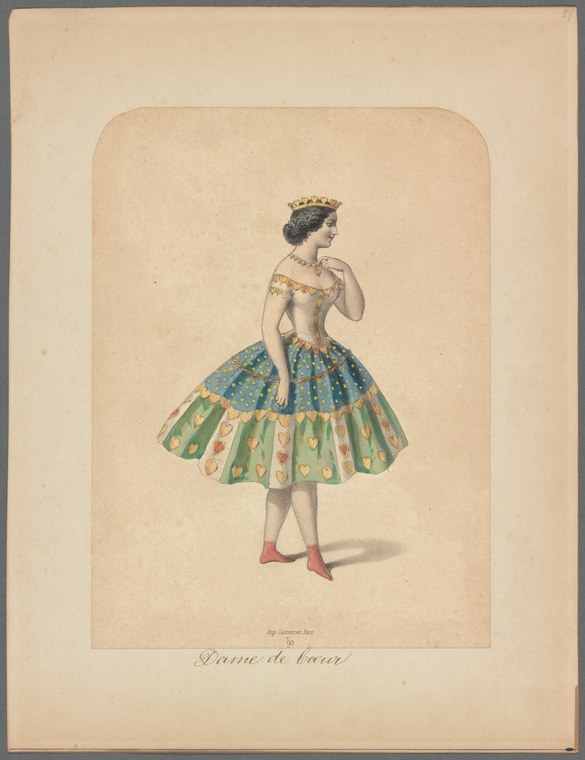
Dame de coeur
Unknown artist
- Collection:
- Prints depicting dance
- Source:
- New York Public Library
- Rights:
- Public domain — free to use, share and adapt.
- Recorded as:
- Public Domain
This image documents the visual identity and costume vocabulary of mid-nineteenth-century Romantic ballet at the height of its influence. For historians, it reveals how dancers were marketed to the public and how costume construction created the silhouettes and movement possibilities of the period; for dancers, it offers insight into the theatrical roles, dress codes, and aesthetic ideals that shaped the training and performance of their art.
What you are looking at
A single female figure in theatrical dress stands in a three-quarter pose against a plain cream background, her body angled to the right while her gaze and torso face toward the viewer. She wears a diadem or crown and an off-shoulder bodice in gold or tan with jewelry at her neck and upper arms. Her most striking feature is an elaborately constructed skirt that rises to a voluminous bell shape: the upper portion is teal-blue patterned with floral or foliate motifs in gold and green, while the lower half is divided into deep, stiff pleats or gores alternating between pale cream or white and sage green, creating a fan or shell-like silhouette. The construction suggests a heavily boned or wired understructure. She wears flesh-colored stockings and small red heeled shoes. Her right arm rests near her body while her left arm is raised, hand near her head in a graceful, elongated gesture. The figure's stance is light and turned, suggesting motion or performance, and the entire composition is framed by a rounded rectangle border.
The dancing
A single dancer occupies the frame in a turned, three-quarter position with her weight seemingly on one leg in a position suggestive of balletic stance. Her raised left arm follows a vertical line, hand delicate near her head, while her right arm hangs naturally. The pose suggests a moment of elegant repose or a classical attitude—the body is elongated and the carriage is upright. Her frame is narrow and her proportions idealized, consistent with theatrical dance training of the nineteenth century.
The dance depicted
This is almost certainly a Romantic-era ballet figure, likely from the mid-nineteenth century. The title "Dame de coeur" (Queen of Hearts or Woman of Hearts) and the theatrical dress—crown, jeweled bodice, and especially the constructed skirt—are consistent with the theatrical costumes of ballet blanc and court or fairy-tale roles. The pose and carriage reflect academic ballet technique of the period. However, the figure is shown in a standing pose rather than in active movement, suggesting this is a costume study or promotional image of a dancer in role rather than a depiction of a specific choreographed moment.
How it was made
This is a hand-colored engraving or lithograph, as evidenced by the fine black line work defining the figure and the precise outlines, combined with careful watercolor or lithographic tinting in muted palette (creams, teal, greens, flesh tones, and reds). The technique allowed for elegant linear detail in the costume and jewelry while the coloring builds volume and three-dimensionality. The rounded-rectangle frame and the inscription at the foot suggest this is a single-sheet theatrical souvenir or costume illustration, probably intended for publication in a theatrical journal or as a standalone print for collectors.
About this work
This is a theatrical costume study or souvenir print of a mid-nineteenth-century Romantic ballet dancer in the role of 'Dame de coeur.' The image captures the aesthetic of ballet blanc and courtly fairy-tale narratives that dominated European ballet in the 1840s–1860s. The work belongs in a dance collection as evidence of how Romantic ballet roles were visualized, marketed, and remembered—not as documentation of actual choreography, but as an idealized image of the dancer and her costume in performance persona. The careful rendering of the elaborate constructed skirt and the elegant pose indicate both the technical sophistication of costume design and the importance of the female form as the focus of balletic spectacle in this era.
How to look at it
Observe the constructed artificiality of the skirt: it is not a garment meant to move fluidly, but a sculptural object that extends the line of the body and creates a silhouette of elegance and otherworldliness. The dancer's pose—balanced, elongated, and graceful—reflects the academic ballet technique of the period, which prized verticality, turnout, and refined carriage. The crown and jewelry mark her as a figure of rank or fantasy. Note the artist's choice to show her in stillness rather than mid-leap or in a dramatic moment—this is a presentation of the role and the costume, not a narrative action.
The period
This print dates to the era of Romantic ballet (c. 1840–1870), when the female dancer became the focal point of European theatrical dance. This was the period of Marie Taglioni, Fanny Elssler, and the explosive popularity of works like La Sylphide and Giselle. During this time, theatrical prints and lithographs of famous dancers and their roles became commercial commodities, sold in sheet form to the public and collected by enthusiasts. The rise of chromolithography and hand-colored engravings made such images affordable and widespread, serving both as publicity for the theaters and as souvenirs for audiences.
Where it lives
The work is held in the New York Public Library's collection of prints depicting dance. It is a single-sheet theatrical souvenir or illustration, likely published in the mid-nineteenth century, though the artist and precise date are unknown.
Dance in this work
Questions about this work
What is 'Dame de coeur' and why would a dancer perform this role?
'Dame de coeur' translates to 'Woman of Hearts' or 'Queen of Hearts' and likely represents a court or fairy-tale role in a mid-nineteenth-century ballet. Such roles were common in Romantic ballet, which frequently drew on literary sources, mythology, and fantasy narratives. The role would have been performed by a principal dancer at a major European theater.
Is this a real costume or an exaggeration by the artist?
The costume appears to be exaggerated but not fantastical. The basic elements—jeweled bodice, crown, and constructed skirt—are consistent with documented mid-nineteenth-century ballet costumes. However, the artist has likely idealized and emphasized the proportions of the skirt to showcase the costume's elegance and to create a visually striking image suitable for a theatrical souvenir.
Why is the figure shown standing still rather than dancing?
This is a costume study or role portrait, not a depiction of choreography in action. Such images served as publicity and costume documentation, presenting the dancer and role to the public in a formal, idealized manner. The standing pose allows the full costume to be displayed and admired.
More dance artwork





