49 works in this view — arrow keys or swipe to move between them.
Dance in Art
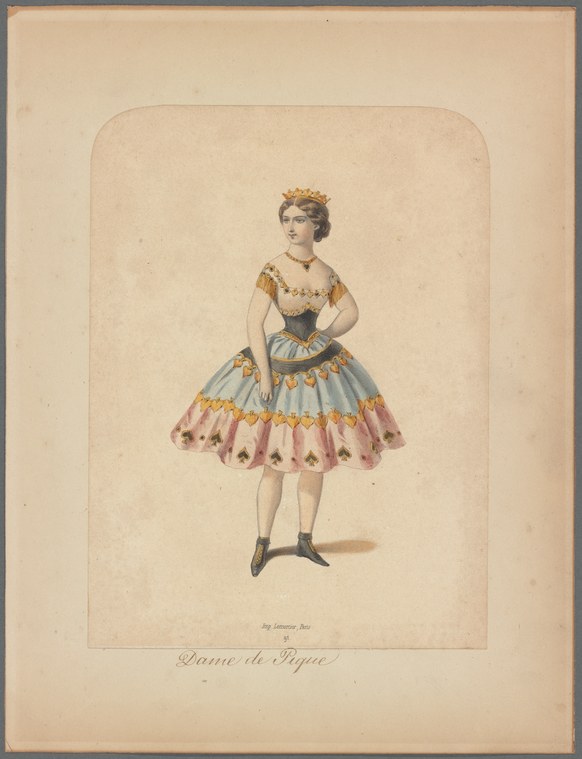
Dame de pique
Unknown artist
- Collection:
- Prints depicting dance
- Source:
- New York Public Library
- Rights:
- Public domain — free to use, share and adapt.
- Recorded as:
- Public Domain
This image preserves evidence of how mid-19th-century theatrical dancers were visually presented to the public and how their roles were merchandised through costume. The specificity of the named role ('Dame de pique') and the professional quality of the print suggest this was a celebrated performance, offering a rare window into the material culture and visual promotion of Romantic-era ballet. For historians of dance costume and theatrical practice, this is primary evidence of how bodies were dressed, framed, and commodified in the Victorian theater.
What you are looking at
A single female dancer stands centered against a plain background in a three-quarter pose, facing slightly left. She wears an elaborate mid-19th-century costume: a short, wide skirt in pale blue silk with a deep hem band in rose or mauve decorated with gold embroidery and small floral or ornamental motifs. The skirt is gathered at a dark corset waist and sits well above the ankle, revealing black ankle boots with heels. Her upper body is dressed in a short-sleeved bodice with a low neckline trimmed in gold braid, and she wears a gold tiara or decorative headdress in her upswept auburn hair. A gold chain or necklace adorns her neck. Her posture is upright and composed, with one foot slightly advanced, suggesting a moment of repose rather than active movement. The figure is rendered with watercolor or hand-colored engraving technique against an off-white ground, and her shadow falls subtly beneath her feet, anchoring her in space.
The dancing
The single dancer stands in a relaxed, frontal pose with minimal dynamic tension in the limbs. Her weight appears evenly distributed, with the advanced foot suggesting either a preparatory stance or a moment of transition. The arms hang at the sides in a natural position, unstudied and without the lifted frame or turned-out épaulement typical of classical ballet training. Her shoulders are level and unbraced. This is a portrait stance rather than a captured moment of choreography—the body presents itself to the viewer rather than expressing movement or partnered interaction.
The dance depicted
This is a theatrical dancer of the mid-19th century, most likely a performer from the Romantic ballet era (1830s–1850s), presented in the costume of a specific role. The title 'Dame de pique' (Queen of Spades) suggests a character from a dramatic or pantomimic narrative rather than a pure classical ballet. The costume—with its short skirt, corset silhouette, and decorative headdress—aligns with the theatrical fashion of the 1840s. However, the image does not depict active dancing or a recognisable dance technique; it is instead a promotional or documentary portrait showing the performer's costume and appearance. The pose and presentation suggest this is one in a series of character studies, likely published as a print to document the dress and roles of popular dancers of the period.
How it was made
This is a hand-colored engraving or aquatint print, a standard format for theatrical portraiture in the mid-19th century. The technique allowed fine detail in the costume and face while using watercolor wash to render the fabric textures and colors. The controlled line work and the precision of the engraved outlines are consistent with professional theatrical print production, while the hand-coloring—visible in the subtle modulations of blue in the skirt and the individual flower motifs in the hem—shows the work of a colorist's hand. Such prints were affordable, portable, and widely distributed to theater audiences and collectors, making them a primary means of circulating images of popular dancers and roles.
About this work
This is a mid-19th-century hand-colored theatrical print documenting the costume and appearance of a dancer in the role of 'Dame de pique' (Queen of Spades). The work belongs to a tradition of promotional portraiture that emerged with Romantic ballet and the rise of the theatrical star system. The dancer is presented in full stage costume—a short Romantic-era skirt, tiara, and decorative jewelry—in a posed studio setting that emphasizes the visual spectacle of her dress rather than the dynamics of dance itself. The print is a historical record of both the performer's appearance and the theatrical fashion of its time, and a valuable document of how dancers and their roles were marketed to audiences in the era before photography became standard.
How to look at it
Observe the precision of the costume details—the placement and pattern of the hem embroidery, the fit of the corset, the cut and drape of the skirt, and the style of the headdress—all of which provide evidence of 1840s theatrical fashion. Note that the dancer is not in motion: this is a presentation pose designed to display the costume and the performer's face and bearing to an imagined audience looking at a print. The watercolor finish and the subtle shadow beneath the feet create a sense of the figure standing on a stage or in a studio, yet the background is neutral and abstract rather than scenographic. This is a promotional image, not a dance document.
The period
This print dates to the height of Romantic ballet (1830s–1850s), an era when ballet was dominated by female performers and roles, and when the short tutu and ethereal aesthetic became standard. The theatrical print industry was flourishing in this period, particularly in France and England, producing thousands of hand-colored engravings of popular singers, dancers, and actors. These prints were sold at theaters, through print shops, and by subscription, and they served both as souvenirs and as fashion documentation. The 'Queen of Spades' theme may reference literary or operatic sources popular in the period, though without further archival evidence, the specific production cannot be identified.
Where it lives
This hand-colored engraving is held in the New York Public Library's collection of prints depicting dance. The collection preserves theatrical and documentary imagery spanning several centuries and multiple traditions. The work is catalogued by title and format but without named artist or precise publication date, which is typical of theatrical prints of this era, many of which circulated anonymously or with credit only to the publisher.
Dance in this work
Questions about this work
What role is this dancer performing?
The title 'Dame de pique' translates as 'Queen of Spades,' suggesting a character from a dramatic ballet or pantomime with a literary or operatic source. Without additional documentation, the specific production and its date cannot be confirmed. The costume and print style are consistent with Romantic-era ballet of the 1840s.
How were theatrical dancers promoted and documented before photography?
Hand-colored engravings like this one were the primary means of circulating images of famous dancers and their roles. These prints were sold as souvenirs at theaters and through print shops, and they also served as fashion documentation, showing audiences what stars wore and how they appeared. They were affordable enough to be mass-produced but detailed enough to preserve accurate costume information.
Why is the dancer shown standing still rather than dancing?
This is a costume portrait, not a action image. The print's purpose was to document the performer's appearance and the role's costume for publicity and archival purposes. A static, frontal pose allowed the artist to render costume details clearly and to present the performer to the viewer as a professional and a star. Theatrical prints of this era rarely attempted to depict movement.
What does the short skirt tell us about the period?
The knee-length tutu became standard in Romantic ballet from the 1830s onward, replacing the longer skirts of earlier eras. It allowed greater visibility of the leg and footwork, and it became associated with the ethereal, weightless aesthetic that defined the period. This costume is characteristic of mid-19th-century ballet practice.
More dance artwork





