49 works in this view — arrow keys or swipe to move between them.
Dance in Art
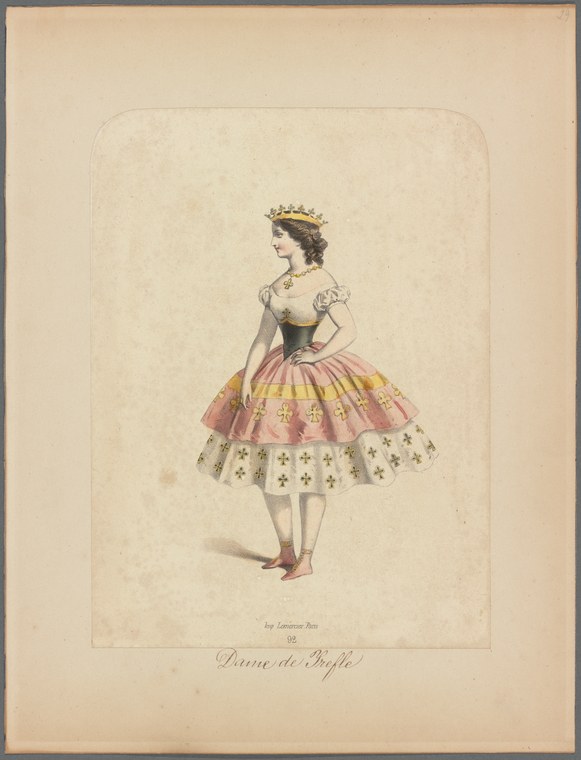
Dame de trefle
Unknown artist
- Collection:
- Prints depicting dance
- Source:
- New York Public Library
- Rights:
- Public domain — free to use, share and adapt.
- Recorded as:
- Public Domain
This image preserves a record of how a specific theatrical role was costumed and presented to audiences in the Romantic ballet era, at a moment when named character roles in ballet were becoming increasingly elaborate and codified. For dancers and historians, it offers concrete evidence of the visual language of mid-19th-century ballet—the silhouette, the color palette, the use of tiara and ornament to signal rank and character—at a level of detail rarely preserved in written records. The print format itself is historically significant: it shows how lithography was used to popularize and commodify the image of the dancer, making the theatrical spectacle portable and collectible.
What you are looking at
A single female dancer stands in three-quarter profile against a plain cream background, posed in a moment of stillness rather than active motion. She wears an elaborate mid-19th-century costume: a fitted black bodice with short puffed sleeves and a low neckline, paired with a dramatically voluminous skirt composed of three tiers of ruffled fabric in contrasting colors—pink silk with gold accents at the top, white linen or muslin at the base, decorated with small repeated floral or cross motifs in gold. The skirt is gathered or gathered in a way that creates distinct horizontal bands and allows it to flare sharply outward. She wears red heeled slippers. A simple tiara or coronet sits upon her hair, which is styled up in the period fashion. Her posture is upright and composed, with one arm held at her side and the other positioned gracefully. The title 'Dame de trefle' (Lady of Clubs) is inscribed below the image, and there is text at the bottom left that appears to read 'hop Lithograph Paris' or similar.
The dancing
The figure is a single dancer, standing in an elegant but restrained pose rather than mid-leap or mid-turn. Her weight appears evenly distributed on both feet, with minimal indication of active footwork or mid-movement capture. The arm positions are graceful but static: one arm hangs naturally while the other is softly bent or raised. Her frame is upright and dignified, with the torso held vertically and the neck elongated. There is no partner, no dynamic weight transfer, and no sense of rapid movement frozen in time; instead, the artist has chosen a moment of poise and display.
The dance depicted
This image most likely depicts a dancer in the Romantic ballet era, probably from a stage work or a character dance sequence. The elaborate costume, the tiara, and the composition suggest this is a named character or a specific theatrical role rather than an anonymous corps member. The 'Dame de trefle' title—referencing one of the card suits—suggests this might be from a ballet with a playing-card theme, a device that appeared in mid-19th-century dance works. The pose is characteristic of a pose de présentation rather than a moment of active choreography; the artist has frozen the dancer in a formal, almost heraldic stance that emphasizes the beauty of the costume and the dancer's bearing rather than her technical skill in motion.
How it was made
The image is a hand-colored lithograph, a process evident from the soft, slightly textured application of color and the way light washes have been built up in layers—the facial features are delicately rendered in thin washes, while the fabrics show distinct hand-coloring in clearly demarcated areas. The print shows signs of aging typical of 19th-century lithography: slight foxing and a cream-toned background. The inscription 'hop Lithograph Paris' at the lower left indicates the work was printed in Paris, a major center for dance illustration and theatrical lithography in the 1830s–1860s. This process allowed for wide circulation of theatrical images to theater-goers and collectors, making such prints a key document of how specific roles were visualized and marketed to the public.
About this work
This is a hand-colored lithographic portrait of a Romantic-era ballet dancer in theatrical costume, captured in a formal, heraldic pose rather than mid-choreography. The work belongs to a tradition of theatrical portraiture that emerged in early 19th-century Paris, where lithography allowed theaters and publishers to circulate images of celebrated dancers and specific roles to audiences and collectors. The elaborate costume, the named character (Dame de trefle), and the restrained, dignified pose all suggest this represents a specific performer in a specific role, likely from a popular ballet of the 1840s–1860s. The work is simultaneously a document of theatrical fashion, a record of a named role in dance history, and an example of how printmaking democratized access to the spectacle of professional dance.
How to look at it
Look first at the costume and pose: the artist has chosen an utterly still, frontal or three-quarter presentation, not a moment of action. This is typical of theatrical portraiture, where the goal is to display the beauty of the role and the performer's dignity rather than to capture technique. Notice the precision of the tiered skirt—each tier of fabric is a different color and pattern, suggesting expensive, labor-intensive costuming. The delicate hand-coloring shows the artist or hand-colorist's attention to the fabric surfaces and textures. The tiara and the formal posture together signal that this is a character of rank or fantasy status, not an ordinary maiden or a nameless corps dancer.
The period
This work dates to the peak of Romantic ballet, an era when narrative ballets with elaborate costumes and named characters began to dominate the stage in Paris and throughout Europe. The mid-19th century saw an explosion of theatrical lithographs marketing specific roles and performers; prints like this were sold in theater lobbies and through print shops, creating a visual archive of ballet that complemented written reviews. The costume—with its tiered, colorful skirt and the suggestion of fantasy (the card-suit naming convention)—fits the aesthetic of ballets like 'Le Jeu de Cartes' or similar fantastical narratives popular in the 1840s–1860s. Hand-colored lithography was the dominant technology for this kind of theatrical portraiture; it was faster and cheaper than engraving and allowed for wider distribution than painting.
Where it lives
The work is held in the New York Public Library's prints collection on dance. It is part of a broader archive of theatrical lithographs from the 19th century, many produced in Paris and distributed internationally to document and promote ballet and theatrical dance.
Dance in this work
Questions about this work
What is a 'Dame de trefle'?
The title refers to the Lady of Clubs—one of the suits from a deck of playing cards. This suggests the dancer performed in a narrative ballet or theatrical sequence that used cards or card suits as characters. Card-themed ballets were popular in the mid-19th century as a way to create elaborate fantasy worlds with clearly differentiated characters.
How do we know this is Romantic ballet?
The costume is the key evidence: the tiered, ruffled skirt, the puffed sleeves, the tiara, and the emphasis on ornamental fabric are all hallmarks of Romantic-era ballet (c. 1830–1860). The formal pose and the theatrical presentation also match the conventions of how dancers and roles were presented in this period.
Why is she standing so still?
This is a portrait of a role, not a moment from choreography. The artist chose to present the dancer in a formal, dignified stance that emphasizes the costume and the character's status. This was standard practice in theatrical portraiture—the goal was to make the role recognizable and visually appealing, not to capture mid-movement technique.
How was this image made and distributed?
This is a hand-colored lithograph, a printing process that allowed multiple copies to be produced and hand-tinted with watercolor. Such prints were sold in theater lobbies, print shops, and through subscription to create a visual record of popular roles and performers. This made ballet imagery accessible to a wide public, not just theatergoers.
More dance artwork





