49 works in this view — arrow keys or swipe to move between them.
Dance in Art
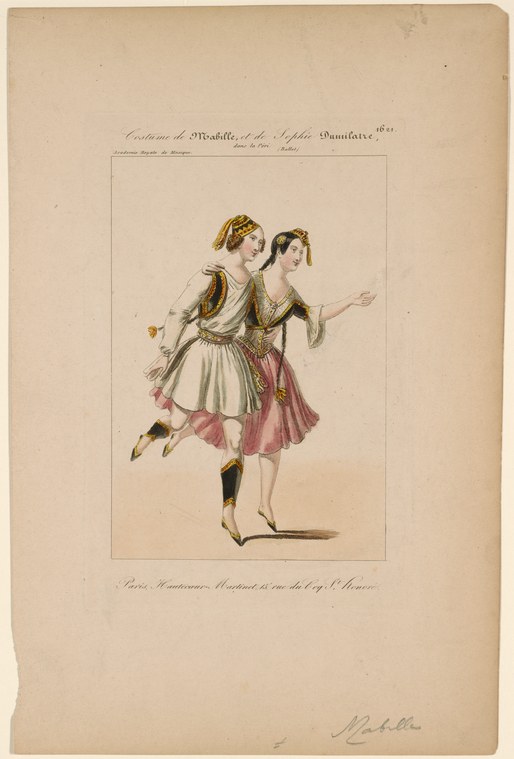
Costume de Mabille, et de Sophie Dumilâtre, dans La Péri
Unknown artist
- Collection:
- Prints depicting dance
- Source:
- New York Public Library
- Rights:
- Public domain — free to use, share and adapt.
- Recorded as:
- Public Domain
This work documents a specific moment in a landmark Romantic ballet and preserves the precise costume and posture of two named dancers—Mabille and Dumilâtre—at the height of their careers. As a costume plate, it is evidence of how theatrical dance was professionalized, documented, and circulated across the nineteenth-century world. For anyone studying Romantic ballet, French theatrical practice, or the material culture of dance, it is an exact contemporary record.
What you are looking at
Two female dancers are depicted in a lively pose against a plain background, rendered in hand-colored engraving or lithography. Both wear Romantic-era ballet costume: short, pale tutus with fitted bodices, their hair styled with golden ribbons or ornaments. The dancer on the left faces right in profile, her body angled forward in an energetic posture; the one on the right faces left, her arm extended outward in an inviting gesture. Both wear soft ballet slippers and black stockings or leg wrappings. The composition captures a moment of interaction between the two—the extended arm of the right-hand figure suggests engagement or partnered movement, while the forward pitch of the left-hand figure conveys momentum. The style of the dress, the pale tulle, and the overall composition are consistent with Romantic ballet of the 1840s.
The dancing
Both dancers are shown in upright, active positions with the weight distributed lightly through the legs. The figure on the left leans forward from the hip, suggesting a preparatory or traveling action; the figure on the right stands more centered, with her right arm extended outward at approximately shoulder height in a beckoning or narrative gesture. Their arms are not in a formal ballroom hold but positioned independently, which suggests solo or loosely partnered movement rather than strict couple dances. The delicate, balletic posture throughout—the carriage of the head, the line of the spine, the pointed feet—indicates training in theatrical ballet of the period.
The dance depicted
This is a costume study for *La Péri*, a Romantic ballet choreographed by Jean Coralli and Théophile Gautier, first performed in 1843. The inscription confirms the figures represent Mabille and Sophie Dumilâtre, who danced in this work. *La Péri* was a major Romantic ballet featuring a supernatural peri (spirit being) and human protagonists, and the costume shown here—the short tutu, the tight bodice, the pale tones—is the standard Romantic ballet dress of that era. The image is a costume plate, used to document and distribute designs for dancers and theaters. The narrative pose of the two figures, and the artist's choice to show them in an engaged moment rather than an isolated study, suggests this captured or referenced a specific pas de deux or ensemble moment from the ballet's choreography.
How it was made
This is a hand-colored engraving or lithograph, evident from the fine line work defining the figures' outlines and the watercolor or gouache coloring applied over the printed image. The technique allowed for mass distribution of costume designs to theaters across Europe and the Americas, making it a practical tool for professional dancers and choreographers. The careful attention to detail—the rendering of the fabrics' texture, the precision of the figures' positions, the legibility of the costume trim—indicates this was made as a professional publication, likely for dancers learning the roles or for theaters producing the work.
About this work
This is a costume plate documenting two roles in *La Péri*, one of the signature Romantic ballets of the 1840s. It records not simply what the dancers wore but how they were posed in a moment of dramatic interaction—a visual archive of performance style at the height of the Romantic movement in ballet. The engraving format allowed it to circulate widely, serving as a reference for dancers and theaters abroad and as a souvenir of a celebrated production. For historians of dance costume, theatrical practice, and Romantic aesthetics, it is a rare and precise record of how major roles were embodied and presented in this pivotal era of ballet history.
How to look at it
Attend to the specific posture of each figure: the left dancer's forward lean and the right dancer's extended arm create a sense of dialogue or narrative rather than pure formal display. This suggests the image captures or references an actual choreographic moment—a pas de deux or ensemble passage—rather than a static costume presentation. Notice also how the artist has rendered the weight distribution: both dancers appear light and lifted, the spines long, the line from hip to ankle attenuated, all hallmarks of Romantic ballet technique. The costume details—the golden ribbons in the hair, the precise rendering of the tulle—were not incidental: they were part of the visual identity of the role and would be recognized by audiences familiar with the ballet.
The artist
The artist is not recorded in the catalogue. However, the style and format are consistent with professional theater lithographers and engravers working in Paris during the 1840s, when such costume plates were a standard commercial practice. The inscription suggests the work was published either by a theatrical house or by a print seller specializing in theatrical imagery.
The period
This costume plate dates to the golden age of Romantic ballet in Paris. *La Péri* premiered in 1843, a moment when the Romantic ballet was at the peak of its influence: the supernatural themes, the ethereal aesthetic, the emphasis on the ballerina's virtuosity and grace were central to the movement. The use of the short tutu, pointe shoes (visible in the delicate slipper work), and pale, floating fabrics was not merely fashion but embodied the Romantic ideal of weightlessness and otherworldliness. The practice of publishing costume plates was part of the professionalization of ballet in this era—a way to standardize productions, train dancers in other cities, and create a market for theatrical imagery among the public.
Where it lives
This work is held in the New York Public Library's collection of prints depicting dance. It is a published engraving or lithograph, part of a body of theatrical costume documentation from the nineteenth century. The inscription and format suggest it was issued as a standalone print, possibly for circulation to theaters and dancers.
Dance in this work
Questions about this work
Who were Mabille and Sophie Dumilâtre?
Sophie Dumilâtre was a prominent Parisian ballerina of the 1840s, known for her technical skill and interpretive range. Mabille was a contemporary dancer, likely in supporting or ensemble roles. Both appear to have danced in *La Péri* during its run in Paris. Theater records and dance histories of the period would provide fuller biographical detail, but this costume plate is one of the few records that preserves their appearance in a celebrated role.
What was *La Péri* about?
*La Péri*, with choreography by Jean Coralli and a libretto by Théophile Gautier, tells the story of a mortal protagonist's encounter with a peri—a supernatural being from Persian mythology. It blended the Romantic fascination with the otherworldly, exotic themes, and the display of the ballerina's technical and expressive abilities. The ballet was a major success and was performed across Europe and beyond.
Why were costume plates important?
Costume plates served multiple purposes: they documented designs for theaters producing the same ballet in different cities, provided reference materials for dancers learning roles, and created a market for theatrical imagery among the public. Before photography, engraved and lithographed costume plates were the primary way that performance styles and designs were circulated and preserved.
How can you tell this is a Romantic ballet costume?
The short tutu (roughly knee-length), the fitted bodice, the pale, ethereal colors, the soft ballet slippers, and the long, lifted line of the body are all signatures of Romantic ballet, as distinct from earlier Classical or later ballet styles. The emphasis on weightlessness and grace—achieved through the short skirt that exposed the leg and showed off technique—was deliberate and new in the 1840s.
More dance artwork





