49 works in this view — arrow keys or swipe to move between them.
Dance in Art
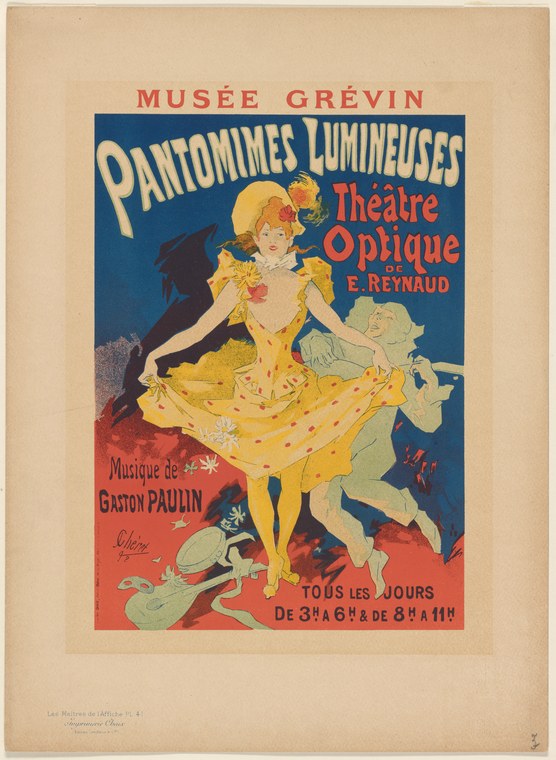
Musée Grévin, pantomimes lumineuses, Théâtre Optique de E. Reynaud, musique de Gaston Paulin
Unknown artist
- Collection:
- Prints depicting dance
- Source:
- New York Public Library
- Rights:
- Public domain — free to use, share and adapt.
- Recorded as:
- Public Domain
The Théâtre Optique was a direct precursor to cinema; this poster captures the moment when dance-like movement became a recorded, repeatable medium. For dance historians, it illustrates how late 19th-century theatrical pantomime—a form deeply indebted to ballet vocabulary—translated into animation, and thus how dance vocabulary shaped early cinema. The work also documents a specific entertainment technology and the Parisian leisure culture that sustained it.
What you are looking at
This is a poster for the Musée Grévin's Théâtre Optique, a proto-cinematic light-projection entertainment. A young woman in a yellow dress with puffed sleeves and a yellow bonnet dominates the composition, her body twisted in an exuberant contrapposto pose. She gazes downward with a coy expression while her skirt balloons outward, caught mid-movement. Behind and beside her, rendered in paler tones, are two cherub-like figures—one dark and shadowy to the left, one greenish-pale to the right—who seem to be attending or pursuing her. The background is divided: deep cobalt blue above, warm coral-red below, creating theatrical depth. The palette is vivid and flat, typical of Belle Époque chromolithography. The setting reads as a stage or fantastical space rather than a naturalistic interior.
The dancing
The central figure stands with weight shifted onto one leg, the other extended and relaxed; her torso is angled and her shoulders asymmetrical, creating a sense of arrested motion. Her arms are held at roughly shoulder height in an open, expansive gesture—neither a balletic port de bras nor a classical frame, but something lighter and more playful. The two attendant figures are diminutive and sketch-like; their posture and positioning suggest they are reacting to or supporting the main dancer's movement. The composition shows a solo female figure as the clear focal point, with secondary characters arranged in a subordinate spatial relationship.
The dance depicted
This image documents the Théâtre Optique, Émile Reynaud's animation device (patented 1877, displayed at the Musée Grévin from 1892). The 'Pantomimes Lumineuses' were not live dance but animated performances—hand-drawn figures projected onto a screen in sequence to create the illusion of movement. The figure's pose is consistent with the flowing, whimsical movement vocabulary of late 19th-century theatrical pantomime and féerie (spectacular fairy plays), but it represents animated pantomime, not live dance. The music was by Gaston Paulin. The work bridges theatre and cinema: it employed dance-like gesture and narrative, but executed through optical projection rather than performed bodies.
How it was made
This is a color lithographic poster, likely from the 1890s, printed in the style of the Belle Époque entertainment poster. The technique allowed for bold, flat areas of colour and flowing contours suited to promoting the novelty of the Théâtre Optique. Lithography enabled mass production of vibrant, eye-catching promotional materials for commercial entertainment, and this poster would have been displayed on kiosks and walls throughout Paris. The style—with its elegant lettering, decorative composition, and emphasis on the spectator's gaze—is characteristic of the Toulouse-Lautrec–influenced school of poster design.
About this work
This is a promotional poster for the Musée Grévin's Théâtre Optique, Émile Reynaud's pioneering animated projection system. It advertises performances of 'Pantomimes Lumineuses' (Luminous Pantomimes) featuring music by Gaston Paulin, shown daily at 3 p.m. and 8 p.m. The poster depicts one of the animated characters—a young woman in Belle Époque dress, captured in a moment of theatrical, gesture-driven movement. Rather than documenting live dance, it represents the emergence of animation as a form of visual entertainment that borrowed heavily from the vocabulary of stage pantomime and ballet. It belongs in a gallery of dance in art because it shows how the language of movement and gesture, developed through centuries of dance and theatre, was adapted to a new medium—and because it represents a pivotal moment when the representation of movement began to shift from live performance to mechanical reproduction.
How to look at it
Look at the central figure's posture: the twisted torso, the asymmetrical arm position, the play between weight and weightlessness in the lifted skirt. This is the vocabulary of stage pantomime and light theatrical dance, adapted to animation. The artist has chosen a moment of arrested energy—not a static pose but a fleeting gesture, the kind of instant that would have been drawn in sequence on glass plates and projected in rapid succession to create the illusion of movement. Notice how the secondary figures (the cherubs) are rendered in shadow and subordinate position; they frame and contextualize the protagonist's movement. The bold colors and graphic simplicity are not limitations of the medium but deliberate choices that make the moving figures legible when projected at scale.
The artist
The artist of the poster is not recorded in the catalogue. However, the work was created to advertise Émile Reynaud's Théâtre Optique and the performances choreographed/animated for it. Reynaud (1844–1918) was a French inventor and animator; his Théâtre Optique was a hand-drawn predecessor to film, using glass plates and a complex mechanical projector to create the illusion of animated movement. The posters for this attraction would have been commissioned by the Musée Grévin (a wax museum opened in 1882 that also housed entertainment spectacles) and designed by a commercial poster artist in the idiom of contemporary Parisian theatrical publicity.
The period
In the 1890s, theatrical pantomime and féerie were dominant forms of entertainment in Paris, performed by dancers and actors in elaborate costumes and sets. At the same time, photography and early cinema were beginning to capture and replay movement. Reynaud's Théâtre Optique (which operated at the Musée Grévin from 1892 to 1900) occupied a fascinating middle ground: it used hand-drawn animation to tell stories of movement, music, and gesture—territory traditionally occupied by ballet and pantomime—but via mechanical projection, not live bodies. The Belle Époque poster style, popularized by artists like Toulouse-Lautrec, was at its height; entertainment venues competed for audiences through eye-catching chromolithographic publicity. This poster thus documents both a theatrical form (animated pantomime) and the commercial visual culture that promoted it.
Where it lives
This poster is held in the New York Public Library's collection of prints depicting dance. It is a chromolithographic theater poster, a common commercial object produced in large quantities for street display and venue promotion in 1890s Paris. The catalogue record attributes it to the Musée Grévin and credits the music to Gaston Paulin; the underlying theatrical attraction—Reynaud's Théâtre Optique—is named in the title.
Dance in this work
Questions about this work
Was the Théâtre Optique live dance or film?
Neither, exactly. It was hand-drawn animation projected via a mechanical optical device. The drawings depicted characters in pantomimic poses and gestures—the vocabulary of stage dance and theatre—but they were not performed by live dancers and not photographed from live movement. It was a precursor to cinema, created a decade before the Lumière brothers' films.
Why is an animation system in a gallery of dance?
Because the Théâtre Optique's vocabulary of movement was entirely drawn from theatrical pantomime and light ballet, and because it represents a watershed moment: the point at which the representation of human movement shifted from live performance to repeatable media. Animation inherited its grammar from dance.
What was the Musée Grévin?
A wax museum founded in Paris in 1882, modeled on Madame Tussauds. It housed static wax figures but also hosted live and mechanical entertainments, including Reynaud's Théâtre Optique from 1892 to 1900. It was a commercial entertainment venue targeting the Parisian middle class.
When was this poster made?
The catalogue record does not provide a date, but the Théâtre Optique operated at the Musée Grévin from 1892 to 1900, so the poster dates to that window. The style of the lettering and the chromolithographic technique are consistent with 1890s Parisian theatre poster design.
More dance artwork





