49 works in this view — arrow keys or swipe to move between them.
Dance in Art
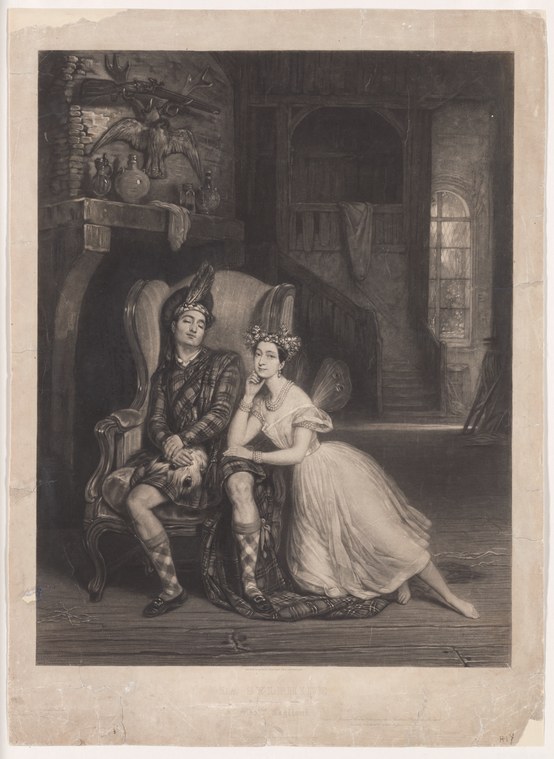
La sylphide d'apres le tableau original appartenant a Madelle. Taglioni: Dedie a Monsieur Veron, directeur de l'Academie Royale de Musique par son tres humble et tres obeissant Serviteur G. Lepaulle
Unknown artist
- Collection:
- Prints depicting dance
- Source:
- New York Public Library
- Rights:
- Public domain — free to use, share and adapt.
- Recorded as:
- Public Domain
Marie Taglioni's *La Sylphide* was the defining ballet of the Romantic era and established the aesthetic and narrative conventions that shaped European ballet for over a century. This print is a primary historical document of how that landmark work was staged, costumed, and emotionally framed. For dance historians, it provides visual evidence of the specific gesture vocabulary, spatial relationships, and theatrical presentation of Romantic ballet at the moment of its greatest influence.
What you are looking at
A young woman in a pale, high-waisted white gown kneels beside a seated man in dark, elaborately patterned Eastern or fantastical costume, complete with a tall feathered headdress. The man sits in an ornate chair with his legs crossed, gazing upward in a dreamy or transported state. The woman leans toward him with one hand raised in supplication or tender gesture, her expression focused and gentle. The setting is a shadowed interior—classical arches visible in the background suggest a palace or temple—with drapery and architectural details rendered in deep chiaroscuro. A sculptural bust or figure looms in the upper left, adding to the theatrical, otherworldly atmosphere. The print's romantic mood and the contrast between the woman's ethereal white dress and the man's ornate, mysterious garb create a scene of enchantment or supernatural encounter.
The dancing
The woman's body is in a deep lunge or kneeling position, her torso leaning forward from the hips with her weight supported on one knee, the other leg extended or bent beneath her. Her arms are raised in an open, expressive frame—one hand near her face in a gesture of emotion or wonder, the other extended toward the seated man. The man remains stationary and upright in the chair, his posture formal and composed despite his upward gaze. The spatial relationship is intimate but asymmetrical: she is the agent of movement and emotion; he is the object of her attention and devotion. No formal ballroom or social dance hold is present; instead, the gesture vocabulary belongs to theatrical mime and romantic drama.
The dance depicted
This print depicts a scene from *La Sylphide*, the foundational Romantic ballet first choreographed by Filippo Taglioni in 1832 for his daughter Marie Taglioni. The image most likely represents the moment of supernatural encounter between the mortal hero James and the Sylph—a weightless, ethereal creature from the spirit world. The Sylph's traditional costume of a white tunic and the man's exotic, non-naturalistic dress align with Romantic ballet's aesthetic of the otherworldly and unattainable. The kneeling, supplicant pose of the woman and the passive, entranced gaze of the man enact the central dramatic tension of the ballet: desire, enchantment, and the impossibility of union between the mortal and the supernatural. The staging and gesture suggest the vocabulary of early 19th-century pantomime and danced drama rather than virtuosic technique.
How it was made
This is an engraving or steel engraving, a reproductive printmaking process that allowed multiple copies to reach a wide audience. The technique's fine lines, careful cross-hatching to create tone and shadow, and the ability to render delicate detail—the fabric folds of the Sylph's dress, the feathered headdress, the architectural setting—are characteristic of mid-19th-century dance documentation. The dedication to Monsieur Véron, director of the Académie Royale de Musique, suggests this was an official or semi-official record produced for circulation among the Parisian cultural elite and ballet enthusiasts. Engravings of this type served as the primary visual documentation of stage performance before photography became practical for theatrical subjects.
About this work
This engraving documents a key moment from *La Sylphide*, the 1832 Romantic ballet that redefined European dance around the aesthetic of weightlessness, otherworldliness, and tragic longing. The print captures the central dramatic encounter: the kneeling Sylph in her iconic white tunic approaching the entranced mortal hero. As a reproductive print dedicated to the director of the Paris Opéra, it functioned as both artistic record and cultural artifact, circulating the work's iconic imagery to audiences across Europe. It preserves not only the costume and setting but also the emotional and gestural language of Romantic ballet—a vocabulary of mime, supplication, and supernatural enchantment that dominated theatrical dance practice for decades.
How to look at it
Attend first to the woman's pose: the deep lunge and extended arm are not positions of balance or classical symmetry, but of yearning and emotional extremity. This is pantomime rendered in the body—the language of Romantic theater rather than formal dance technique. Note the contrast between her curved, responsive posture and the man's rigid, upright repose: the Sylph is agency and desire; the mortal is enchanted passivity. The engraver has chosen a moment of stillness and intimate proximity, not a moment of technical virtuosity, because the ballet's power lay in its dramatic narrative and emotional atmosphere rather than in displayed skill. The shadowed, dreamlike setting reinforces that this is a supernatural encounter happening outside ordinary time.
The artist
The print is credited to G. Lepaulle, a reproductive engraver active in Paris during the mid-19th century. Little is known of Lepaulle's other work, but his involvement in documenting this prestigious ballet production suggests he was among the skilled engravers employed to record major Opéra productions for wider distribution. The dedication to Véron indicates this was a commissioned or sanctioned print, part of the apparatus by which the Opéra controlled and disseminated its cultural image.
The period
This print belongs to the Romantic era in ballet, roughly 1830–1850, when European dance was transformed by new aesthetic ideals: the elevation and ethereal quality of the female dancer, the supernatural and exotic as primary subject matter, and the primacy of pantomime and dramatic narrative over technical display. Marie Taglioni's debut as the Sylph in 1832 established the Romantic ballerina as the era's cultural ideal—weightless, pure, unattainable. The ballet was performed across Europe and generated a vast ephemeral culture of prints, lithographs, and written descriptions. This engraving dates from the era when *La Sylphide* was at peak cultural dominance and when reproductive prints were the standard medium for disseminating images of stage performance to the broader public.
Where it lives
The print is held by the New York Public Library in its collection of dance imagery. It is a reproductive engraving produced in Paris during the height of the ballet's popularity and circulated as part of the official and semi-official culture surrounding the Opéra and its productions.
Dance in this work
Questions about this work
Is this Marie Taglioni performing?
The print is dedicated to her and represents the role she originated—the Sylph in *La Sylphide*. However, as a reproductive engraving made after the original painting, it is not a direct record of a specific performance or dancer, but rather an idealized image of the character and its signature moment. Engravings of this period often depicted canonical roles rather than individual performers.
What makes this Romantic ballet and not Classical?
The central subject is the supernatural and unattainable—the Sylph, a spirit being from another realm—rather than a mortal court or social world. The aesthetic emphasizes weightlessness, otherworldliness, and emotional extremity. The woman's costume is the high-waisted white tunic that became the Romantic tutu, and the gestural language is one of supplication and longing rather than formal social dance.
Why is she kneeling?
The kneeling pose enacts the Sylph's devotion and the enchantment she casts over the mortal hero James. In the ballet's narrative, the Sylph appears to him as an irresistible, supernatural being, and he is drawn into her world. Her kneeling and extended arm are the gesture vocabulary of Romantic pantomime—expressing emotion, desire, and the boundary between the mortal and spirit worlds.
Who was Marie Taglioni?
Marie Taglioni (1804–1884) was a Swedish-Italian dancer who became the defining ballerina of the Romantic era. Her debut as the Sylph in 1832 established both the role and the aesthetic ideal of the Romantic ballerina: ethereal, weightless, expressive, and tragic. She was the most celebrated dancer of her time and danced *La Sylphide* hundreds of times across Europe.
More dance artwork





