49 works in this view — arrow keys or swipe to move between them.
Dance in Art
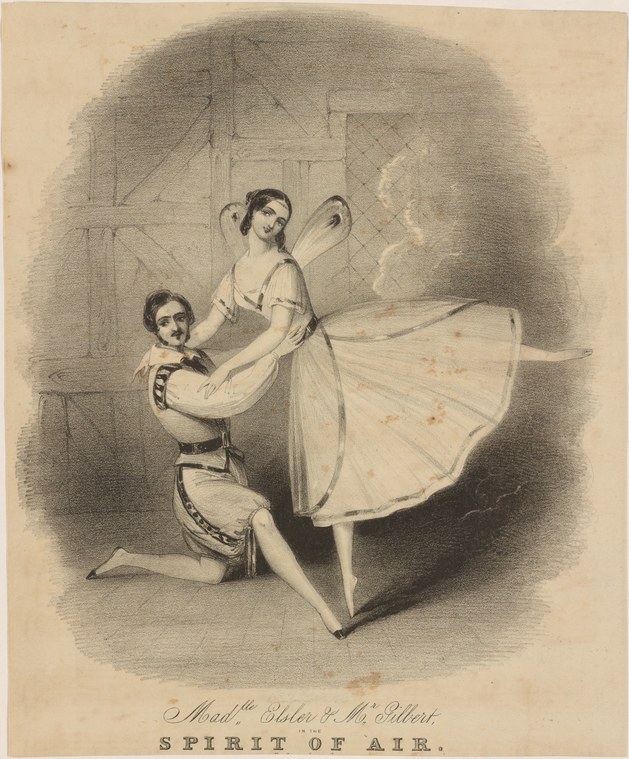
Madlle Elsler [sic] & Mr. Gilbert, in The spirit of air
Unknown artist
- Collection:
- Prints depicting dance
- Source:
- New York Public Library
- Rights:
- Public domain — free to use, share and adapt.
- Recorded as:
- Public Domain
This print preserves the image of a legendary dancer (Fanny Elsler) in a specific historical role, offering visual evidence of how Romantic ballet was staged, costumed, and conceptualized in its early flourishing. The work demonstrates the centrality of narrative pantomime and supernatural thematics to the period's aesthetic, and how printmaking served as the primary medium for disseminating knowledge of celebrated performances to a broad public.
What you are looking at
A theatrical scene in what appears to be a modest interior—a wooden-framed doorway and latticed window visible in the shadowed background. Two figures occupy the stage: a kneeling male dancer in pale breeches and a decorative tunic, looking upward with evident devotion, and a standing female dancer in a long, pale muslin gown with a fitted bodice and short sleeves. The woman's arms are raised in an ethereal gesture; her skirt billows and floats around her as if caught in motion or suspended in air. The lighting is dramatic, with strong shadow work concentrating focus on the figures while the background recedes into penumbral darkness. The composition suggests a moment of transcendence or spiritual encounter rather than social dance—the man gazes upward at the woman as though she embodies something immaterial or divine.
The dancing
The male dancer is in a deep kneeling position, his upper body upright and his gaze directed upward with arms slightly open in an attitude of wonder or supplication. The female dancer stands with both arms raised, the upper arms nearly level with the shoulder, creating an open, expansive frame; her weight appears distributed on both feet, and her torso is elongated. Her skirt is rendered with particular attention to its volume and lightness, suggesting either movement or the artist's desire to emphasize its ethereal quality. The spatial relationship between them is intimate but not physically connected—they occupy a shared moment of spiritual rather than physical communion.
The dance depicted
The title identifies this as Mademoiselle Elsler and Mr. Gilbert performing in "The Spirit of Air," a ballet-pantomime likely from the Romantic era. The imagery aligns with early nineteenth-century Romantic ballet conventions: the supernatural female figure, the kneeling mortal male in rapturous regard, the ethereal floating drapery, and the theatrical interior setting. Elsler was a celebrated dancer of the 1830s–1840s, known for both dramatic and comic roles. The posture of the male dancer—kneeling in devoted adoration—and the aerial quality of the female figure's presentation suggest a narrative of divine or supernatural encounter, a common theme in Romantic ballet where ethereal beings (sylphs, spirits, nymphs) interact with earthly mortals.
How it was made
This is a lithograph or engraving, executed with delicate tonal work and line. The technique employs fine cross-hatching and wash effects to create atmospheric depth, with the background rendered in heavy shadow that contrasts sharply with the illuminated bodies of the dancers. The foreground is left relatively clear, allowing the viewer's eye to focus entirely on the figures and their interaction. The medium's capacity for fine detail and dramatic contrast made it ideal for theatrical promotion and documentation in the early nineteenth century, enabling wide circulation among audiences and theater-goers.
About this work
This print documents a moment from a Romantic-era theatrical ballet performed by two celebrated dancers of the 1830s–40s. The work combines the conventions of Romantic ballet—supernatural encounters, the elevation and ethereality of the female dancer, the devotional posture of the male—with the technical sophistication of early nineteenth-century printmaking. The image captures not a virtuosic display of technique but a narrative and emotional climax: the meeting of mortal and spirit, rendered through pose, drapery, and dramatic lighting. As both a record of a specific performance and a work of theatrical promotion, it reveals how dancers of the period were marketed and how their movement was translated into visual form for an audience that could not always attend live performances.
How to look at it
Attend to the contrast between the grounded, earthly kneeling pose of the male dancer and the weightless, floating presentation of the female figure—this visual opposition encodes the narrative of mortal and spirit. Note the careful rendering of the woman's skirt: its volume and luminosity suggest both the lightness of fabric in motion and a quality of immateriality. The background's darkness focuses attention on the faces and bodies, allowing the viewer to read the emotional content of the encounter through posture and expression. The artist has chosen the moment of revelation or union rather than virtuosic display, prioritizing narrative and atmosphere over technical pyrotechnics.
The period
This work dates to the height of Romantic ballet, approximately the 1830s–1840s, when works like La Sylphide (1832) and Giselle (1841) established the aesthetic of the supernatural, the ethereal, and the tragic. Fanny Elsler (1810–1884) was one of the two dominant ballerinas of the period, celebrated for her dramatic intensity and technical brilliance. The image reflects the period's fascination with the intersection of the real and the supernatural, and the ballet stage's exploration of desire, loss, and spiritual transcendence. Lithography and fine engraving were the primary media for theatrical documentation and promotion, serving audiences who followed ballet through prints, playbills, and illustrated periodicals.
Where it lives
The print is held in the New York Public Library's collection of prints depicting dance. It is a theatrical ephemeral artifact, produced for wide distribution to promote the ballet and its stars, and represents the standard means by which performances were documented and circulated in the nineteenth century.
Dance in this work
Questions about this work
Who was Fanny Elsler?
Fanny Elsler (1810–1884) was an Austrian ballerina and one of the two most celebrated dancers of the Romantic era, alongside Marie Taglioni. She was known for her dramatic intensity, technical virtuosity, and charisma, and she danced across Europe and the Americas. She specialized in both ethereal, supernatural roles and comic, character dances, and was a favorite of audiences and critics.
What is 'The Spirit of Air'?
"The Spirit of Air" is likely a ballet-pantomime from the 1830s–1840s featuring supernatural or allegorical themes. The title and imagery suggest a narrative encounter between a mortal male dancer and an ethereal female spirit, a common plot device in Romantic ballet. The specific ballet has not been definitively confirmed from available records, but the style and conventions are entirely consistent with the period's aesthetics.
Why are theatrical dances documented in prints?
In the nineteenth century, before photography became standard, lithographs and engravings were the primary means of documenting and promoting theatrical performances. They served multiple purposes: advertising the ballet and its stars, allowing people who could not attend to see representations of celebrated dancers and moments, and creating a visual archive of performance practice. Prints circulated widely and were collected by theater enthusiasts.
What does the kneeling pose tell us?
The male dancer's kneeling posture and upward gaze are deliberate narrative choices, not virtuosic display. This pose conveys devotion, wonder, or spiritual submission—the earthly human meeting and adoring the divine or supernatural. It is characteristic of Romantic ballet's dramatic vocabulary and its focus on emotional and narrative content rather than technical showmanship.
More dance artwork





