49 works in this view — arrow keys or swipe to move between them.
Dance in Art
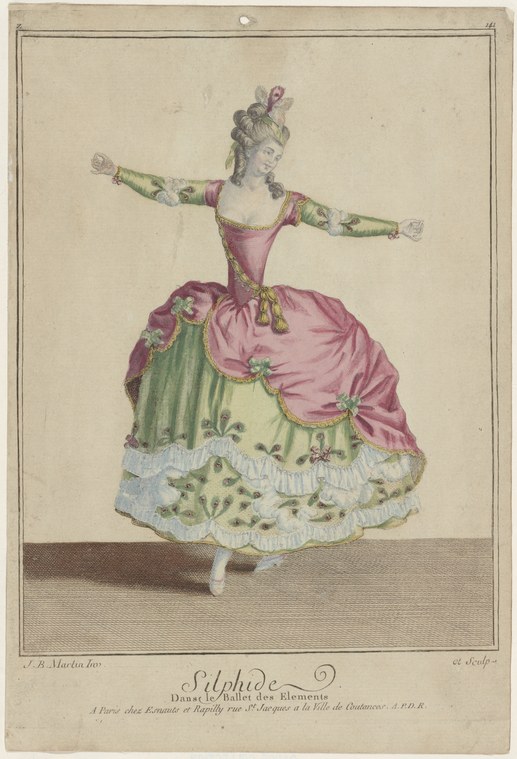
Silphide dans Le ballet des éléments
Unknown artist
- Collection:
- Prints depicting dance
- Source:
- New York Public Library
- Rights:
- Public domain — free to use, share and adapt.
- Recorded as:
- Public Domain
This image preserves a specific historical moment in the development of ballet costume and stage practice. The figure of the Sylphide became central to Romantic ballet aesthetics throughout the 19th century, and this image documents how such ethereal, supernatural characters were visualised and performed in the period before the emergence of gas lighting and the pointe shoe as standardised elements of ballet. For historians, it is evidence of how academic classical technique was understood and rendered in visual art at a formative moment in its history.
What you are looking at
A single female dancer is depicted in a moment of graceful, exuberant movement against a plain background. She stands on the ball of one foot in a balletic pose, her body angled in three-quarter view, with one arm extended forward and the other stretched outward to her side at shoulder height, creating an open, expansive frame. Her costume is ornate and theatrical: a fitted bodice in mauve or dusty rose with short sleeves that appear to be decorated with green patterning, topped by an elaborate skirt composed of contrasting fabrics. The skirt features a substantial undergown or underskirt in pale green (possibly silk or linen) embellished with painted or printed floral motifs, overlaid with a draped upper skirt in rose or mauve that gathers and swags dramatically across the hips and legs, creating a three-dimensional silhouette. The skirt hem is finished with white gathered or pleated lace or gauze ruffles. Her hair is styled high on her head in the fashion of the late 18th century, adorned with what appears to be a small plume or ribbon. The overall effect is one of theatrical spectacle and controlled elegance, frozen in a moment of suspended motion.
The dancing
The dancer's weight is clearly shifted onto one leg, creating a vertical line from her supporting foot through an extended torso. Her free leg appears slightly flexed or extended, though it remains largely concealed by her voluminous skirt. Both arms are held at approximately shoulder height, the extended position suggesting either a preparatory moment or a sustained classical frame. Her torso is lifted and elongated, and her gaze is directed upward and outward in a refined, ethereal expression typical of stage performers of this period. The pose demonstrates familiarity with balletic carriage: the vertical alignment of the body, the use of the full extension of the limbs within the confines of the costume, and the cultivated grace of arm placement all suggest a trained dancer executing a stylised moment.
The dance depicted
This is identified by its inscription as depicting a character from a ballet — "Silphide" from the ballet *Les Éléments* (The Elements). This character and work belong to the tradition of Romantic ballet, the dominant theatrical dance form of the 18th and early 19th centuries. Sylphs were supernatural, ethereal female characters who populated the Romantic ballet repertory; this particular figure appears to represent a literal element or spirit character within a ballet structured around the four or five classical elements. The pose and costume align with the classical ballet vocabulary that was becoming standardised in the late 18th century: the turnout, the lifted carriage, and the refined port de bras evident here are hallmarks of the emerging academic ballet technique. The work documents not the performance itself but the iconic character and moment that would have been familiar to theatre audiences of the period.
How it was made
This is a hand-coloured engraving or etching, evident from the fine linear construction visible in the figure, background, and costume details. The image shows the characteristic precision of line engraving combined with selective hand-colouration in watercolour or similar media — a standard method of theatrical portraiture in the 18th century. The technique allowed for wide distribution of images of celebrated dancers and roles to theatre-goers and collectors, making this a mass medium rather than a unique artwork. The delicate rendering of the lace and the subtle gradations of colour in the draped fabrics show a sophisticated hand and considerable skill in the colourist's craft. Such prints were often bound into albums or framed in domestic interiors, serving as mementos of celebrated performances and performers.
About this work
This is a theatrical document — a hand-coloured engraving recording the costume and pose of the character Sylphide as performed in the ballet *Les Éléments*. The work sits at a crucial moment in dance history: the late 18th century, when ballet was consolidating its academic vocabulary and when theatrical prints were the primary means by which images of celebrated roles and dancers circulated beyond the theatre itself. The inscription and the composition make clear that this was produced for an educated, theatre-going public familiar with ballet, its conventions, and its mythological and allegorical characters.
For a dance historian or curious viewer, the work offers a vivid record of how an iconic Romantic ballet character was costumed, how she was posed on stage, and how artists understood and depicted the balletic body in motion — or in this case, in a carefully composed moment that suggests both stillness and suspended animation.
How to look at it
Notice the careful balance between the static pose and the suggestion of continuous motion: the dancer is caught in a moment of suspension, and the swaying, gathered layers of the skirt suggest movement even though the figure is essentially still. The artist has chosen a moment of full extension and openness — both arms away from the body, the weight lifted — which conveys energy and control simultaneously. The elaborate costume deserves close attention: the contrast between the fitted bodice, the patterned underskirt, and the diaphanous ruffled hem create a sense of weightlessness and ethereal fragility that was central to Romantic ballet aesthetics. The upward gaze and refined posture are conventions of late 18th-century ballet portraiture, designed to convey grace, dignity, and an almost supernatural refinement.
The artist
The engraving is inscribed "J. B. Martin inv." (inventor) and "et Sculpt" (and sculptor/engraver), suggesting it was both designed and engraved by the same hand, likely Jean-Baptiste Martin, a theatrical printmaker active in the late 18th century. Such prints were often collaborations between artists who designed the composition and engravers who executed the plate, though this inscription suggests a single hand undertook both roles. Martin was part of a substantial tradition of Parisian theatrical printmakers who documented the celebrated roles and dancers of the Opéra and other venues.
The period
This work dates to the era of late 18th-century ballet, a period of transition between the Baroque theatrical tradition and the full emergence of Romantic ballet in the early 19th century. Ballet at this time was performed in court theatres and commercial opera houses; the vocabulary was increasingly codified through the work of choreographers such as Gasparo Angiolini, Jean-Georges Noverre, and later Carlo Blasis. The figure of the sylph or supernatural female character was already a familiar trope in ballet and pantomime, though the specific Romantic iconography we associate with sylphs — the emphasis on ethereal lightness, the ballet skirt, the upward gaze — was still emerging. Hand-coloured engravings such as this were a booming market in Paris and London, circulating images of theatrical life and celebrated performers to an educated, prosperous audience.
Where it lives
This engraving is held in the New York Public Library's collection of prints depicting dance, where it is catalogued as part of a broader archive of theatrical portraiture. The inscription and style place it within the Parisian tradition of theatrical documentation, suggesting it was produced for commercial circulation among theatre patrons in the late 18th century.
Dance in this work
Questions about this work
What was a sylphide in 18th-century ballet?
A sylphide (or sylph) was a supernatural, ethereal female character drawn from classical mythology and popular in allegorical court ballets and theatrical pantomimes. Such characters represented the elements, spirits of the air, or enchanted beings, and were typically portrayed as weightless, graceful, and otherworldly. The term later became iconic in Romantic ballet, particularly through the ballet *La Sylphide* (1832).
Is this image based on a real dancer or a generic character?
The inscription does not name a specific dancer, so this may represent either an idealized version of the character Sylphide or a celebrated performer known for the role. In the 18th century, theatrical prints often documented both the role itself and the famous dancer who performed it; the two became inseparable in the public imagination.
How was this print made and distributed?
This is a hand-coloured engraving, a labour-intensive process in which an engraver incised a design into a metal plate, prints were pulled from the plate, and then individual prints were coloured by hand with watercolour or gouache. Such prints were sold in theatre lobbies, in print shops, and through subscription; they were expensive enough to appeal to a prosperous audience but cheap enough to circulate widely among theatre-goers.
What does this costume tell us about ballet technique of the period?
The fitted bodice and relatively high waistline reflect the fashion of the 1780s–90s. The skirt, while elaborate, is considerably shorter and more structured than later Romantic tutus, and it does not impede the dancer's legs. The apparent freedom of the limbs suggests that the dancer could execute turnout, extensions, and complex footwork — evidence that academic ballet technique was already established.
More dance artwork





