49 works in this view — arrow keys or swipe to move between them.
Dance in Art
Mr. Gilbert and Madame Guibilei [sic]
Unknown artist
- Collection:
- Prints depicting dance
- Source:
- New York Public Library
- Rights:
- Public domain — free to use, share and adapt.
- Recorded as:
- Public Domain
This print is a primary document of Romantic ballet performance practice and of how ballet dancers' bodies and partnerships were publicly imaged. Without knowing the ballet or the full names of the dancers, the work still shows us the technical vocabulary of the era—the female dancer's control in the turn, the male dancer's supporting presence—and confirms that these conventions were not invented by later historians but were actively performed and celebrated by contemporaries.
What you are looking at
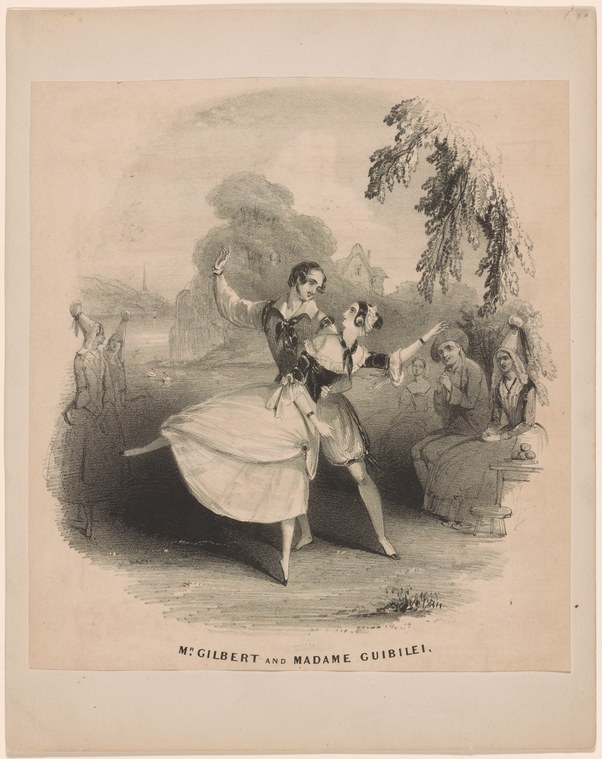
A theatrical scene of two dancers in a parkland setting, rendered in the soft tones and delicate line work of early 19th-century printmaking. The male dancer, identified as Mr. Gilbert, wears dark clothing with bright white breeches and strikes an energetic pose with one arm raised; his partner, Madame Guibilei, is captured mid-pirouette in a pale tulle skirt, her body angled into the turn with arms positioned for balance. The composition places them in the foreground of a Romantic landscape: behind them, a weeping willow droops at the right, while the middle distance opens to water and a church spire. Other figures—audience members or fellow performers—sit or stand at the margins, observing the pair. The light is even and cool, suggesting either morning or the theatrical lighting of an indoor stage made to resemble outdoors.
The dancing
The male dancer leans forward into a dynamic step, his right arm extended upward and his torso tilted, suggesting forward momentum and elevation. The female dancer executes a sustained turn: her body is vertical and controlled, her arms held out in a supported frame, her weight clearly on the working leg. Their proximity suggests a choreographed partnership rather than an improvised social dance. The relative scales and the clarity with which the artist rendered their limbs and spines show close attention to balletic form and the mechanics of the turn.
The dance depicted
This is almost certainly a scene from Romantic ballet, most likely a pas de deux performed in the 1830s or 1840s. The names "Guibilei" and "Gilbert" do not appear in standard dance histories, but the style of dress, the composition (couple in landscape), and the technical vocabulary of the bodies strongly suggest this is a scene from a ballet blanc or a contemporary theatrical ballet. The pairing of a vigorous male dancer with a sustained female turn in pointe work is consistent with the emerging conventions of the Romantic era, when the ballerina's ethereal presence and the male dancer's athleticism defined the aesthetic. Without a known source, the specific ballet cannot be named, but the image documents a moment of technical execution rather than narrative drama.
How it was made
This is an engraving or steel engraving, judged from the uniform line weight, the fine cross-hatching in the shadows, and the tonal gradations built entirely through parallel lines rather than pigment. The technique allowed for mass reproduction and was the dominant medium for theatrical documentation and art criticism in the early 19th century. The soft modeling of the sky and fabric, achieved through careful gradation of line density, shows the printmaker's skill in suggesting volume and light without color. This would have circulated as part of a theatrical press, a souvenir, or an art periodical—a work for a broad audience of theatre-goers and art lovers rather than collectors of fine paintings.
About this work
This is a print documenting a balletic partnership from the early 19th century, when Romantic ballet was establishing its visual and kinetic vocabulary. The scene captures two named dancers—almost certainly professionals of the Paris or London stage—in a moment of technical display. The setting, the movement vocabulary, and the composition all declare this a work of theatrical portraiture, memorializing a specific performance or pairing rather than inventing a narrative. The image belongs in a dance gallery because it records not only what Romantic ballet looked like but how it was understood: as a partnership of distinct roles, as a bodily achievement set in an idealized landscape, and as a spectacle worth preserving in print.
How to look at it
Attend to the moment the artist chose: not the apex of a jump or the full extension of a leg, but a moment of transition or sustained control—the male dancer mid-stride, the female dancer held in the turn. This suggests a printmaker interested in documenting technique rather than drama. Notice too the balance of the composition: the two dancers occupy the center, while the landscape frames them without dominating, and the spectators at the margins of the scene allow us to look with them. The print demonstrates the early 19th-century convention of staging ballet in nature, a Romantic motif in which the ethereal dance finds its perfect setting in an idealized, pastoral world.
The artist
The artist is not recorded in the catalogue, but the style of the print—the fine line work, the handling of fabric and landscape detail, the theatrical subject matter—suggests a professional theatre print-maker of the 1830s–1850s working in the centres of European ballet. Such prints were typically made by engravers who specialized in reproducing theatrical scenes, often after drawings by other artists. The signature or initials, if present, are not clearly legible in this reproduction.
The period
The 1830s and 1840s were the height of Romantic ballet, when the ballerina in white tulle became the dominant image of the art form and the male dancer's role was being reconfigured as supporter and foil. This print emerges from the same cultural moment that produced the great Romantic ballets: La Sylphide (1832), Giselle (1841), and many others now lost. The period also saw the rise of theatrical prints and lithographs as a major medium for documenting and promoting new ballets and famous dancers. Engraved prints in particular allowed for a kind of portable, repeatable image of performance that photographs would later replace—these were how most people encountered the memory of a great dancer or a celebrated scene.
Where it lives
The work is held in the New York Public Library's collection of prints depicting dance. It is catalogued without attribution, date, or medium record, though the style and subject matter place it in the early 19th century. The collection itself is a broad survey of dance imagery across media and periods, assembled for research and exhibition.
Dance in this work
Questions about this work
Who were Mr. Gilbert and Madame Guibilei?
Their full names and dates are not recorded in the catalogue or in the print itself. They were likely professional ballet dancers performing in Paris or London in the 1830s–1840s, when this print was made, but without further documentation they remain known only through this image. Many dancers of the Romantic era have been lost to history, preserved only in prints and playbills like this one.
What ballet is this from?
The specific ballet is not identified in the catalogue or visible in the print itself. The style of dress, the dance vocabulary, and the composition suggest a Romantic ballet of the 1830s–1840s, but without a title, artist's inscription, or publication information, the work cannot be attributed to a known ballet.
How was this print made?
This is an engraving, likely steel-engraved, the dominant reproductive medium for theatrical scenes in the early 19th century. An engraver worked with a sharp tool to incise fine lines into a metal plate, which was then inked and printed. The technique allowed for precise detail and many thousands of impressions, making it ideal for theatre documentation and circulation to a broad audience.
Why is the dance set in a landscape?
This reflects the Romantic aesthetic of the 1830s–1840s, when ballet increasingly used nature and pastoral settings to frame the ballerina's ethereal presence. The landscape was not merely decorative but ideological—it positioned dance as belonging to a realm of nature, dream, and beauty beyond the everyday world.
More dance artwork





