49 works in this view — arrow keys or swipe to move between them.
Dance in Art
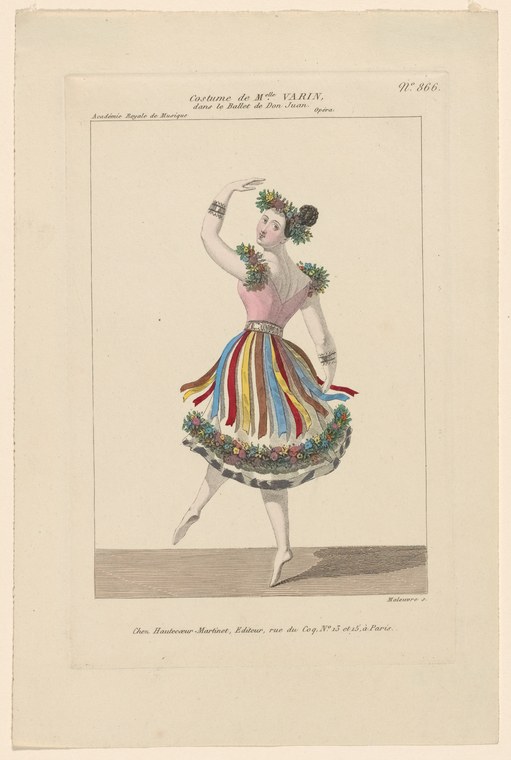
Costume de Melle. Varin, dans le ballet de Don Juan: opéra, Académie Royale de Musique
Unknown artist
- Collection:
- Prints depicting dance
- Source:
- New York Public Library
- Rights:
- Public domain — free to use, share and adapt.
- Recorded as:
- Public Domain
This image documents a real dancer in a real production, preserving her name and role when female dancers in the nineteenth-century ballet were often forgotten or conflated with their characters. The extraordinary costume—with its layered ribbons, plumage, and vivid color—shows the Romantic ballet's investment in spectacle and artifice, and the print's circulation as a commercial object reveals the emergence of the dancer as a marketable public figure. For anyone studying the visual culture of Romantic ballet, the intersection of dance, costume design, and theatrical promotion, this work is essential.
What you are looking at
A young female dancer stands alone against a neutral ground, posed in a moment of theatrical grace. She wears a pale pink bodice with short sleeves and an elaborate skirt composed of deep green foliage or plumes at the hips, transitioning to a spectacular tiered skirt of multicolored silk ribbons—blue, red, yellow, green, and white—that cascade down in vertical stripes. Her arms are raised in an elegant port de bras, one arm curved overhead with the hand bent gracefully, the other extended; her body is turned three-quarters to the viewer. She stands en pointe or nearly so, with her weight lifted and her posture aristocratic. White stockings and pale shoes complete the costume. Her hair is adorned with green foliage that echoes the decoration at her hips. The figure occupies the center of the composition, isolated against a pale background with a gray shadow beneath her feet, giving the image the quality of a studio portrait or costume study rather than a narrative scene.
The dancing
The single dancer demonstrates a lifted, ethereal port de bras typical of early nineteenth-century ballet technique. Her raised arms show a soft, rounded frame rather than the angular geometry of later ballet styles; her elbow is bent and her hand relaxed. Her weight appears to be on the balls of her feet, with the body held in a vertical line from crown to heel. The pose is symmetrical and self-contained, designed to display the costume and the dancer's line rather than to suggest movement or interaction. There is no partner, no group, no suggestion of narrative action—only the formal presentation of a young female body in an attitude of grace.
The dance depicted
This is a costume study for a dancer in the ballet *Don Juan*, performed at the Académie Royale de Musique (the Paris Opéra). The inscription identifies the subject as Mademoiselle Varin, who danced in this work. The lavish, fantastical costume—with its plumage and ribbons—suggests a supernatural or allegorical character rather than a mortal protagonist, consistent with the ballet d'action tradition of the early 1800s. The pose and technique are consistent with Romantic ballet, though without a narrative context or ensemble, the image functions primarily as a record of costume and the dancer's formal presentation rather than as evidence of a specific movement vocabulary. Mlle. Varin's identity and her precise role in the ballet are not established from the image alone.
How it was made
This is a hand-colored engraving or aquatint, a reproductive print technique that was standard for theatrical costume documentation in the early nineteenth century. The fine lines defining the figure's contours, the delicate shading of the skin, and the precise rendering of the costume details are consistent with engraving; the broad, soft tonal areas in the background and the gray shadow suggest aquatint or wash. Hand coloring (evident in the pink bodice, green foliage, multicolored ribbons, and flesh tones) was applied after printing, making each impression a unique hand-finished object. This technique allowed costume designs and cast records to circulate among theater professionals and audiences, functioning as both archival document and promotional image. Such prints were issued as individual sheets and collected into portfolios, reaching a wide audience.
About this work
This is a costume study for a dancer named Mademoiselle Varin, who performed in the ballet *Don Juan* at the Paris Opéra. The work is a hand-colored engraving—a standard format for theatrical documentation in the early 1800s—and shows a young female dancer in an elaborate Romantic-era costume of fantastic design. She stands in a formal pose that displays her line and the intricate dress rather than capturing a moment of action. The image belongs to a long tradition of theatrical prints that recorded both the spectacular visual invention of the stage and the bodies of celebrated dancers, circulating professional knowledge and promoting the theater to ticket-buying audiences. It is evidence of the emerging star system of Romantic ballet and the centrality of costume to its aesthetic.
How to look at it
Attend to the pose: the dancer is frozen in a moment of formal presentation rather than caught mid-action. The raised arms and lifted posture convey grace and ethereality, not virtuosity or effort—consistent with how Romantic ballet valued the illusion of weightlessness and ease. The costume overwhelms the body; the ribbons and plumage are as much the subject as the dancer herself. Note also the isolation: she stands alone, not in a group or in relation to a partner, which was a convention of the theatrical print—it allowed the costume and the dancer's individual line to be clearly visible. The hand-coloring creates a precious, hand-made quality that distinguishes this from a plain engraving and suggests its circulation as a luxury object for theater enthusiasts.
The artist
The artist is not identified in the catalogue record. The inscription attributes the work to an engraver (signature mark visible lower right, though not legible in reproduction), and it was published as a theatrical print by a Paris dealer or publisher. Such prints were produced by specialized engravers working from costume designs or from sketches made during rehearsal or performance, often in rapid succession to capitalize on a production's popularity. The anonymity of the engraver was typical; the dancer and the costume, not the artist, were the objects of interest.
The period
This print dates from the era of Romantic ballet, when ballet had shifted from court entertainment to public spectacle, and when the female dancer—no longer an aristocratic amateur but a trained professional—became the focus of intense public and critical attention. The 1820s–1840s saw the rise of the *prima ballerina* as star performer, and theatrical prints documenting celebrated dancers became a major genre of popular imagery. *Don Juan*, based on the Don Juan legend and typical of the narrative ballets that dominated the period, would have been a vehicle for spectacular choreography and design. The elaborate costume shown here—the fantastical plumage, the jewel-toned ribbons—exemplifies the Romantic aesthetics of the period: a turn away from the austere neoclassicism of earlier decades toward ornamentation, exoticism, and theatrical illusion.
Where it lives
This work is held in the New York Public Library's collection of prints depicting dance. It is a commercial theatrical print, one of many issued to document and promote productions at the Académie Royale de Musique (the Paris Opéra) in the early nineteenth century. Such prints were both archival documents and consumer goods, sold to audiences and collected into portfolios.
Dance in this work
Questions about this work
What ballet is this from?
*Don Juan*, an opéra-ballet performed at the Paris Opéra (Académie Royale de Musique). This was a major form of theatrical entertainment in the early nineteenth century, typically combining sung and danced scenes. The specific plot and characters are not identifiable from this costume study alone, but the fantastical dress suggests a supernatural or allegorical role.
Who was Mademoiselle Varin?
She was a dancer at the Paris Opéra in the early nineteenth century, and this print is one of the primary records of her stage presence. Beyond this image and the inscription on the print, little is documented about her career or biography. She is one of many dancers whose names survive only in theatrical prints like this one.
How was this print made?
It is a hand-colored engraving or aquatint. An engraver carved or etched the design onto a metal plate, which was then inked and printed onto paper. Each print was then colored by hand, using watercolor or gouache, making each impression unique and precious. This labor-intensive process was standard for theatrical costume documentation, ensuring that each print was a finished artwork.
Why is the costume so elaborate?
Romantic ballet was intensely visual, and costumes were as important to the spectacle as dancing. The layered ribbons, the plumage, and the vivid colors signal that this character was fantastical—perhaps a spirit, an allegorical figure, or a supernatural being. The costume helped audiences understand the narrative and enhanced the illusion of theatrical magic.
More dance artwork





